




Try Livestorm for free
Get started in minutes and run your first engaging webinar today.
- No credit card needed
- No installation required
853 marketing leaders + Livestorm's exclusive 2025 dataset reveal what works for your webinar stategy in 2026
This report combines two methodologies to provide the most complete view of webinar marketing in 2025.
First, we surveyed 853 go-to-market professionals* across B2B companies between December 11-20, 2025, asking them about webinar criticality, strategic importance, AI adoption maturity, repurposing workflows, and promotional strategies.
Second, we extracted a complete dataset from Livestorm's data warehouse covering all webinars run on the platform from January 1 to December 31, 2025—comprising 33,786 webinar sessions from 3,199 organizations and 7,062,572 registrations.
Together, these sources provide the most comprehensive benchmark: what marketers say they do (survey) combined with what actually happens at scale (behavioral data).
*811 go-to-market professionals across Marketing (45%), Communication (12%), Executive leadership (12%), Sales (11%), Growth (7%), Tech (8%), and Product teams (6%). Support functions (HR, Finance, Design) were excluded as they don't directly manage webinar strategy.
Ask any CMO what keeps them up at night, and you'll hear three answers:
Pipeline Generation (53.9%)
Brand Awareness (53.6%)
Customer Expansion (53.1%).
Those three priorities are essentially tied. This isn't a hierarchy—it's a mandate. You need all three working simultaneously, or the growth engine stalls.
Here's why webinars matter: they're the only channel that delivers on all three at once.
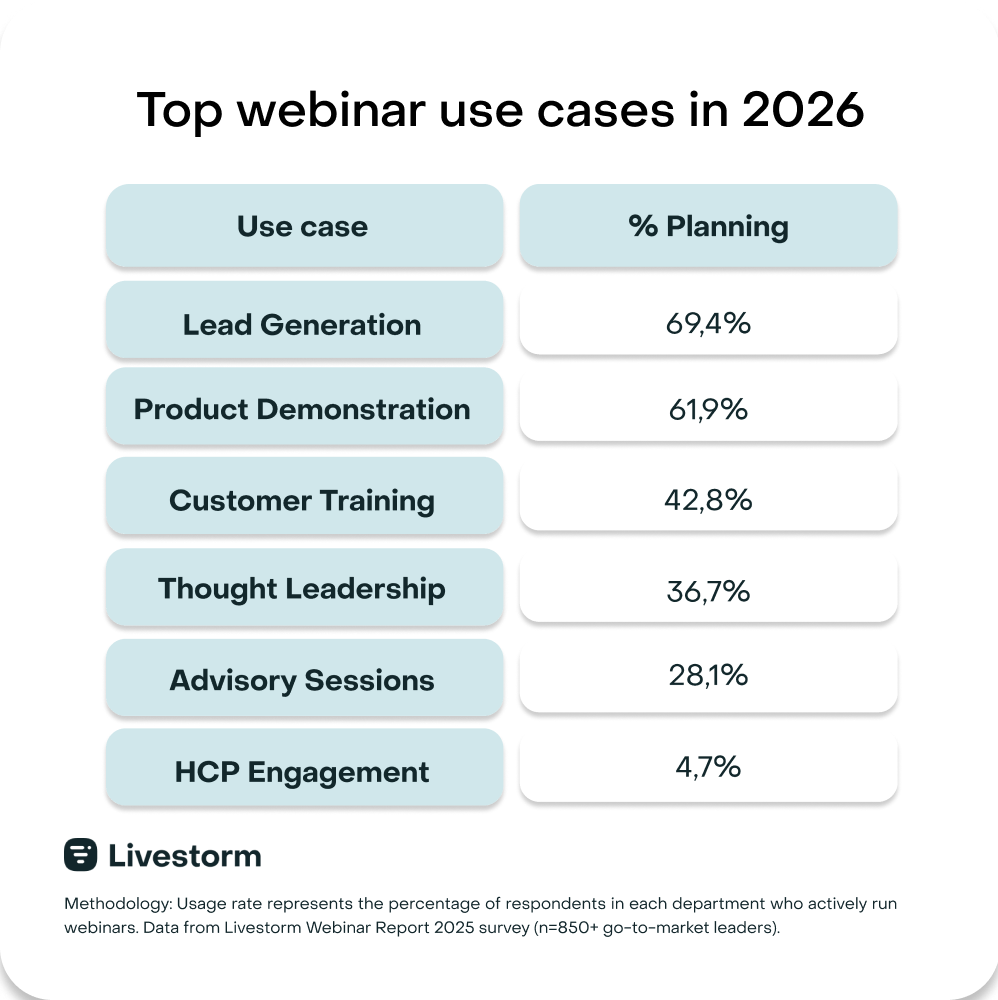
Lead generation dominates as the #1 webinar use case in 2026, with 7 in 10 marketers (69.4%) planning webinars to fill their pipeline.
However, webinars have evolved beyond pure lead-gen: over 6 in 10 (61.9%) will use them for product demonstrations, while 42.8% focus on customer marketing—proving webinars serve the entire customer lifecycle, not just acquisition.


The Pipeline Truth: 2026 Webinar Benchmark Report
Drive more registrations, boost attendance & multiply content 13x. Based on 7M+ registrations, 33K sessions + 850 go-to-market leader insights.
DownloadGo-to-market leaders are clear on why webinars matter (51% rate them critical to strategy). But execution tells a different story. From empty seats to silent chat rooms, the biggest webinar challenges aren't technical: they're human, operational, and systemic.
In 2020, webinars lived in the "marketing tactics" column of your org chart—a way to capture leads, fill top-of-funnel, run product launches. By 2025, they've become operational DNA.
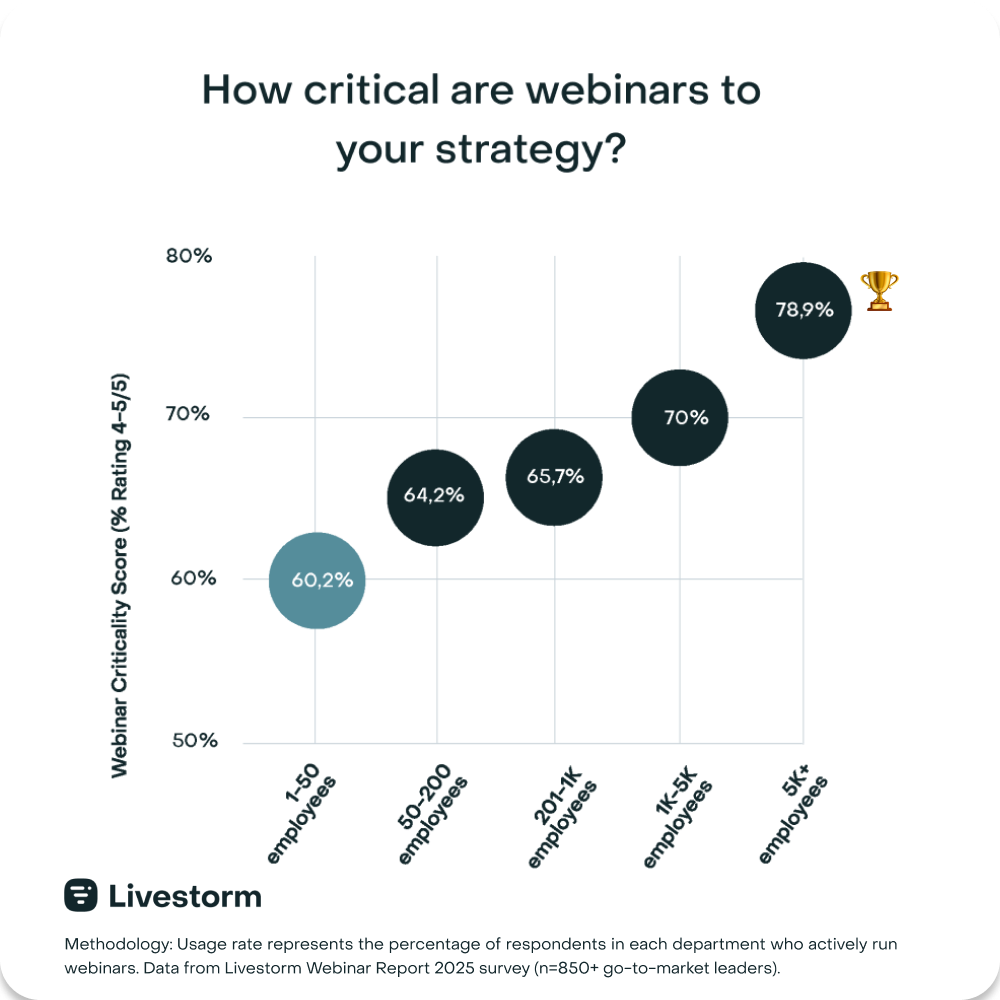
Here's the pattern that matters: the larger the organization, the more critical webinars become.
Criticality Score = % of respondents rating webinars 4 or 5 out of 5 ("Critical" or "Very Critical") in response to "How critical are webinars to your marketing strategy?" Data from Livestorm Webinar Report 2025 (n=850+).
The pattern: Larger organizations achieve higher show-up rates and rate webinars as more strategically critical, despite running fewer total events. This isn't a contradiction—it's strategic maturity. Small companies experiment with volume. Large companies perfect a few high-stakes events.
Webinar per departement
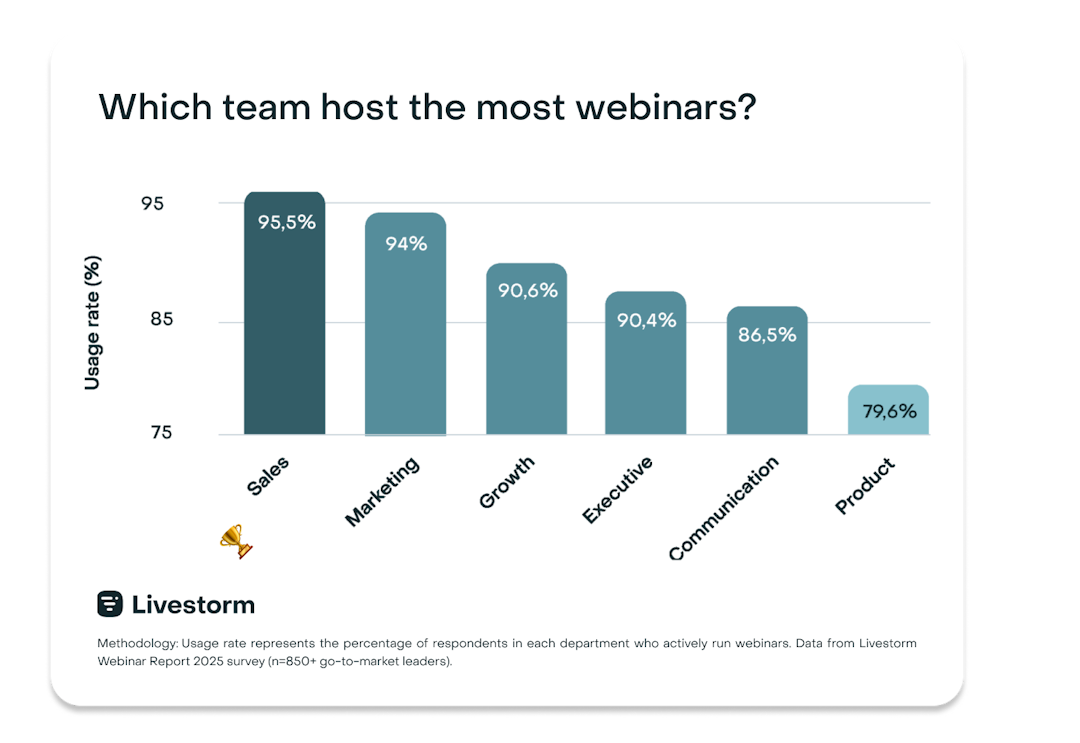
43% of respondents sit in Marketing departments, and they actively run webinars (94% execution rate, nearly matching Sales). But here's the shift: Sales and Growth teams post the highest per-capita participation rates: 95.5% and 90.6% respectively. Translation: webinars have migrated from "marketing campaigns" (mass lead gen events) to revenue infrastructure (daily product demos, sales calls run by Sales reps).
The shift: Webinars aren't a tactic anymore: they're a strategic lever.
What this means:
Sales teams use webinars for product demos and customer training
Growth teams deploy them as thought leadership engines—building authority before buyers enter the pipeline
Executives (90.4% actively run webinars) use them to communicate vision and build trust with prospects they've never met
Communication teams use webinars for internal alignment
Product teams run release webinars and beta walkthroughs
Key finding: Webinars started in marketing. They now live everywhere revenue happens.
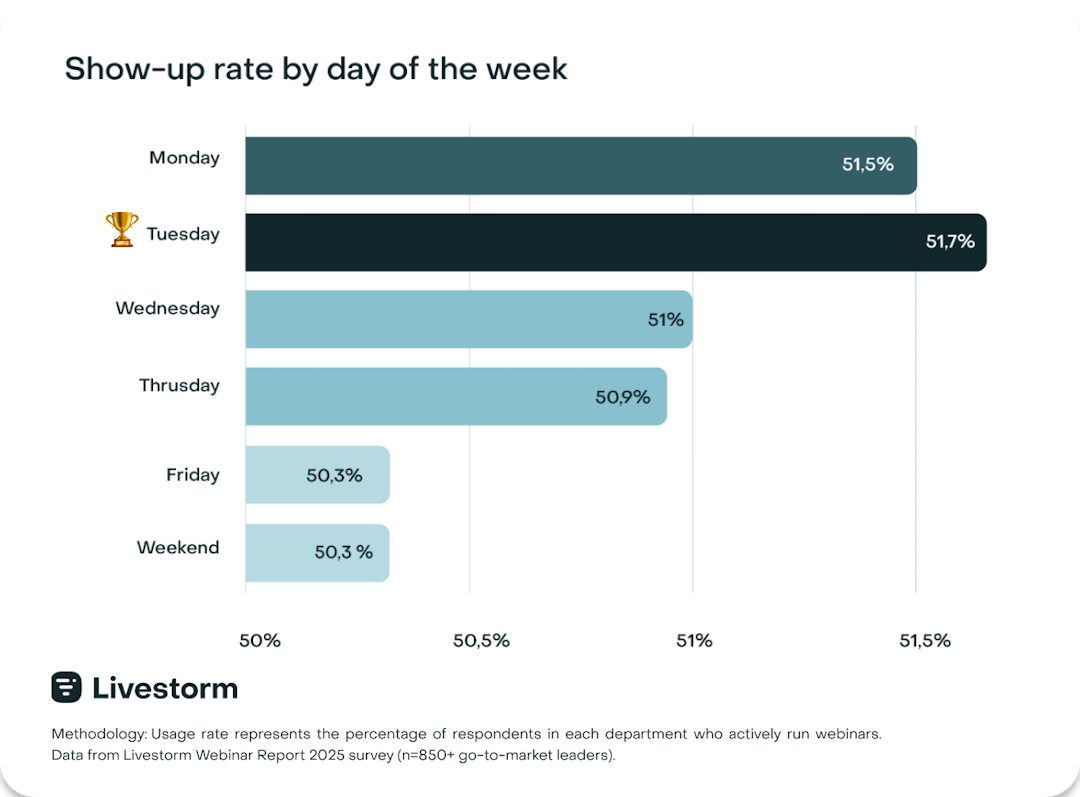
The pattern is clear: Tuesday peaks at 51.7% show-up rate (highest conversion), while Wednesday draws the largest audience (94 attendees, 51% show-up). Monday performs nearly identically (82 attendees, 51.5% show-up), proving the "Monday catch-up myth" is false—people are engaged, not distracted.
Why early-to-midweek works:
Monday = reset energy. Fresh week, clear calendar, people are engaged (not playing catch-up like we thought).
Tuesday-Wednesday = prime attention. Workweek rhythm is established, urgency is high.
Thursday-Friday = fade-out. Mental bandwidth drops to 50.9-50.3% show-up. "I'll watch the replay" (they won't).
Weekends? Don't bother. Only 2% of webinars run Saturday-Sunday, and show-up rates stay at 50.3% cumulated (the lowest of the week).
Optimal webinar days: Monday, Tuesday, or Wednesday—all three perform nearly identically (51-51.7% show-up).
The Pipeline Truth: 2026 Webinar Benchmark Report
Drive more registrations, boost attendance & multiply content 13x. Based on 7M+ registrations, 33K sessions + 850 go-to-market leader insights.
DownloadBest webinar times:
11:00 AM ET (late morning, post-email check)
2:00 PM ET (post-lunch, pre-end-of-day)
Avoid:
8-9 AM (too early for West Coast)
4-5 PM (end-of-day mental fatigue)
Lunch hours (12-1 PM)
Source: Livestorm behavioral data, 2025
The takeaway: Schedule your flagship webinars Monday- Tuesday-Wednesday at 11am or 2pm ET. Avoid Thursday-Friday unless you have a compelling reason (e.g., industry-specific schedules).
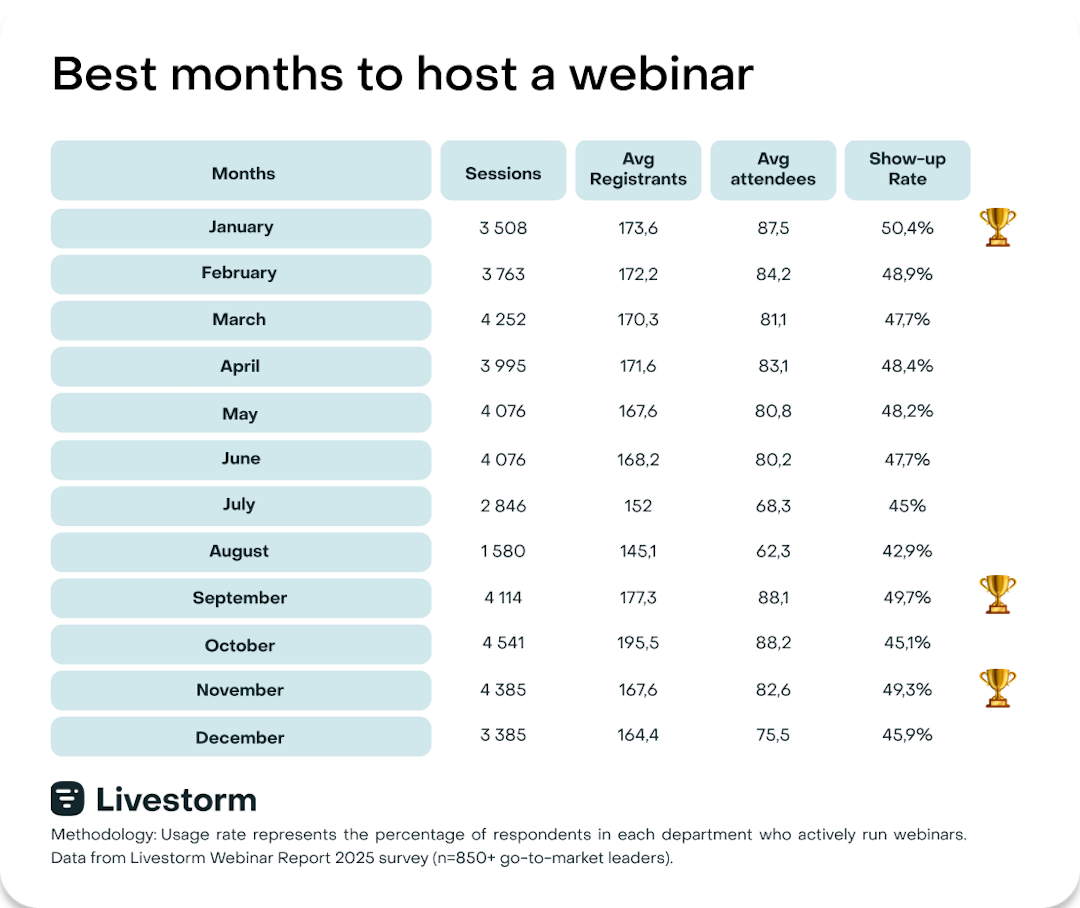
The seasonal pattern is clear: January dominates with 50.4% show-up rate—the highest of the year. September and November follow closely (49.7% and 49.3% respectively), proving that back-to-work/back-to-school momentum and Q4 urgency drive engagement.
Top performing months by show-up rate:
January: 50.4% (fresh start energy, clear calendars, new year momentum)
September: 49.7% (back-to-work surge after summer vacation)
November: 49.3% (Q4 deadline urgency kicks in)
February: 48.9% (Q1 momentum still strong)
Top performing months by registrations:
October: 195 avg registrants (Q4 planning season)
September: 177 avg (post-summer pipeline building)
January: 174 avg (new year strategy implementation)
February: 172 avg (Q1 execution mode)
Summer slump is real: July and August show the weakest performance—45% and 42.9% show-up rates respectively. Vacation mode kills both registrations (145-152 avg) and attendance (62-68 avg attendees).
2025 marks a breakthrough in webinar conversion quality. Show-up rates improved consistently across nearly all months vs 2024, with Q1 and Q4 leading the charge. September and November posted the strongest show-up rates (49.7% and 49.3% respectively), while August remains the softest month at 42.9%.
Optimal webinar months: January (best conversion), September-November (high engagement + strong registrations), and February-April (Q1 execution momentum).
Most marketers guess when to promote their webinars. Then they're surprised when registrations trickle in slowly. Here's what actually happens: 4.35 million registrations across Livestorm's platform reveal the exact behavioral pattern.
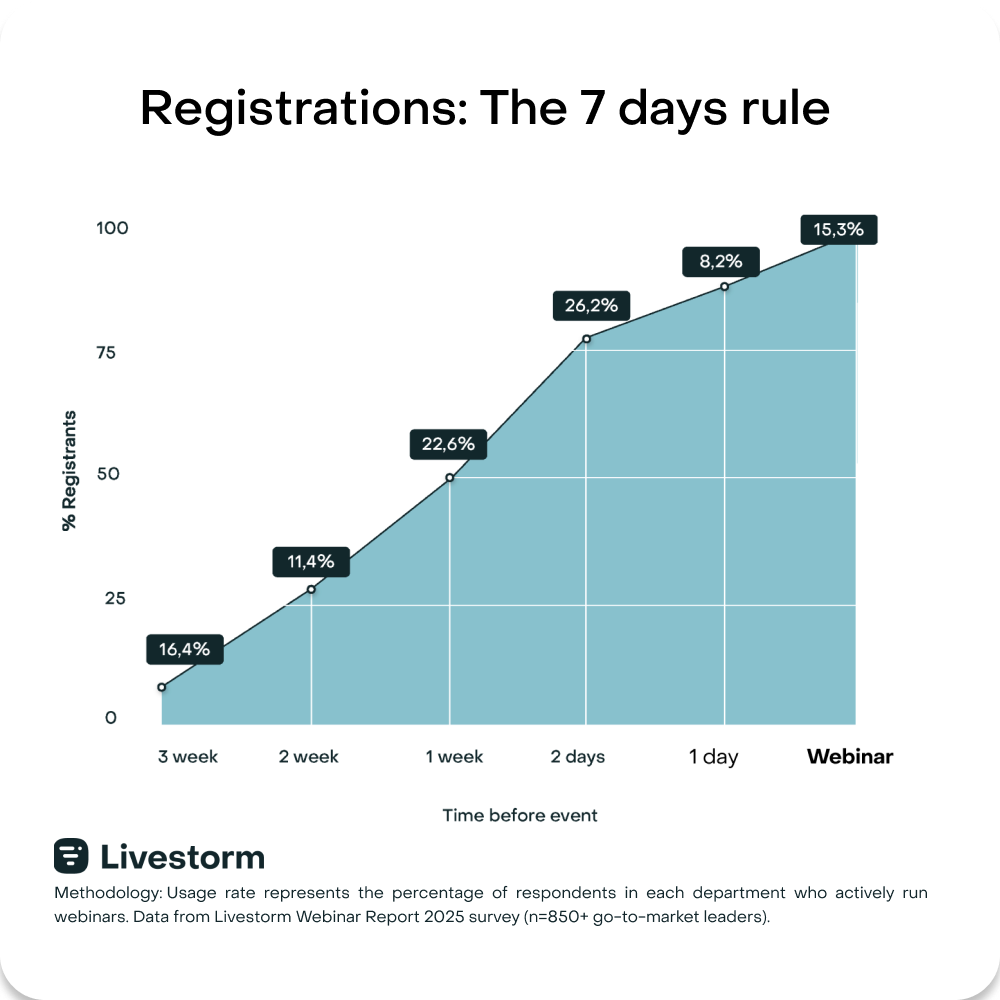
49.6% of registrations happen in the final week. Nearly half. And 15.3% register on the day itself. Translation: If you close registration 24 hours early "to give people time to prepare," you're locking out 15% of your potential audience.
The myth of the early bird: Opening registration 30+ days in advance doesn't work. Only 16.4% register 3+ weeks early—that's ~10 people per 100-registrant webinar. You're spending weeks promoting to capture less than a fifth of your audience.
Why? Because professional attention spans are short. B2B buyers don't plan their calendar a month out unless it's mandatory. They see your webinar promo, think "interesting," and forget about it until the week before—if they remember at all.
The real momentum happens in the final week:
2-6 days before: 26.2% (the sprint begins)
1 day before: 8.2% (last-minute planners)
Day of event: 15.3% (impulse attendees)
Translation: Front-load your promotion budget to the 7-day window. That's where half your audience makes their decision. Don't waste ad spend 30 days out when most people register in the final week.
Based on this registration data, here's the promotion framework that actually works:
Phase 1: Early Awareness (D-30 to D-15) - 20% of effort
Small segment, but highest intent. These are power users, customers, and partners who genuinely mark their calendars. Use this phase for save-the-date announcements and speaker reveals.
Phase 2: Primary Push (D-14 to D-7) - 30% of effort
Concentrate your budget here: email blasts (2-3 sends), paid ads (LinkedIn, Google), detailed landing pages, partner promotions.
Phase 3: Last-Minute Sprint (D-7 to D-Day) - 50% of effort
This is your peak conversion window. Nearly half of all registrations happen in this final week. Use daily emails with FOMO messaging ("Starts tomorrow," "Last chance"), countdown timers, and retargeting ads. Keep registration open until start time.
The myth of closing registration early: If you close registration 24 hours early "to give people time to prepare," you're locking out 12% of your potential audience. Modern platforms automate confirmation emails—let people register until the event starts.
Email dominates with 86%, nearly double any other channel. Organic social (43%) comes second. Community and newsletter (33%) tie for third. Paid ads? Just 20%, despite being the most talked-about tactic.
The Pipeline Truth: 2026 Webinar Benchmark Report
Drive more registrations, boost attendance & multiply content 13x. Based on 7M+ registrations, 33K sessions + 850 go-to-market leader insights.
DownloadHere's the brutal reality: you're losing more than half your audience before the event even starts (47.7% average show-up rate). That means 52% of your audience registered, confirmed their interest, and then didn't show up.
Average webinar show-up rate: 51.3%
2025 show-up rate: 47.7%
2024 show-up rate: 48.9%
Year-over-year decrease: -1.2 percentage points
Average registrants per webinar: 175
Average live attendees: 83
Average no-shows: 92
Teams achieving show-up rates above 60% do three things differently:
Stricter qualification + personalized reminders: They don't blast "Register now" to cold lists. They pre-qualify interest, then send personalized reminders at D-3, D-1, and D-Day with specific reasons each person should attend.
Multi-channel promotion: Email alone isn't enough. Top teams combine email, LinkedIn/Twitter, countdown timers on landing pages, and FOMO messaging.
Registration stays open until start time: 35% register in the last 3 days. 15% register same-day. Close registration 24 hours early and you lock out 15% of your potential audience.
The average viewer stays for 26 minutes—that's 38% of a 68-minute webinar. Translation: you have less than half an hour to deliver value, capture intent, and move prospects through the funnel.
| Duration Range | Average Attendees | Chat Messages per Person | Active Participation Rate |
|---|---|---|---|
| 30-44 minutes | 152 | 0.40 | 12.5% |
| 45-59 minutes | 161 | 0.49 | 14.2% |
| 60-75 minutes | 205 | 0.58 | 15.4% |
| 75-89 minutes | 190 | 0.80 | 16.9% |
| 90+ minutes | 184 | 1.10 | 20.7% |
Source: Livestorm platform data, 33,786 sessions, 2025.
Engagement is where pipeline intent reveals itself. The questions people ask in live Q&A, the polls they respond to, the chat messages they send—these aren't vanity metrics. They're buying signals.
Average webinar engagement metrics (2025):
Average watch time: 26 minutes (out of 68-minute sessions)
Chat messages per attendee: 0.58 (for 60-75 minute webinars)
Active participation rate: 15.4%
Q&A questions per session: 20.4
Average polls per webinar: 2.77
Chat is your leading indicator. Webinars with 90% chat adoption (teams designate a moderator, let it flow) see the highest engagement. Don't over-moderate—real-time reactions create energy.
Q&A drives buying intent. The questions people ask reveal exactly what objections need addressing. Sales teams that review Q&A logs before follow-ups close deals faster.
Polls segment your audience. Use 2-3 polls to understand who's in the room (job title, company size), what pain points matter most, and whether they're ready to buy or still researching.
| Feature | Usage Rate |
|---|---|
| Chat | 90% |
| Q&A | 65% |
| Polls | 28% |
Source: Livestorm customer data, 2025
The opportunity: Only 28% use polls regularly, despite polls being the easiest way to segment your audience in real-time and gather instant feedback. This is free market research—use it.
You spent $5,000 on promotion. Your team invested 20 hours in prep. You got 175 registrants and 83 live attendees. The Q&A was fire—27 questions, real buying intent, engaged audience.
Then, the webinar ends.
For most teams: The recording gets uploaded. An on-demand link gets sent to the 92 no-shows. Maybe someone writes a bland blog recap three weeks later.
→ The transcript? All 12,000 words? Sits in a Google Doc, unread.
→ The 27 Q&A questions that revealed exactly what your market cares about? Lost.
→ The 3 poll results that segmented your audience by pain point? Ignored.
You just spent $5,000 and 20 hours to create a one-time event. And you're about to do it again next month.
Here's what winning teams do differently: They treat the webinar as the input to a content engine, not the output. One 68-minute webinar becomes 13 assets that reach 19,500 people instead of 1,000.
The gap: 85% aren't systematically turning webinars into multi-channel content engines. Most do the bare minimum (upload replay), maybe cut a few clips, call it done.
Our survey asked: "What's your biggest blocker to repurposing at scale?"
The #1 answer: Bandwidth / time (32%)
Not "we don't see the value." Not "we don't have the tools." Time. Translation: "We know what we should do. We just can't do it fast enough."
The replay decision seems simple: gate it to capture emails, or open it to maximize reach? Most teams (62%) gate their replays. Only 20% make them public. The data is unambiguous: they're leaving 368% more views on the table.
Webinar Replay Statistics
| Replay Access Setting | Percentage Using | Average On-Demand Views |
|---|---|---|
| Public (everyone) | 20% | 14.60 |
| Registered users only | 62% | 3.97 |
| Nobody (closed) | 18% | 3.12 |
Key finding: Public webinar replays generate 368% more on-demand views than gated replays (14.60 vs 3.97 average views).
Organic search traffic
Google indexes the page, people discover it months later searching for "[your topic] webinar"
Social sharing
Anyone can share the link (no login wall)
Virality potential
One LinkedIn post with 10K impressions → 50 new views → 5 new leads you didn't pay for.
80% of teams use AI regularly for marketing workflows—email copy, social posts, research, analytics. But only 59.8% use AI for webinars. That's a 20-point gap. Why?
The answer reveals the opportunity: awareness, trust, and workflow systematization.
General AI adoption vs. webinar-specific AI adoption:
General marketing AI usage: 80.2%
Webinar-specific AI usage: 59.8%
Adoption gap: 20.4 percentage points
The Pipeline Truth: 2026 Webinar Benchmark Report
Drive more registrations, boost attendance & multiply content 13x. Based on 7M+ registrations, 33K sessions + 850 go-to-market leader insights.
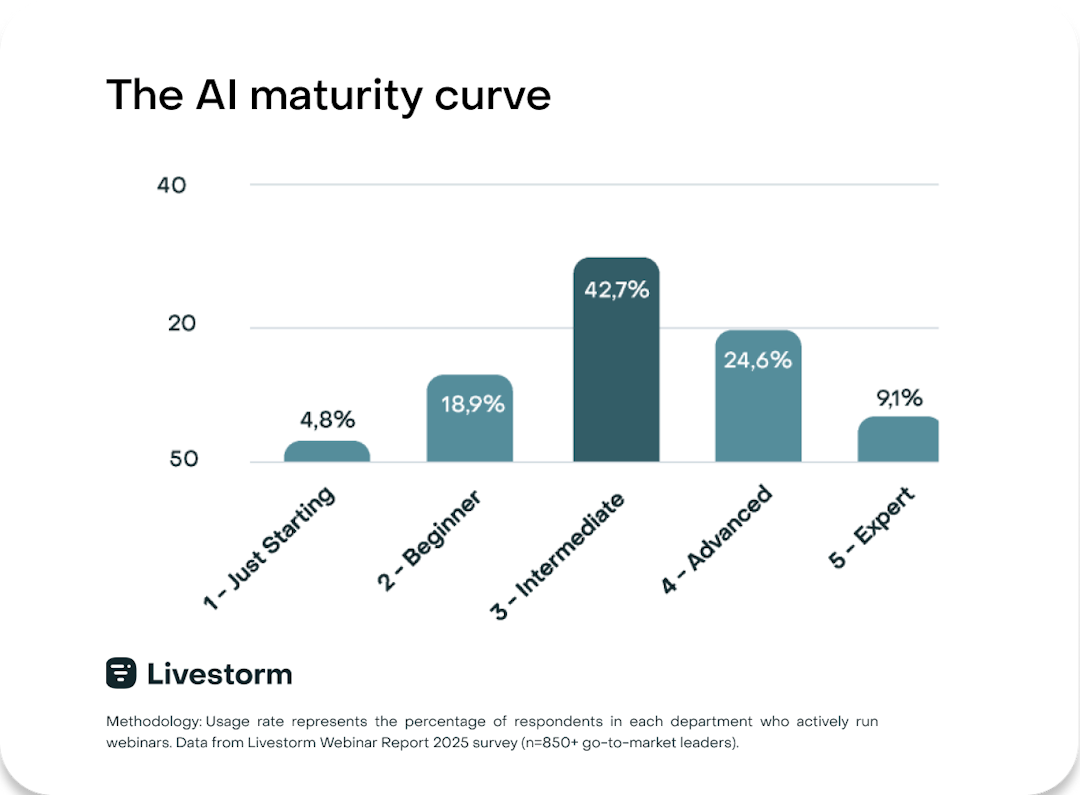
DownloadMedian maturity score: 3.0/5.0 (Intermediate)
Translation: One-third of marketers are stuck in the middle. They use AI for routine tasks but haven't operationalized it into "every webinar becomes 13 assets within 1 week" SOP.
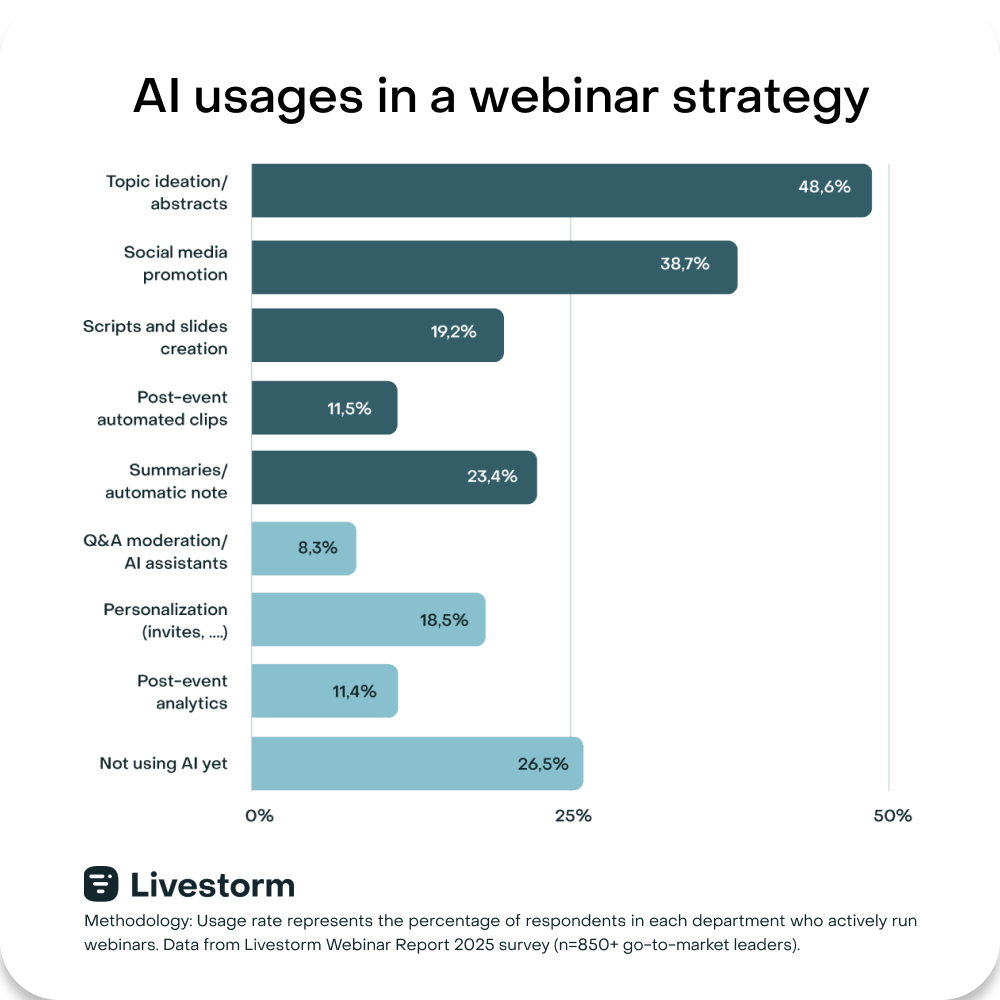
The bottleneck: Only 11,5% use AI for automated clip creation—an example where AI delivers an outstanding ROI. Teams are using AI to create content (scripts, slides) but not to multiply content (transcripts → 10 assets).
Opportunity: 94% of teams aren't systematizing post-event repurposing with AI, despite 42% citing "lack of time" as their primary barrier.
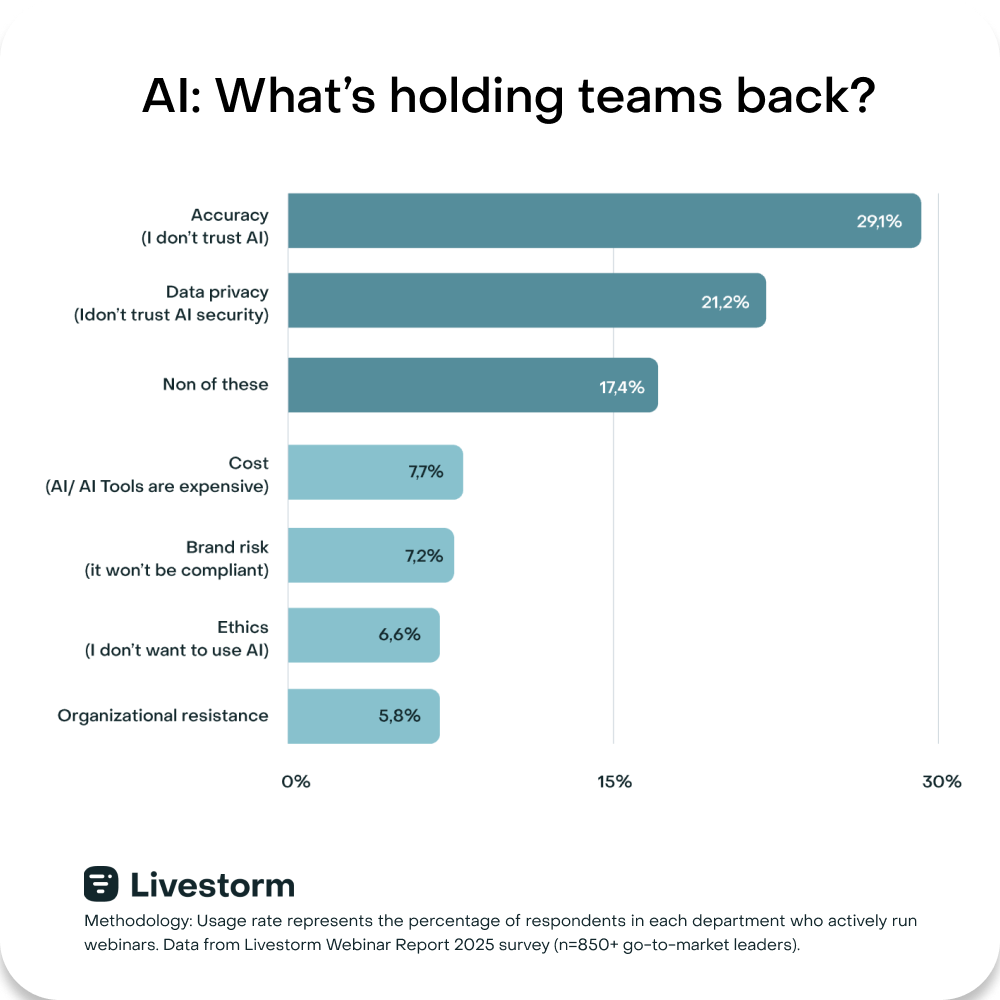
AI Adoption Barriers
50% of concerns are trust-related. The solution: human-in-the-loop workflows. AI drafts, human reviews. Trust but verify.
Let's cut through the noise. The question every CMO gets asked: "Do webinars actually drive pipeline?"
The uncomfortable truth most marketing teams face: They don't actually know. Our data shows only 6-8% of Livestorm customers use native CRM integrations (Salesforce, HubSpot, Brevo) to automatically sync webinar data to their pipeline. The other 92%? They're either exporting CSVs manually, cobbling together Zapier workflows, or (most commonly) not tracking attribution at all.
93% of webinar-influenced pipeline is invisible.
Here's what actually happens (Sarah's story):
Day 1: Sarah registers for your "Trends 2026" webinar
Day 7: Sarah attends live, asks 3 questions, downloads slide deck
Day 14: Sarah reads the repurposed blog post
Day 21: Sarah clicks a LinkedIn video clip, visits pricing page
Day 42: Sarah fills out a demo request form
Day 60: Sales closes the deal (€50K ARR)
→ What your CRM shows: Lead source = "Organic Search" (the demo form)
→ What actually happened: The webinar was the first touch that built trust. The repurposed content was the nurture sequence that kept her engaged. The demo was the conversion point.
But marketing gets credit for: Nothing. Or worse, just the demo form.
The webinar that started the journey? Invisible. The blog post that kept her warm? Invisible. The LinkedIn clip that brought her back? Invisible.
Finance asks: "What's the ROI of webinars?" And you're exporting CSVs at midnight trying to prove it.
You don't need perfect attribution to answer that question. This short video covers what you can prove to Finance today and how to connect your webinar data to your CRM so the pipeline stops disappearing. To put numbers on your own program, try our free webinar ROI calculator.
Survey Methodology
Between December 11-20, 2025, we surveyed 853 marketing professionals across B2B companies. We asked them about webinar criticality and strategic importance, AI adoption maturity and blockers, repurposing workflows and challenges, promotional strategies and conversion tactics, and attribution and ROI measurement.
Sample: 853 marketing professionals across B2B companies
Survey Period: December 11-20, 2025
Geographic Coverage: Global
Screening Criteria: Active webinar practitioners who ran at least one webinar in 2025
Weighting: We applied equal distribution across company size segments (SMB, Scale-up, Mid-Market, Enterprise, Large Enterprise) to prevent small business over-indexing in aggregate results. This ensures true performance patterns across segments.
Margin of Error:
Percentages: ±3-5%
Duration estimates: ±5-10 minutes
Platform Data Methodology
We extracted a complete dataset from Livestorm's data warehouse covering all webinars run on the platform from January 1 to December 31, 2025. The numbers: 3,199 organizations and 33,786 webinar sessions. We excluded test events and internal company webinars, removed sessions with <10 registrants (likely private/internal), excluded sessions <15 minutes duration (likely not full webinars), and anonymized all customer and attendee data per GDPR and ISO 27001.
Dataset: 33,786 webinar sessions from 3,199 organizations
Date Range: January 1 - December 31, 2025
Metrics Analyzed:
Duration, registration rates, show-up rates, attendee counts
Engagement metrics (chat messages, Q&A questions, polls, active participation)
On-demand viewing patterns
Day of week and time of day patterns
Why both sources matter: Survey data alone tells you what marketers think works, but is subject to recall bias and aspiration gaps. Livestorm data alone tells you what actually happens, but lacks context on strategy, intent, and decision-making. Together, they reveal the gap between intention and execution.
Table of content
The Pipeline Truth: 2026 Webinar Benchmark Report
Try Livestorm for free
Get started in minutes and run your first engaging webinar today.