ABM stands for account-based marketing, a strategy that treats individual high-value accounts as markets of one, aligning sales and marketing efforts around specific target companies.
Lead Generation
How to Implement ABM Play That Work [Experts Takes]
Published on December 12, 2025 • About 12 min. read
Written by Brillixa Herdhiana
Precision over Volume: The ABM Playbook
Table of content
Share this article
Key Takeaways
67% of ABM programs underperform in their first year, typically due to execution challenges rather than strategy or budget deficiencies.
Systematic frameworks for resource allocation, such as the 70/20/10 model, enable 34% faster ABM program maturity while preserving demand gen results.
Comprehensive closed-won analysis and multi-dimensional account scoring drive 36% higher account win rates than basic demographic targeting alone.
Channel orchestration based on account journey stage and dynamic per-account budgeting yield 23% higher ROI compared to static models.
Sales and marketing alignment—especially with marketing-owned SDR teams—produces 28% higher qualified opportunity rates and prevents operational silos.
67% of ABM programs fail to deliver expected results within their first year. The culprit isn't bad strategy or insufficient budget—it's the execution gap between knowing what ABM is and actually making it work in practice.
You've built your ABM strategy, identified your ideal customer profile, and secured leadership buy-in.
Now comes the challenging part that separates successful programs from those that stall after the first quarter. While 87% of B2B marketers report that ABM delivers higher ROI than other marketing activities according to ITSMA research, the difference lies in systematic implementation.
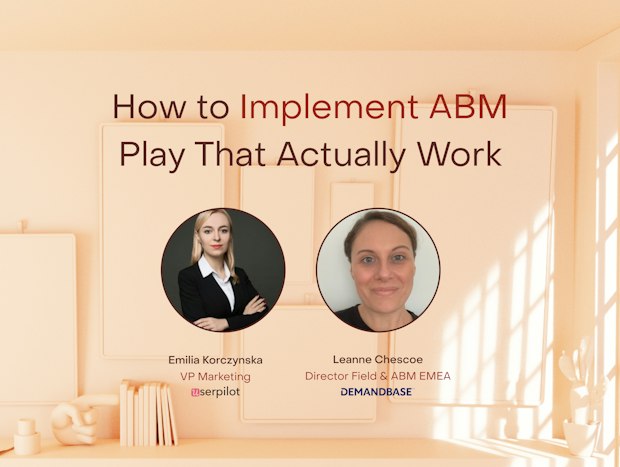
This comprehensive guide draws from real-world insights shared by Emilia, VP Marketing at Userpilot, and Leanne, Director of Field & ABM EMEA at Demandbase—two seasoned experts who have successfully scaled ABM programs at enterprise organizations.
You'll discover the operational frameworks, measurement strategies, and tactical approaches that transform ABM theory into revenue-generating practice.
When ABM Implementation Makes Sense
Before investing in ABM execution, conduct an honest assessment of whether your organization is truly ready for implementation beyond just having a defined ideal customer profile.
Is Your Business Ready for ABM?
"ABM might be right for you if your growth goals depend on focusing rather than casting that wide net. You might have a challenge around pipeline quality. So are you generating enough opportunities or the right ones?"
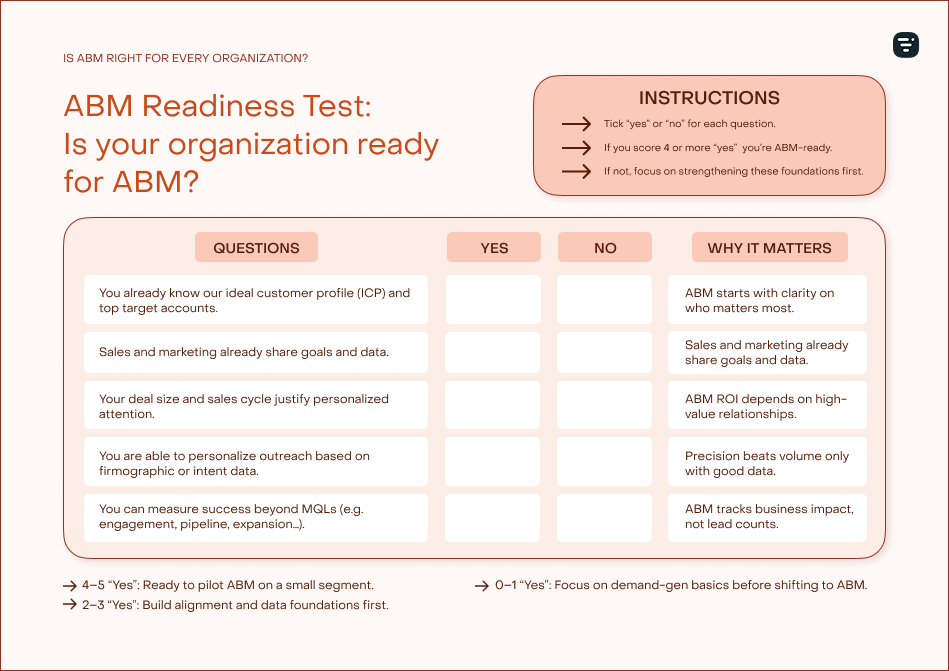
Three critical indicators suggest your organization is ready for ABM implementation.
First, you're experiencing volume versus quality misalignment where marketing generates substantial lead volume, but deals consistently stall because accounts weren't a good fit.
Second, when sales teams report being "drowning in leads" but struggling to close deals, it typically indicates your go-to-market motion is too broad and unfocused.
Finally, Leanne notes that companies often "celebrate those large deals that might churn after a year. They might drain customer success resources."
This pattern suggests you're closing deals with accounts that lack long-term fit, making ABM's quality focus essential for sustainable growth.
Resource Allocation Frameworks That Work
Successful ABM implementation doesn't require abandoning your existing demand generation efforts. Instead, it demands strategic resource rebalancing.
Emilia emphasizes this balanced approach: "You need to build momentum and be patient. I would say not to cut off the transactional inbound motion and make sure you have enough resources to keep it going while you're ramping your ABM program."
The most successful organizations use a 70/20/10 resource allocation model:
70% of resources maintain proven demand generation tactics
20% funds ABM implementation and testing
10% supports experimental tactics and optimization.
This framework works because it maintains revenue stability while building ABM capabilities, preventing the common mistake of abandoning effective programs before ABM momentum develops.
Organizations that follow this balanced approach see 34% faster ABM program maturity while maintaining baseline revenue performance during the transition period.
Building Your Target Account Framework
Moving beyond basic ideal customer profiles requires systematic analysis and operational scoring methodologies that scale with program growth.
Closed-Won Analysis for ABM Play
"Take the time to really do that closed-won analysis and understand what do our good customers look like," Leanne advises.
This analysis forms the foundation of successful ABM implementation because it reveals the characteristics that predict not just initial sales success, but long-term customer value.
Emilia's team focuses on recent performance: "The last 3-6 months because that gives you the most accurate idea of which accounts are closing at the highest rate and bringing you most value."
This timeframe captures current market conditions and buying behavior patterns while providing sufficient data for statistical significance.
Your analysis should examine four critical dimensions. Revenue analysis identifies accounts with highest lifetime value rather than just initial contract size. Retention patterns focus on customers who consistently renew and expand their relationships.
Product utilization analysis reveals which accounts adopt multiple products or use advanced features, indicating strong product-market fit. Geographic and industry clustering uncovers concentration patterns that suggest replicable success formulas.
According to Terminus's ABM Benchmark Report, companies conducting thorough closed-won analysis see 36% higher account win rates in their ABM programs compared to those using basic demographic targeting.
Account Scoring Systems
"Build out this ideal customer profile scoring, almost like a lead scoring methodology, but at an account level," Leanne recommends. However, effective ABM scoring requires moving beyond basic firmographic data to include behavioral and intent signals.
Successful scoring models use multi-dimensional frameworks that weight different factors based on their predictive value.
Fit scores (40% weight) include industry alignment, revenue range, employee count, and technology stack compatibility.
Intent scores (35% weight) measure website engagement patterns, content consumption behavior, and search activity.
Relationship scores (25% weight) evaluate existing connections, previous interactions, and referral source quality.
Emilia's team operationalizes this through engagement thresholds:
"We set certain conditions based on their engagements with our ads, our content as benchmarks for moving into the awareness, interested, and towards the bottom of the funnel."
This systematic approach ensures consistent account qualification and prevents subjective decision-making that can undermine program effectiveness.
Do you need a Strategic, Lite, or Programmatic ABM Approaches?
Successful ABM implementation requires matching your tactical approach to available resources while maintaining program quality standards.
Leanne's team developed "an entitlement model" that defines clear criteria for different ABM program types, ensuring resource allocation aligns with potential account value.
One-to-One Programs target your highest-value opportunities—typically deals over specific size thresholds that are likely to close within six months.
One-to-Few Programs focus on industry-specific campaigns targeting 10-50 similar accounts with shared challenges and use cases.
Programmatic ABM enables scalable campaigns targeting hundreds of accounts through automated personalization and scoring systems.
This tiered framework ensures optimal resource utilization while maintaining program effectiveness across different account segments and opportunity stages.
What's the Best Channel for your ABM Campaign?
Effective ABM implementation requires orchestrating multiple channels based on account journey stages rather than running isolated, channel-specific campaigns.
Strategic Channel Selection
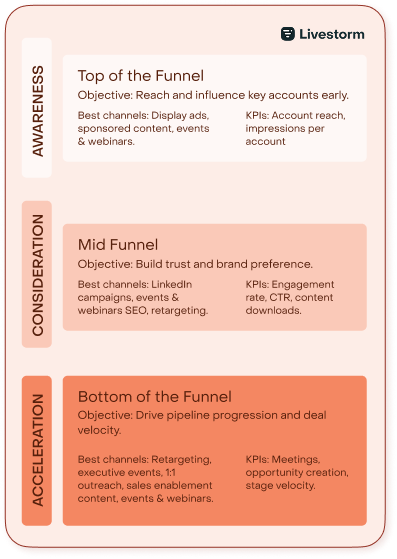
Both experts emphasize that successful channel selection depends on where accounts sit in their buying journey rather than channel preferences or budget availability. This strategic approach maximizes engagement efficiency while optimizing cost-per-result across different funnel stages.
Emilia's team "made the decision early on to start from LinkedIn as our main content distribution channel," but emphasizes the importance of ROI-driven timing and measurement. Their approach demonstrates how channel selection should align with account engagement patterns and demonstrated intent levels.
Leanne takes a more sophisticated, multi-channel approach: "We found display worked really well, so we have this always-on approach throughout the funnel."
However, her team introduces different channels strategically based on account behavior: "Once they get to what we would call our aware stage, we would incorporate targeted search. And then we've started to use LinkedIn when they get to what we would call our engage stage."
This systematic channel orchestration includes always-on display campaigns for consistent account coverage, search marketing activation when accounts show off-site intent signals, LinkedIn engagement for accounts that have demonstrated awareness, and email nurturing for account-specific relationship building. This coordinated approach aligns with proven B2B marketing strategies that emphasize integrated touchpoints across the customer journey rather than siloed channel management.
Budget Allocation Across Stages
"The budget per account depends on where those accounts sit in the funnel," Leanne explains, highlighting how successful ABM programs adjust investment based on account progression and engagement signals.
Her team's systematic approach allocates "about $50 per account at the top of funnel, and as they move through, particularly when they become opportunities, we adjust our spend per account." This dynamic allocation model ranges from $30-50 monthly for awareness-stage accounts to $200-500+ for decision-stage accounts, with investment increasing as conversion probability rises.
Companies following staged budget approaches report 23% better ROI according to 6sense's ABM Platform Benchmark compared to organizations using flat per-account allocation models. This approach mirrors successful lead generation funnel strategies that adjust investment based on prospect readiness and engagement levels, ensuring budget efficiency while maintaining adequate investment in high-intent accounts.
Events as ABM Amplifiers
Strategic event planning accelerates ABM programs when aligned with account journey stages and executed with clear ROI criteria rather than vanity metrics.
Systematic Event Strategy by Stage
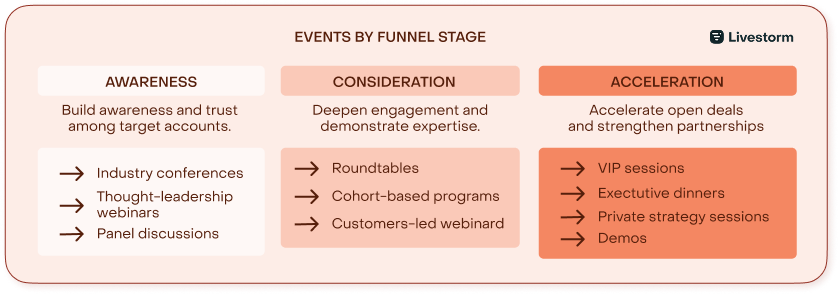
"You won't be running the same type of events at different stages of that funnel," Leanne emphasizes. Her systematic approach demonstrates how event format and content must align with account readiness and buying stage to maximize engagement and progression.
Awareness Stage Events focus on industry events and analyst-sponsored content for early engagement and relationship building.
Consideration Stage Events shift to intimate formats designed for relationship deepening and problem identification.
Decision Stage Events emphasize high-touch experiences for deal acceleration and stakeholder alignment.
"Once they're more like mid-funnel, it's more our own like smaller-run like what we would call our field events, so it's more like a curated roundtable, workshop, a lunch and learn, or a dinner."
"For the bottom of the funnel, that's really going to be around that acceleration phase. We've got deals in play and we're using these as like a closing event. Those tend to be more things like VIP events that we do, like sporting events and concerts."
Emilia reinforces this strategic approach: "I see events as a type of content distribution channel, and the whole strategy needs to be aligned with that."
This reframing helps teams think systematically about event ROI rather than treating events as isolated tactics or relationship-building exercises.
This approach aligns with comprehensive B2B event marketing strategies that treat events as integrated touchpoints rather than standalone activities.
ROI-Driven Event
Leanne's team established quantifiable criteria for event investment decisions:
"Before we would consider sponsoring something, we want to see at least a 60% attendance rate from our target accounts."
This standard ensures event investment aligns with account coverage objectives rather than general brand awareness goals.
According to Bizzabo's Event Marketing Report, B2B companies using attendance quality metrics see 41% higher event ROI than those focused purely on attendance volume or general industry participation.
For virtual ABM events, organizations should leverage webinar best practices to create engaging experiences that move target accounts through the funnel while providing detailed engagement data for follow-up prioritization.
This data-driven approach enables more precise account scoring and sales handoff timing.
Sales and Marketing Alignment
Operational alignment between sales and marketing teams often determines ABM program success more than strategy sophistication or technology investment.
Shared OKRs That Eliminate Conflict
"Having the same OKRs for sales and marketing regarding that ABM program is the key—this is the fundamental change you can make to remove the conflict of interest," Emilia emphasizes.
This structural change addresses the root cause of most ABM implementation failures: misaligned incentives between teams.
Operational alignment requires shared revenue targets where both teams measure success based on pipeline generated from target accounts. Joint account coverage metrics ensure collaborative responsibility for buying group identification and engagement.
Collaborative journey stage progression KPIs align both teams around account movement through funnel stages. Combined content performance accountability makes both teams responsible for message effectiveness and engagement quality.
This comprehensive alignment approach prevents the common scenario where marketing celebrates campaign engagement while sales focuses solely on closed deals, creating friction and suboptimal resource allocation.
Marketing-Owned SDR Teams for ABM Success
Both experts strongly advocate for SDR teams operating within marketing for ABM programs, citing dramatic performance improvements from this organizational change.
"I prefer if anyone has a BDR team to have them within the marketing department. Otherwise, there are communication silos," Emilia states. This structural change addresses the coordination challenges that plague many ABM implementations.
Leanne confirms the impact: "We made that move about a year ago, and it's been so successful. We've just seen conversion rates improved across the board." Her organization's experience demonstrates how organizational alignment translates directly into performance improvements.
Marketing-owned SDR teams provide several critical advantages. Program alignment ensures SDRs understand campaign context and account journey stages, enabling more effective outreach timing and messaging.
Message consistency creates seamless integration between marketing campaigns and direct outreach. Direct feedback loops provide immediate insight into account responsiveness and message effectiveness. Resource optimization enables coordinated allocation between campaigns and outreach efforts.
Companies with marketing-owned SDR teams report 28% higher qualified opportunity rates according to TOPO's Sales Development Benchmark Report.
This organizational change supports more effective sales webinar programs where SDRs can seamlessly transition engaged webinar attendees into qualified sales conversations.
What are the ABM Measurement
Traditional marketing metrics like MQLs can mislead ABM program optimization efforts. Effective measurement requires shifting focus to account-level progression and efficiency metrics that drive tactical improvements.
Leading Indicators for Complex Sales Cycles
"With enterprise sales cycles that can take three to six or more months, you can't wait for ROAS to measure campaign success. You need to track leading metrics like progression through the funnel," Emilia explains.
This measurement philosophy prevents the common mistake of abandoning effective programs before they have sufficient time to demonstrate results.
Successful ABM measurement tracks four critical progression categories.
Awareness indicators include account website visits, content engagement patterns, and brand search activity.
Interest signals measure multiple stakeholder engagement, repeated website visits, and content downloads across buying group members.
Consideration metrics track sales conversation initiation, demo requests, and competitive research activity.
Decision indicators monitor procurement involvement, reference requests, and proposal engagement levels.
This comprehensive tracking approach provides early performance signals while maintaining focus on ultimate revenue outcomes, enabling program optimization during execution rather than after campaign completion.
Efficiency Metrics
"What I like looking at is efficiency metrics. I'm looking at pipeline per dollar spent—how much pipeline have we generated from accounts in a specific campaign divided by how much we've spent," Emilia details.
This measurement approach enables tactical adjustments during campaign execution rather than waiting for final ROI calculations.
Key efficiency metrics include pipeline per dollar spent for immediate campaign effectiveness assessment, account engagement cost calculated by dividing campaign spend by engaged accounts rather than total targeted accounts, journey stage velocity measuring time and cost required to move accounts between stages, and buying group coverage cost tracking the investment required per stakeholder identified and engaged within target accounts.
Companies focusing on efficiency metrics achieve 45% better ABM ROI according to 6sense's Revenue Intelligence Report compared to organizations using traditional volume-based metrics.
This measurement approach complements effective webinar funnel tracking that focuses on account-level progression rather than individual lead metrics.
Communication Systems
"Keep sales leaders updated monthly on where you are with ABM programs," Leanne suggests. Her team creates "a simple one-slide update showing percentage of accounts on-site, journey stage velocity impact, and pipeline generation."
This regular communication addresses the common challenge of stakeholder impatience with longer ABM sales cycles while maintaining program support during the critical early implementation period. Companies with structured ABM reporting see 52% higher program renewal rates according to Demandbase's ABM Executive Survey.
Transform ABM Strategy Into Revenue-Generating Practice
The gap between ABM theory and successful implementation isn't about strategy sophistication—it's about operational excellence and systematic execution.
As Emilia emphasizes, "ABM is not only about the number of leads—it's about the quality of accounts that we are converting into pipeline and the average contract value per account."
The frameworks shared by Leanne and Emilia demonstrate that sustainable ABM success requires balancing strategic thinking with operational discipline.
Rather than pursuing perfect personalization or comprehensive account coverage, focus on building systematic approaches to account selection, multi-channel orchestration, and performance measurement that can scale with your program growth.
Start with clear organizational readiness assessment, then implement systematic account selection based on data-driven analysis rather than assumptions.
Build channel strategies that align with account journey stages while maintaining budget efficiency across different funnel positions.
Most importantly, establish measurement frameworks that provide actionable insights during program execution rather than waiting for final ROI calculations.
Ready to accelerate your ABM implementation with engaging virtual events that move target accounts through your funnel? Livestorm's webinar platform provides the engagement tracking and account-level insights essential for ABM program optimization.
Our platform integrates seamlessly with your existing marketing stack to support comprehensive ABM execution while delivering the detailed analytics you need for continuous improvement.
Frequently asked questions
What does ABM stand for?
How do you implement an ABM strategy?
Implement ABM by identifying target accounts, aligning sales and marketing teams, creating personalized content and campaigns for each account, and measuring engagement at the account level rather than by individual leads.
What's the first step in implementing ABM?
The first step is identifying and selecting your target accounts based on ideal customer profile criteria, firmographics, revenue potential, and strategic fit with your solution.
What are some examples of ABM tactics?
Common ABM tactics include personalized webinars for target accounts, custom content hubs, executive dinners, direct mail campaigns, and account-specific advertising. Livestorm enables scalable webinar campaigns tailored to individual accounts.
What tools are commonly used for ABM?
ABM programs typically use CRM platforms, marketing automation tools, account intelligence software, advertising platforms, and engagement channels like webinar solutions to coordinate outreach and track account-level interactions.
What's the difference between GTM and ABM?
GTM (go-to-market) is your overall strategy for bringing products to market, while ABM is a specific marketing approach within GTM that focuses resources on engaging predetermined high-value accounts.


Ebooks
Precision over Volume: The ABM Playbook
Learn how to define your ICP, build targeted campaigns, and align teams with templates, checklists, and insights from top B2B marketers.

About the author
Brillixa Herdhiana - Senior Growth Manager
Brillixa joined Livestorm as Growth Manager in 2021. Her experience enables her to contribute to business growth through lead generation from ads and organic channels.
Related categories
Featured resource
Ebooks
Precision over Volume: The ABM Playbook
Learn how to define your ICP, build targeted campaigns, and align teams with templates, checklists, and insights from top B2B marketers.
Newsletter