Attendee-based pricing charges you based on the number of people who can join your webinar simultaneously. This model scales costs directly with your audience size, making it predictable for budgeting and planning.
Webinar
Webinar Pricing: Why Traditional Models Create Quiet Frictions
Published on March 6, 2026 • About 2 min. read
Written by Olivier Thomas
Table of content
Share this article
For years, webinar platforms have followed the same pricing logic: per host, per seat, per capacity tier. It is one of those industry conventions that feels so established we rarely question it.
And yet, if you spend enough time working closely with marketing teams, a strange pattern starts to emerge.
You hear about initiatives delayed because there are no available licenses. Teams negotiating internally over who "deserves" access to the webinar platform. Dry runs minimized not for lack of time, but because someone worries about consuming quota. Campaign performance evaluated alongside an awkward footnote: "yes, but we're still paying for no-shows."
Nothing dramatic. Just a steady accumulation of small frictions that add up over time.
When webinar platform pricing doesn't match how teams actually work
Over time, those frictions begin to feel disproportionate. Not because pricing is unfair, but because it often seems disconnected from how webinar programs actually operate today.
Modern webinar strategies are rarely neat. Some months are quiet. Others spike unexpectedly. Teams expand, reorganize, experiment. A single webinar can involve marketing, sales, customer success, product, sometimes even HR or legal. Collaboration is not the exception anymore — it is the baseline.
Yet many webinar pricing models still behave as if access itself were the scarce resource.
What are you actually paying for?
As a Product Marketing Manager, I have always had a soft spot for systems that are easy to explain. Not just to customers, but internally — to finance, to procurement, to RevOps, to anyone who eventually asks the unavoidable question: "What exactly are we paying for?"
That question sounds simple. It rarely is.
Are you paying for software access? For theoretical capacity? For projected usage? For worst-case scenarios?
The more you dig, the more you realize that traditional webinar software pricing is often built around possibilities rather than realities. "Maximum hosts." "Maximum seats." "Maximum attendees per session."
But marketing programs do not live in maximums. They live in outcomes. Did people show up? Did the session reach an audience? Did engagement actually happen?
From capacity-based to attendee-based pricing
That shift in perspective is what gradually led us to rethink things.
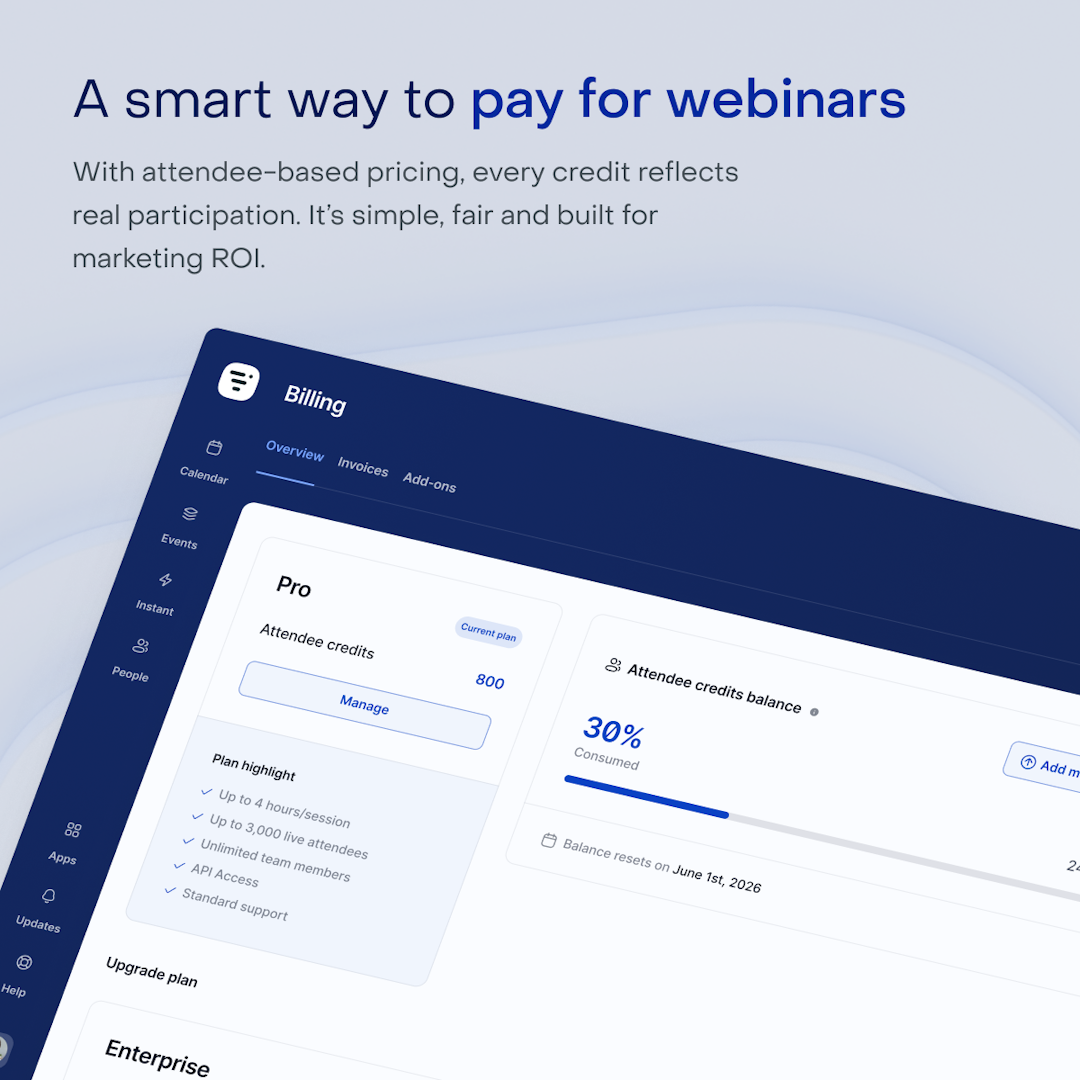
Instead of structuring webinar pricing around who might host or how large a virtual room could be, we asked a quieter, more grounded question: what if pricing simply reflected participation?
Not registrations. Not capacity. Just attendance.
This is the idea behind attendee-based pricing.
At Livestorm, it means something quite straightforward. Team members are unlimited. There is no concept of paid licenses. The number of sessions you run, or the maximum number of participants in a room, does not influence the webinar cost. The only variable that matters is how many people actually join.
One attendee. One unit of value.
How attendee-based pricing changes team behavior
What is interesting about this model is not only how it changes billing, but how it changes behavior.
When adding a colleague no longer triggers a cost discussion, collaboration becomes natural. When running an extra dry run does not feel like waste, teams prepare more comfortably. When experimentation is not constrained by arbitrary limits, usage patterns start to reflect strategy rather than pricing mechanics.
There is also something quietly reassuring about aligning cost with something observable. Someone joined or they did not. No interpretation required. No debates about unused seats or expiring quotas.
It is, in many ways, a return to simplicity. Not simplicity as a slogan, but simplicity as an operational reality.
A different way to think about webinar cost
Attendee-based pricing is our interpretation of what the future of webinar platform pricing should look like.
Less about access. Less about theoretical limits. More about what actually happened.
Frequently asked questions
What is attendee-based webinar pricing?
How does attendee-based pricing differ from other webinar pricing models?
Unlike flat-rate or per-host pricing, attendee-based pricing ties your costs to the capacity you need. You pay for the number of seats rather than features alone, which helps you match spending to actual usage.
Is attendee-based pricing better for small or large webinars?
Attendee-based pricing works well for both. Small teams benefit from lower entry costs for modest audiences, while larger organizations can scale capacity as their webinar programs grow without overpaying for unused seats.
What should I consider when choosing attendee-based pricing?
Consider your typical audience size, how often you host webinars, and whether you need room to grow. Look for platforms that include registration, engagement tools, and analytics within the attendee tier to maximize value.
Can I change my attendee capacity later?
Most platforms with attendee-based pricing let you adjust your capacity tier as your needs change. This flexibility helps you scale up for big launches or scale down during quieter periods without being locked into a single plan.


Ebooks
Webinar Promotion Handbook
Everything you need to promote your webinars and increase attendance.

About the author
Olivier Thomas - Senior Product Marketing Manager
Before joining Livestorm, Olivier built over 10 years of experience shaping go-to-market strategies and driving growth in complex tech environments. At Livestorm, he leads enterprise product marketing, structuring high-impact use cases, and building strategic positioning across industries. He also drives the go-to-market strategy for new features and integrations, ensuring launches translate into adoption and revenue impact.
Related categories
Newsletter