
B2B content marketing is the practice of creating and distributing useful, high-quality content to attract, educate, and convert other businesses. It builds trust and authority across a buying committee over a long sales cycle, rather than driving a single quick purchase.
Content Marketing
B2B Content Marketing: The 2026 Strategy Guide
Published on August 25, 2026 • About 7 min. read
Written by Brillixa Herdhiana
The Content Repurposing Guide: turn 1 webinar into 10+ marketing assets
Table of content
Share this article
Key Takeaways
B2B content marketing builds trust with a buying committee over a long sales cycle, not a quick sale.
A B2B content marketing strategy starts with a revenue goal, not a content calendar.
B2B buyers now research on AI engines first, so structured, quotable content wins.
Webinars are the highest intent content type and the best anchor asset.
Repurposing one webinar into many assets is the highest leverage move in B2B content.
B2B content marketing is the practice of creating and distributing useful content to attract, educate, and win over other businesses. Unlike B2C, it speaks to several decision-makers at once and plays out over long, considered buying cycles. The goal is trust, authority, and pipeline, not a quick sale.
In this guide, I’ll explain what B2B content marketing is, why it matters now, how to build a strategy step by step, and why you should prioritize webinar content.
What is B2B content marketing?
B2B content marketing is a tactic for earning the attention and trust of another business through helpful, relevant content. Your business publishes the answers and guidance your target audience is already searching for. Over time it builds the authority that makes your brand the obvious choice.
In B2B marketing, you're rarely speaking to one person. Instead, you're speaking to a buying committee, and the sale can take months.
B2B vs B2C content marketing
B2C content often chases a fast, emotional purchase. B2B content supports a slower, more measured decision with a bigger price tag and more people involved.
That means your content has to do more than generate interest. It has to give a champion the material to convince a manager, who then needs to make a case to finance.
Why the buying committee changes everything
A single B2B deal can involve an end user who cares about ease of use, a manager who cares about team outcomes, and an executive who cares about return on investment. Successful B2B content answers all three concerns, because any one of them can stall the deal. Map your content to those issues, and you'll shorten the cycle.
Why content marketing matters for B2B in 2026
Content is still the most cost effective way to reach B2B buyers who research independently long before they ever talk to sales. What's changing is where that research happens and how little of it you can directly see.
The buyer researches before they talk to you
B2B buyers typically self-serve now, but a large share of that research never sends a click your way. Around 68% of Google searches end in zero clicks as of Q1 2026 according to SparkToro's zero-click study.
Clicks are even rarer with AI engines. Under 1% of ChatGPT prompts lead to a website click, per the Livestorm and Eskimoz analysis of AI visibility.
That might sound like bad news. But it isn't if those AI answers mention or cite your content.
Content creates long-term value
A good B2B article can keep earning attention and generating interest for years. It also feeds both search and AI visibility and builds the authority that advertising can't.
As Jérémy Lacoste of Eskimoz puts it, the move now is not to replace your B2B content strategy but to evolve it. Keep the blog and enrich it with the content and TL;DR summaries that AI engines favor.
How to build a B2B content marketing strategy (step by step)
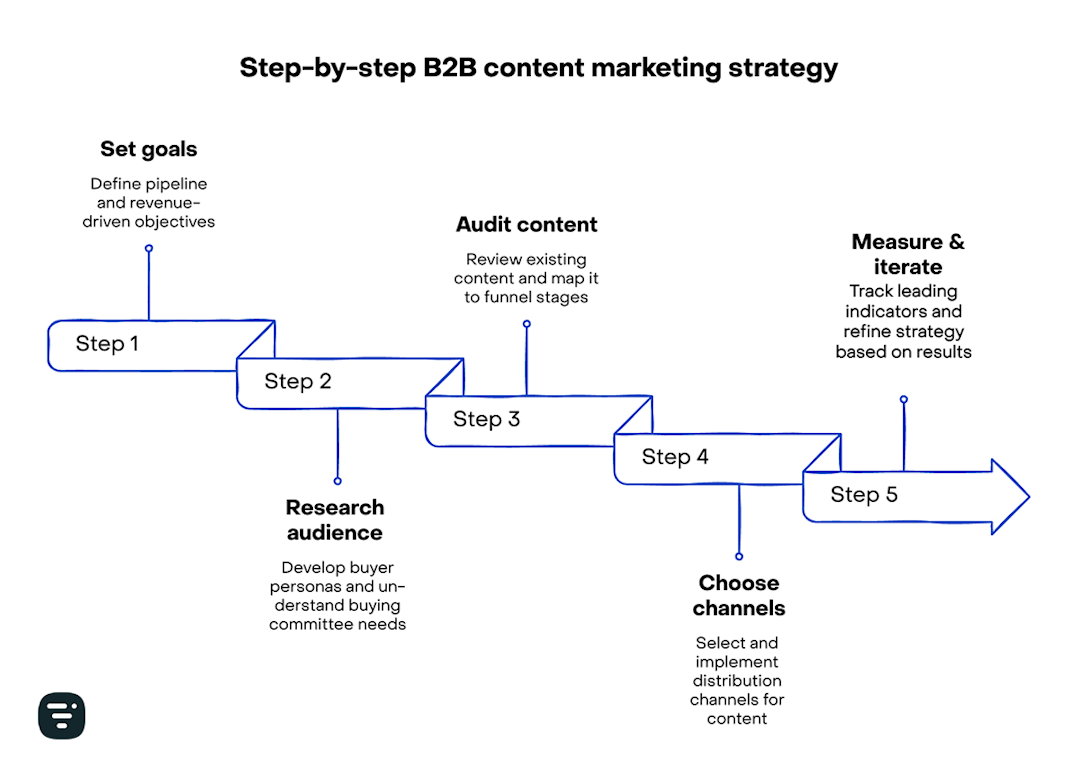
An effective content strategy is much more than a content calendar. It starts with a goal tied to revenue, a real understanding of who you're selling to, and an honest audit of what you already have. From there, you decide the formats, channels, and measurement tactics.
1. Set goals tied to pipeline, not traffic
Choose outcomes you can defend in a revenue meeting. As Livestorm's 2026 Webinar Benchmark Report shows, marketers' top goals are pipeline generation (47.1%), customer expansion (46.4%), and brand awareness (40.7%).
Keep in mind that traffic is a proxy for these goals, not a substitute. As Jérémy argues, our marketing efforts should generate revenue, not traffic.
2. Research your audience and the buying committee
Before you write a word, get specific about who will read it. Develop buyer personas for everyone on the buying committee, including the end user, manager, and executive.
Note the questions that each one needs answered. Your content plan is really a map of those questions and answers.
3. Audit and map content to the funnel
Many teams already have more content than they think. Do a content audit, and map each piece to a funnel stage so you can see the gaps.
Top-of-funnel content earns discovery
Middle-of-funnel content builds the case
Bottom-of-funnel content guides toward a decision
In the discovery stage, inbound marketing is the engine that pulls in buyers rather than chasing them.
4. Choose channels and distribution
Creating content is only the beginning. Content distribution is essential, but many teams under-invest.
Email marketing remains the workhorse for many B2B companies. For example, it's the top webinar promotion channel, used by 86% of surveyed content marketers.
But email only reaches prospects and customers who already know you. To reach the rest of the buying committee, you need the channels where they discover new vendors.
For most B2B companies, that means LinkedIn and YouTube. Post native content, such as text, carousels, and short video, from both company and employee accounts rather than links alone. Treat YouTube as a search engine, with titles and descriptions written like blog posts.
Don't forget sales. Case studies, comparison guides, and webinar clips add valuable information to sales reps' follow-up emails.
Finally, plan repeat promotion from the start. One asset should be shared several times across several channels over weeks, not once on launch day.
5. Measure and iterate
Most of your content's impact will be invisible. Only about 7% of webinar-influenced pipeline is reliably tracked, which means roughly 93% goes unattributed.
To compensate, measure leading metrics and lagging indicators. Lagging metrics prove impact, while leading metrics show demand forming before anyone clicks.
| Metric | Type | What it tells you | Where to track it |
|---|---|---|---|
| Content-influenced pipeline | Lagging | Deals where a contact engaged with content during the cycle | CRM, multi-touch attribution |
| Content-sourced pipeline | Lagging | Deals where content was the first touch | CRM, first-touch attribution |
| MQL to SQL conversion by asset | Lagging | Which content produces leads sales accepts | CRM or marketing automation |
| Sales cycle length, content-engaged vs. not | Lagging | Whether content helps buyers sell internally | CRM |
| Impressions and share of voice | Leading | How often you appear for target topics | Google Search Console, Semrush, Ahrefs |
| AI engine citations | Leading | Whether AI answers mention or link to you | AI visibility tools |
| Branded search volume | Leading | Whether awareness is growing | Google Search Console, Google Trends |
| Webinar attendance and watch time | Leading | Depth of engagement with your anchor asset | Webinar platform analytics |
Review these monthly. Refresh or cut content that earns neither visibility nor pipeline, and invest in the topics and formats that appear in both columns.
The B2B content types that work
The average B2B team already knows the types of content to create. The real question is which ones pull their weight and how they connect. Increasingly, the answer is a video asset that feeds other formats.
The core formats
For B2B marketers, the standard content formats include:
Blog posts capture search demand and answer the questions buyers ask early in their research.
Case studies and customer stories close deals. They give your champion proof to bring to the manager and executive.
White papers and original research earn links, citations, and authority. Original data is the hardest asset for competitors to copy.
Newsletters keep you in the inbox between buying moments, so you're top of mind when the budget is available.
Webinars engage buyers in real time and generate first-party data. They're also the raw material for most of the formats below.
Podcasts build a recurring audience and put your experts in front of buyers on a regular cadence. A webinar audio track is a ready-made episode.
Short-form video earns reach on LinkedIn and YouTube, where the buying committee spends time between meetings.
Templates, calculators, and tools deliver immediate value because they solve a problem on the spot.
Comparison guides and buyer's guides support the bottom of the funnel, where buyers are weighing you against alternatives.
Infographics and one-pagers condense research into something a champion can forward internally without explanation.
Each has a job. But there's no need to manage them independently. Instead, they should all be part of one system.
Why webinars should anchor your B2B content engine
A webinar is the ideal anchor for a B2B content strategy. It's live, first-party, and high intent. That makes it both a demand play and a content goldmine.
It's no surprise that 51% of marketers rate webinars as critical or very important to their strategy. And according to Livestorm's 2025 internal data, webinar participants convert at 4x the rate of non-participants.
Start with a webinar, and build the content funnel from there. For the full story, see why webinars are important for B2B.
Turn one webinar into a month of content (the repurposing engine)
Historically, the hardest part of B2B content has been volume, not ideas. AI can now do most of the heavy lifting of content creation, which is why repurposing has become the highest leverage move in B2B content.
What repurposing looks like in practice
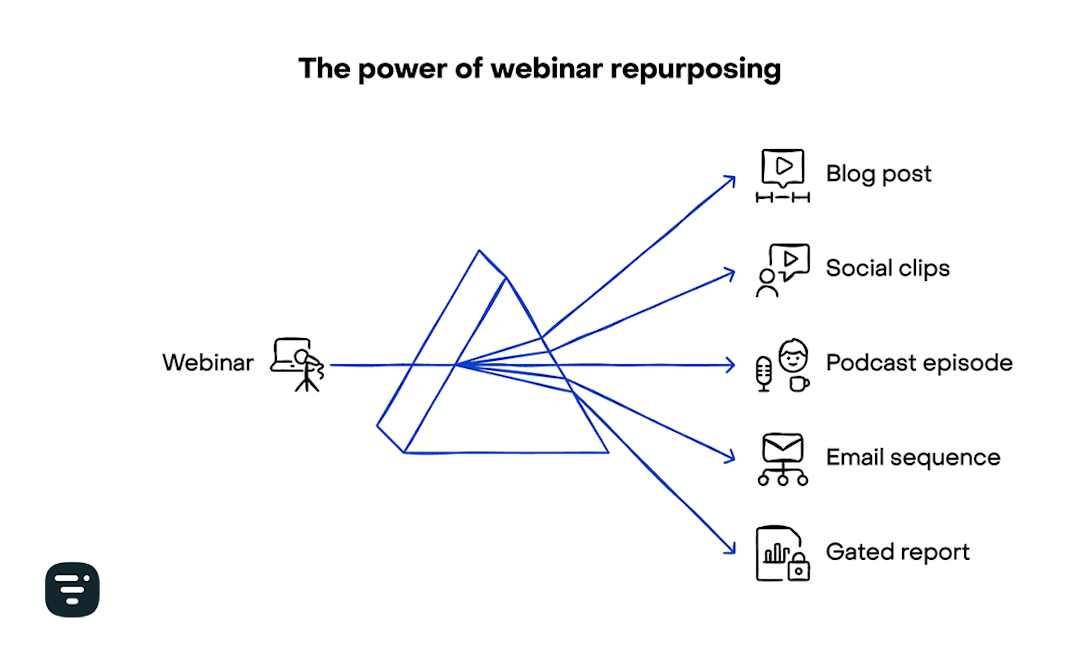
One 60-minute webinar can become a blog post, a dozen social clips, a podcast episode, an email sequence, and a gated report. All you need is the right process and tool. Repurposing a webinar with AI yields about 13x more content assets, saves roughly 6 hours per webinar (about 4x faster), and cuts video content creation cost by around 78% (close to €1,190 saved per webinar), according to Livestorm's 2026 benchmark report.
Start with a webinar recording, and pull the key moments. As Benoît Leggieri, Head of Growth at Livestorm, describes it, a single webinar can be repurposed into a multitude of content, from blog posts to quotes to social posts, with YouTube as a privileged discovery source.
Livestorm's AI content repurposing is built for exactly this workflow. AI Studio, which turns webinars into short social clips, is coming soon.
Why most teams still don't repurpose content
If repurposing is such a clear win, why is this B2B content marketing best practice so rare? The vast majority (85%) of teams don't systematically repurpose their webinar content. The number one blocker is lack of time (32.3%).
For ambitious teams, this is an opening. Those teams that build a repeatable repurposing habit can create a month of content from a single afternoon of work, while everyone else lets the recording gather dust.
B2B content marketing in the age of AI search
Search is fragmenting. Buyers now ask AI engines first. The content that surfaces is structured, well-sourced, and quotable. For B2B marketers, this is a new surface to win.
Write to be cited
AI Overviews appear on roughly nine out of 10 informational queries. But they rarely surface on transactional queries, per the Livestorm and Eskimoz analysis.
To earn AI citations, lead sections with a direct answer, and keep the structure clean and easy to scan. Add TL;DR summaries, and link primary sources.
As Lacoste explains, there's no single top keyword with large language models (LLMs). Reverse-engineer the query fan-out and answer the sub-questions, not just the head term.
Measure share of voice, not just traffic
Because so many journeys start with an AI engine and end on with Google search, the AI-to-Google handoff is nearly impossible to attribute. Treat impressions and citations as leading indicators of demand. Judge your content marketing efforts on whether your brand shows up in the answers, not only on last-click traffic.
B2B content marketing examples to learn from
The best B2B content programs aren't always the flashiest. They're the ones that pick a format, commit to it, and connect it to revenue.
When you study another B2B business's content, look past the polish and find the system. Look for repeatable assets, distribution habits, and the metric they optimize for.
One webinar, run monthly, can feed a blog series, a social clip library, and a nurture sequence at once. This creates the flywheel this whole guide is built around.
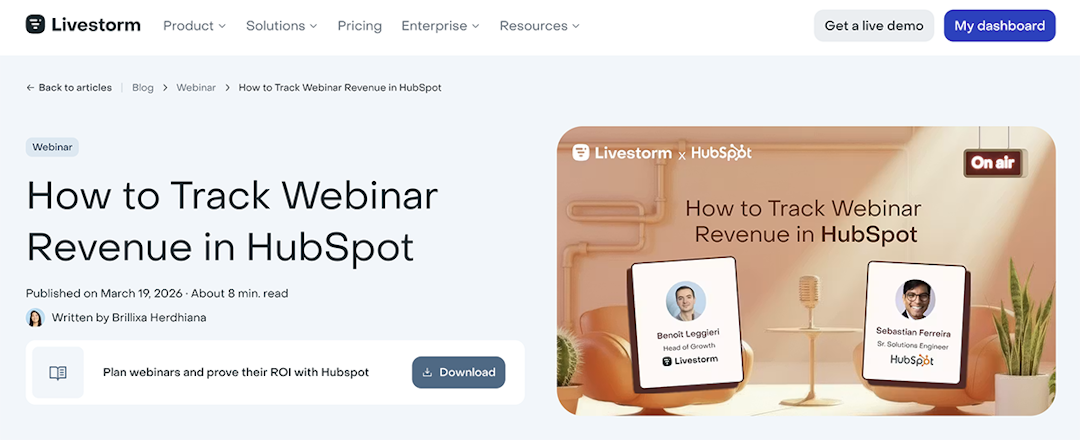
For example, Livestorm co-hosted a webinar with HubSpot, covering how to track webinar revenue. Our team posted the replay and social clips on YouTube.
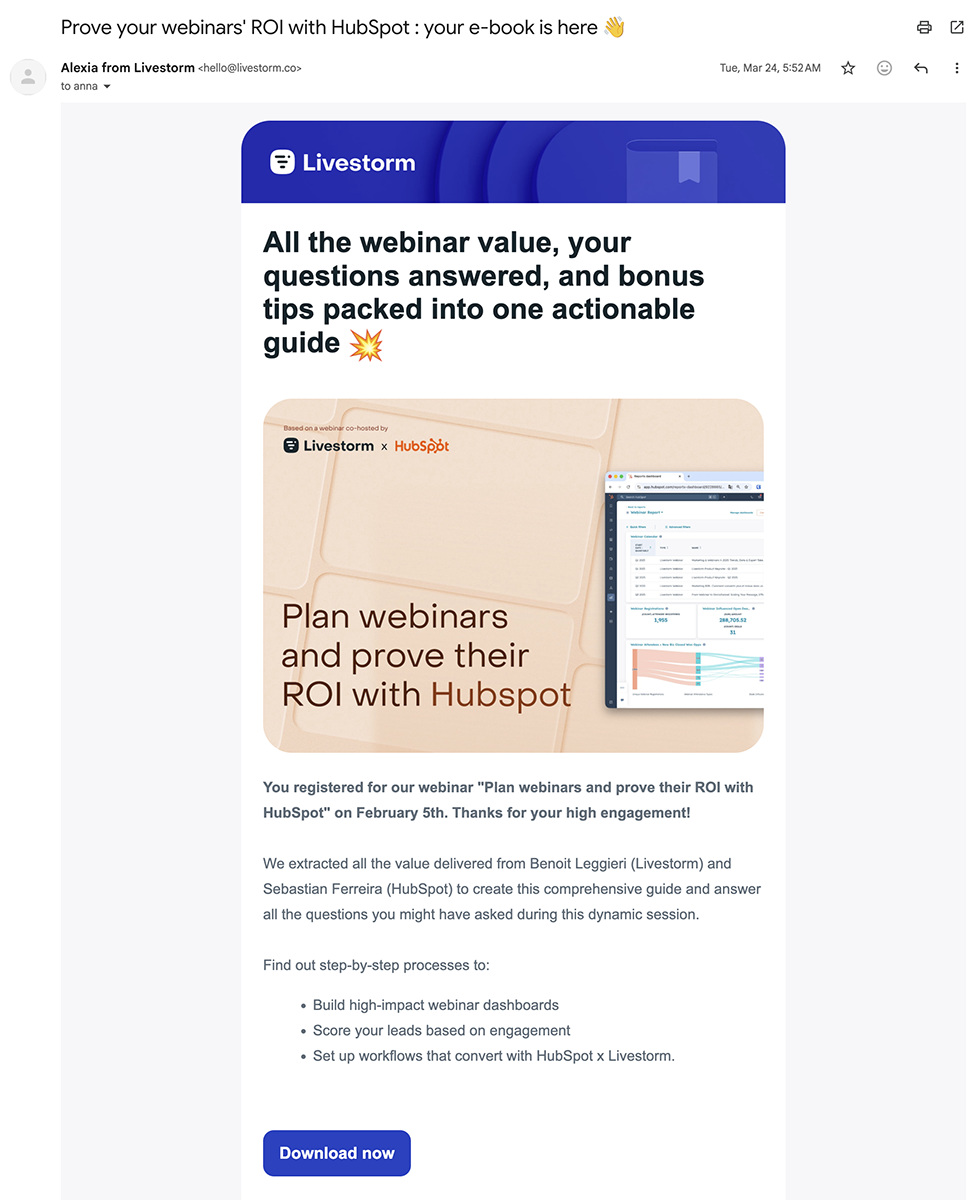
Then, we turned the transcript into a blog post. And we developed an ebook on the topic, which we distributed via email.
Get started with a webinar-powered content engine
You don't necessarily need a bigger team to produce more B2B content. Instead, you need one repeatable engine that starts with a webinar.
To manage the full workflow in one place, Livestorm is a webinar platform with AI Studio (coming soon). Start a free trial to run your first webinar.
Frequently asked questions
What is B2B content marketing?
How is B2B content marketing different from B2C?
B2B content speaks to several decision-makers at once. It supports a longer buying cycle with a higher deal value. In B2B, your content often has to help a champion sell your case internally. B2C content usually targets one person for a faster, more emotional purchase.
What are the main types of B2B content?
The core B2B formats are blog posts, case studies, white papers and original research, newsletters, podcasts, and video or webinars. The most effective content marketing programs connect these formats instead of running them separately, often anchoring the system on a webinar that seeds the rest.
How do I build a B2B content marketing strategy?
To build a successful B2B content marketing strategy, start with a goal tied to revenue. Then, research your audience and buying committee, and audit and map existing content to the funnel. Choose your channels and distribution, then measure and iterate.
How do you measure B2B content marketing ROI?
To measure ROI, track pipeline and revenue influence where you can, but expect a lot to be invisible. Only about 7% of webinar-influenced pipeline is actually tracked. Add leading indicators such as impressions, share of voice, and AI engine citations to see demand before the click.
Can you repurpose a webinar into other content?
Yes, repurposing webinars is the highest leverage move in B2B content. One webinar can become a blog post, social clips, a podcast, an email sequence, and a report. Using AI, teams can get about 13x more assets from a single session while saving roughly 6 hours of work.


Ebooks
The Content Repurposing Guide: turn 1 webinar into 10+ marketing assets
Turn a single webinar into 10+ marketing assets with the content repurposing method: SEO blogs, video clips, LinkedIn posts, newsletters. Free guide.

About the author
Brillixa Herdhiana - Senior Growth Manager
Brillixa joined Livestorm as Growth Manager in 2021. Her experience enables her to contribute to business growth through lead generation from ads and organic channels.
Related categories
Featured resource
Ebooks
The Content Repurposing Guide: turn 1 webinar into 10+ marketing assets
Turn a single webinar into 10+ marketing assets with the content repurposing method: SEO blogs, video clips, LinkedIn posts, newsletters. Free guide.
Newsletter