Webinars help B2B companies educate prospects, generate qualified leads, and build trust at scale. They support long sales cycles by delivering expert content that drives pipeline even after the live session ends.
Webinar
Why Webinars Are Critical for B2B in 2026
Published on February 20, 2026 • About 6 min. read
Written by Brillixa Herdhiana
The Pipeline Truth: 2026 Webinar Benchmark Report

Table of content
Share this article
Key Takeaways
Webinars have evolved from lead generation tools to critical revenue infrastructure, with 51% of B2B companies rating them as essential
Enterprise adoption outpaces small businesses, as 78.9% of large firms see webinars as operationally vital compared to 60.2% of small businesses
AI integration remains an opportunity, as 80% use AI generally but only 60% apply it to webinars, with significant room for advanced adoption
A major attribution gap persists, with 93% of webinar pipeline remaining unmeasured, impacting strategic resource allocation and optimization
More than half (51%) of B2B companies now rate webinars as critical to their strategy, making them key revenue drivers. But that shift from nice-to-have to can't-operate-without didn't happen by accident. It's the result of a structural change in how B2B organizations generate pipeline and close deals.
Livestorm's 2026 Webinar Benchmark Report analyzes 33,786 webinar sessions from 853 marketing professionals, breaking down the forces behind this transformation. You'll see what separates B2B companies building real revenue systems around webinars from those still treating them as one-off lead gen tactics — so you can launch a revenue-focused webinar strategy this year.
How have webinars evolved from tactic to strategy?
Webinars as a revenue channel
Our data reveals that sales teams now host the most webinars, with 95.5% of survey respondents putting sales in the lead. Marketing takes second place at 94%, while growth comes in third at 90.6%.
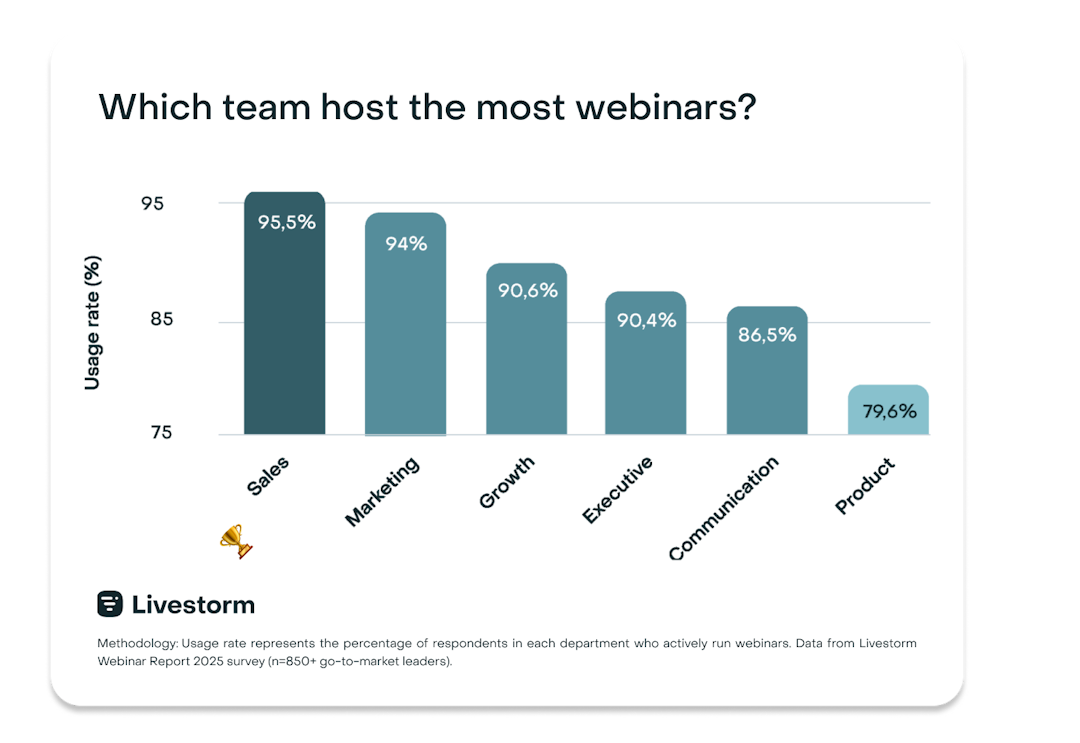
This represents a fundamental shift from webinars as marketing campaigns to webinars as revenue infrastructure. It tells a story that every B2B business leader needs to understand:
Marketing teams run webinars to generate leads
Sales teams run webinars because they've become essential for closing deals
Growth teams run webinars because thought leadership has become a prerequisite for pipeline generation
This evolution also reflects a broader business reality: Complex B2B sales now require multiple touchpoints with prospects who may never meet your team in person. Sales webinars became the scalable solution for delivering high-touch experiences at enterprise scale, enabling teams to compress conversion paths while maintaining personal connection.
Webinars as a scalable enterprise tool
Companies using webinars strategically tend to achieve higher reach and lower per-person costs compared to individual touchpoints. Much more than marginal improvements, they're substantial efficiency gains that fundamentally change what's possible for revenue teams.
Consider how this transforms enterprise operations. A global software company can deliver product demonstrations to hundreds of prospects simultaneously, standardizing messaging while maintaining interactive engagement. The same demonstration that would require dozens of individual sales calls becomes a scalable, systematic process.
Yet not every business views webinars the same way. Over three-quarters (78.9%) of large enterprises rate webinars as critical, while just 60.2% of small businesses consider them essential.
This isn't just about employee count or budget size. It's about scale creating different operational necessities.
When you need to educate hundreds of prospects simultaneously or standardize complex product demonstrations across global sales teams, webinars stop being a nice-to-have channel and become operational requirements.
The pattern is clear. Larger organizations don't just use webinars more frequently. Enterprise teams have architected their revenue operations around webinars.
Smaller companies experiment with volume, while enterprise companies perfect strategic, high-stakes programs that their business models depend on.
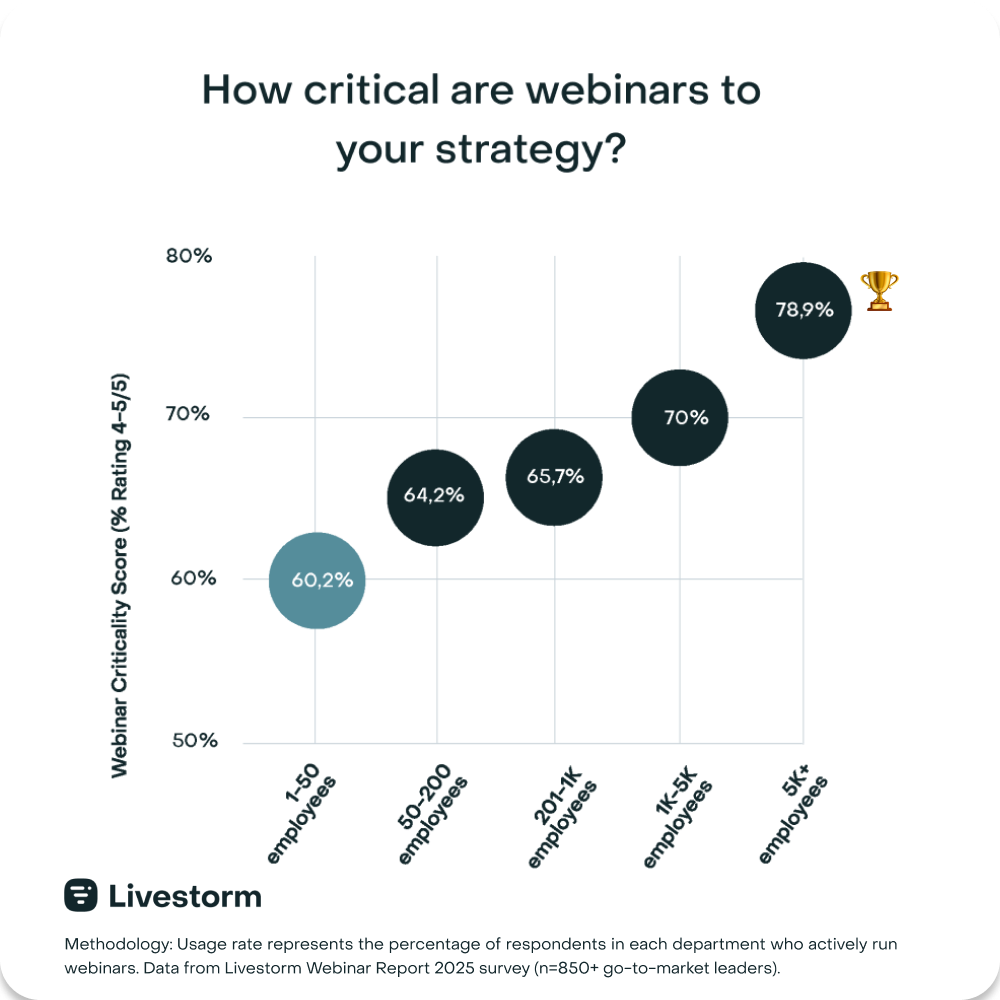
Understanding how to create a webinar strategy that scales with business growth becomes essential for competitive positioning.
3 strategic drivers for B2B webinars
1. Revenue acceleration at scale
A successful webinar strategy requires strategic layering, not one-off online events.
Our data shows that companies deploy webinars across the entire customer lifecycle: 69.4% are planning webinars for lead generation, 61.9% are planning product demonstrations, and 42.8% are planning customer training sessions.
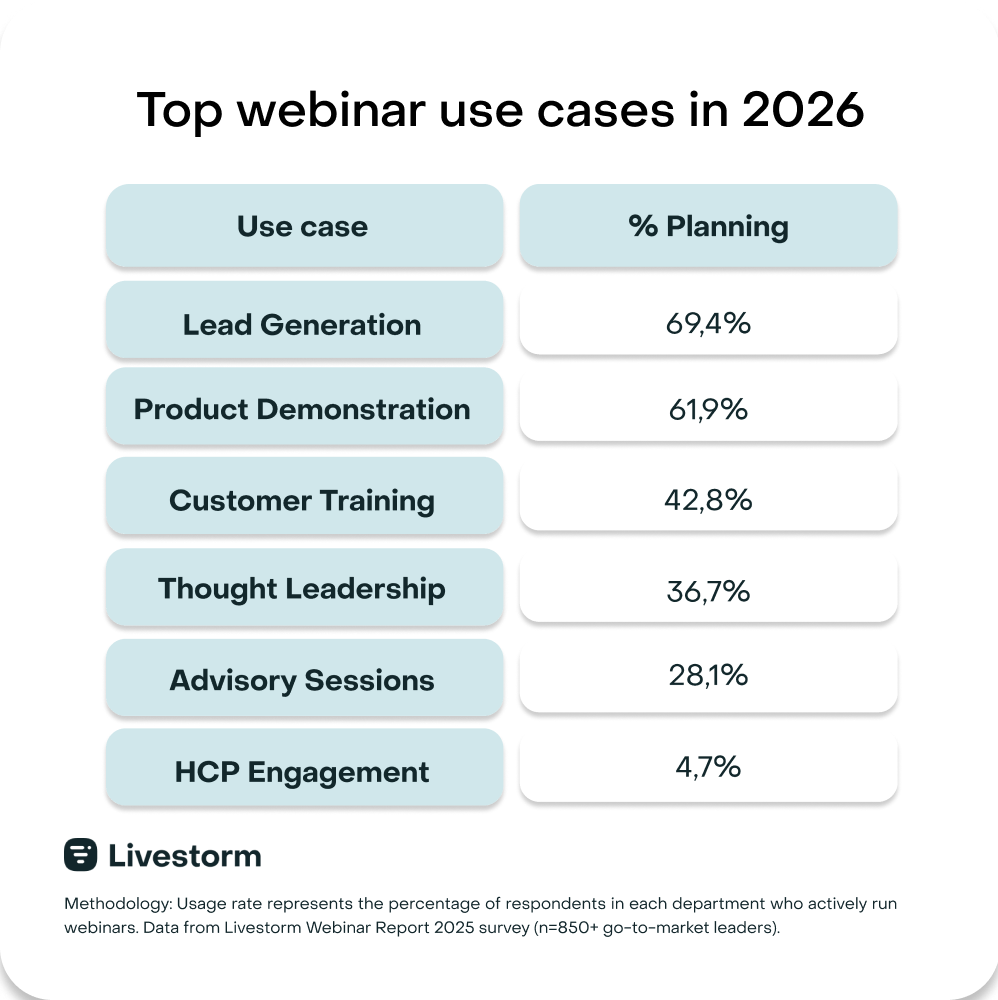
Over time, these use cases compound. Each touchpoint builds on previous interactions, systematically developing relationships that scale with business growth while maintaining personal connection at every stage.
The value that each touchpoint creates explains why 90.4% of survey respondents say executives personally run webinars.
Getting leadership involved isn't about isolated tactics. It’s about strategic communication that builds authority and trust with prospects before they enter formal sales processes.
Executives understand that hosting webinars has become essential for positioning their companies as thought leaders in increasingly competitive markets.
2. Audience education and competitive intelligence
Webinars provide strategic advantages that extend beyond direct lead generation alone. These events create platforms for educating audiences, communicating industry trends, and sharing thought leadership that positions companies as authorities before prospects begin active vendor evaluation.
This positioning matters because B2B buyers now complete significant research before engaging with sales teams.
Companies that systematically use webinars can influence this research phase, creating awareness and familiarity that impact later buying decisions. The strategic value lies not just in capturing demand but in creating it through education.
Forward-thinking companies also recognize webinars as competitive intelligence platforms. They provide direct access to prospect questions, concerns, and priorities that inform product development, messaging, and competitive positioning.
This data leads to insights that influence business development beyond immediate sales opportunities. Successful virtual selling strategies increasingly depend on this intelligence.
3. Operational efficiency for enterprise sales
Webinars solve operational challenges that often become more pressing as companies scale. They standardize product demonstrations across sales teams, scale subject matter expertise beyond individual contributors, and reduce per-prospect costs while maintaining high-touch engagement quality.
Rather than requiring sales representatives to individually demonstrate complex products to each prospect, companies can deliver standardized, high-quality demonstrations that maintain consistency while freeing sales teams to focus on building relationships and closing deals.
This efficiency is particularly important for companies with complex solutions or long sales cycles. By following webinar best practices, sales, marketing, and growth teams can design engaging, effective online events for each stage of the customer journey.
What B2B leaders need to know about webinars in 2026
AI integration opportunities
Our research reveals strategic opportunities hiding in plain sight. While 80% of companies use AI, only 60% apply AI specifically to webinars.
It’s no surprise that two-thirds (66.4%) of survey respondents consider themselves at the beginning or middle of the AI maturity curve. Few consider themselves advanced or expert, leaving plenty of space for early adopters to leverage AI in webinars.
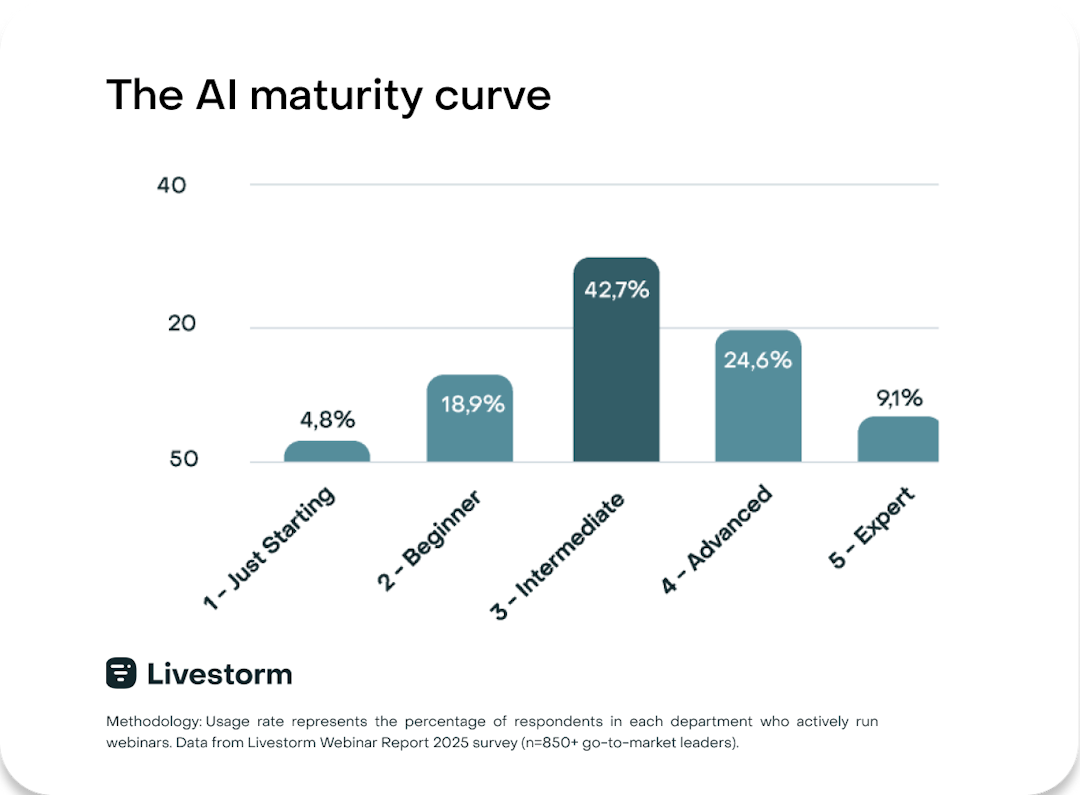
Companies that adopt AI in their webinar workflows can:
Reduce content creation time
Develop more personalized content
Improve audience engagement
Deploy more efficient follow-up processes for webinar attendees
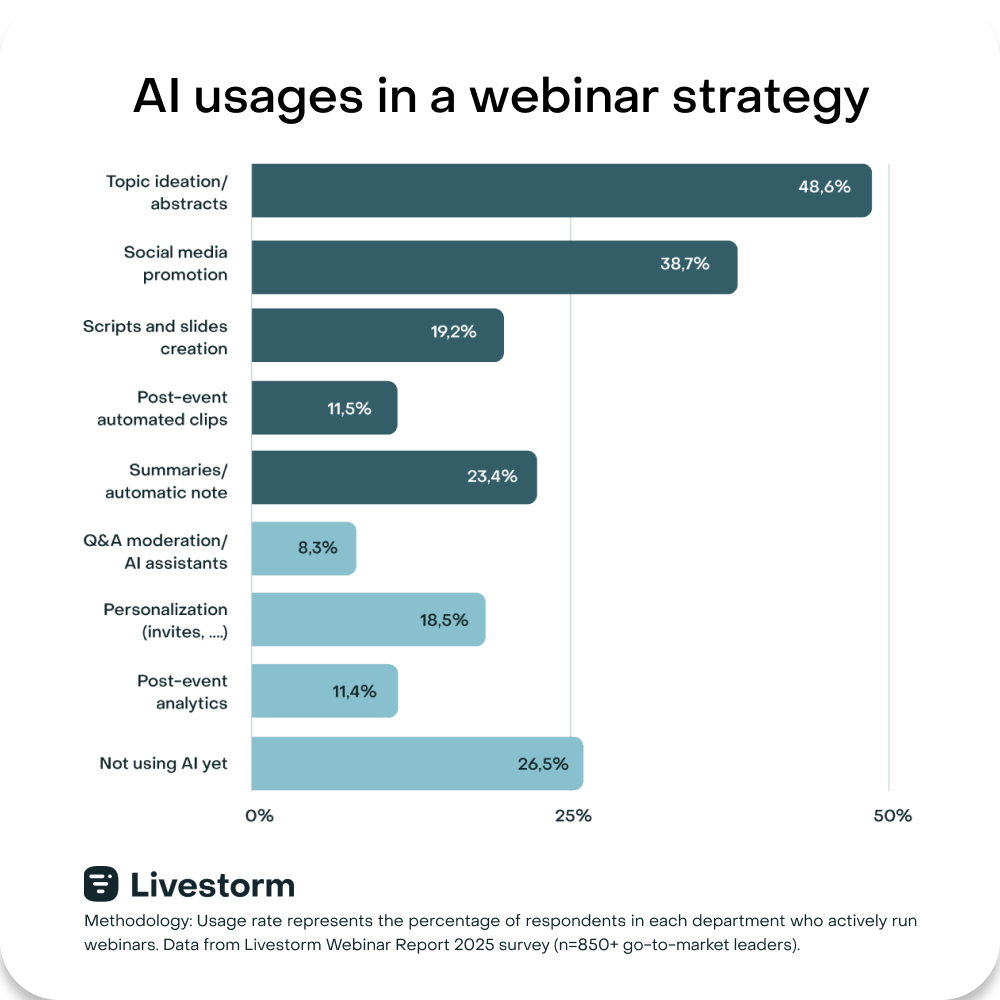
In fact, many are already experimenting with these use cases. Nearly half (48.6%) of our survey respondents use AI for webinar topic ideation, and 38.7% use this tech for social media promotion. Yet over a quarter (26.5%) report that they still aren’t using AI yet.
Attribution challenges
Perhaps the most significant finding in our research is that 93% of webinar pipeline is invisible. This invisible pipeline represents value that companies generate but don't measure, which creates blind spots in resource allocation and strategic planning.
This measurement challenge has cascading effects. Companies that can't accurately measure webinar impact struggle to understand outcomes and optimize their approach. Over time, this can lead to underinvestment in programs that generate significant unmeasured value.
This measurement gap becomes a competitive disadvantage as companies with better attribution systems pull ahead through more strategic resource allocation.
Solving webinar attribution requires more than direct conversion tracking. It involves understanding influence patterns, the impact of relationships, and long-term trust. These elements may not manifest as immediate conversions, but they significantly impact overall revenue performance.
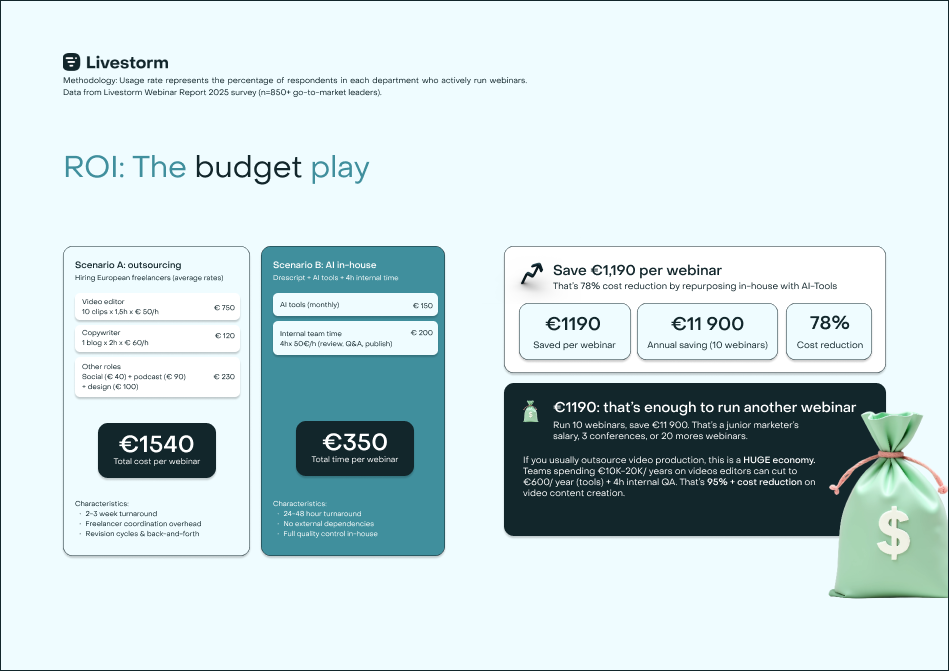
Webinar ROI measurement is essential for analyzing attribution and optimizing strategies.
Resource allocation decisions
The most important question for 2026 isn't whether to use webinars. It’s how to develop a webinar strategy that maximizes business impact. This involves fundamental decisions about team structure, technology investment, and integration with existing revenue operations.
Companies that treat webinars strategically invest in dedicated platforms, systematic processes, and integrations with CRM and marketing automation tools. They recognize that webinar success requires the same investment as other revenue infrastructure rather than ad-hoc campaign management.
The involves three key decisions:
Whether to build internal webinar capabilities or partner with specialized providers
How to integrate webinar programs with existing sales and marketing operations
What metrics to prioritize for strategic optimization rather than tactical improvement
With this framework in place, B2B teams can create a webinar funnel that drives pipeline.
Building your webinar strategy in 2026
The strategic evolution of webinars from marketing tactics to business infrastructure reflects broader changes in B2B operations, customer expectations, and competitive dynamics. Companies that recognize this evolution and adapt their approaches accordingly position themselves for a true advantage in increasingly competitive markets. The competitive advantage belongs to companies that integrate webinars into their revenue operations, apply emerging technologies for operational efficiency, and measure their impact accurately enough to optimize performance.
The transformation from tactical experimentation to strategic infrastructure is already underway. The opportunity lies in recognizing it and adapting accordingly.
Ready to transform your webinar approach from tactical to strategic? Explore our 2026 Webinar Benchmark Report and get the definitive guide to webinars that convert.
Frequently asked questions
Why are webinars critical for B2B marketing?
What makes webinars effective for B2B companies?
Webinars combine thought leadership with measurable engagement, allowing businesses to demonstrate expertise, clarify processes, and provide proof through customer stories. They scale education and reach decision-makers across different audience segments.
How can webinars support different B2B market types?
Webinars educate stakeholders and build trust across producers, resellers, governments, and institutions. You can tailor messaging with different registration pages and track engagement by audience segment.
What B2B activities work well with webinars?
Webinars complement product demos, account-based campaigns, events, and customer training by combining thought leadership with interactive engagement. They provide lead capture and measurable data that integrates with your CRM.
Are webinars better than email for B2B outreach?
Webinars and email work together best. Use segmented invitations and reminder sequences to drive webinar registration, then follow up with replays and next steps to keep leads engaged throughout the buying cycle.
How do webinars demonstrate the 7 P's of B2B marketing?
Webinars showcase People through expert presenters, clarify Process by demonstrating how you work, and provide Physical Evidence through customer stories and replays. They align positioning with value delivery in one branded experience.


Reports
The Pipeline Truth: 2026 Webinar Benchmark Report
Drive more registrations, boost attendance & multiply content 13x. Based on 7M+ registrations, 33K sessions + 850 go-to-market leader insights.

About the author
Brillixa Herdhiana - Senior Growth Manager
Brillixa joined Livestorm as Growth Manager in 2021. Her experience enables her to contribute to business growth through lead generation from ads and organic channels.
Related categories
Featured resource
Reports
The Pipeline Truth: 2026 Webinar Benchmark Report
Drive more registrations, boost attendance & multiply content 13x. Based on 7M+ registrations, 33K sessions + 850 go-to-market leader insights.
Newsletter