Common mistakes include unclear goals, weak promotion, too many slides, and leaving engagement to the end. Avoid them by setting a clear agenda, using a polished registration page, and planning interaction throughout with polls, chat, and Q&A.
Webinar
Webinar Best Practices 2026: Experts Takes
Published on March 6, 2026 • About 5 min. read
Written by Brillixa Herdhiana
The Pipeline Truth: 2026 Webinar Benchmark Report
Table of content
Share this article
Key Takeaways
Getting people to show up live requires a compelling reason to attend in real time, not just a good topic.
How you name and position your webinar shapes audience expectations before a single slide is shown.
Most attendees watch for an average of 26 minutes, which means your hook and structure matter more than your total runtime.
Nearly half of all registrations happen in the final week before the event, and that is a human behavior pattern, not a promotion failure.
Webinar repurposing remains largely untapped, and the primary blocker is not tools but the absence of a repeatable system.
What does the data actually say about how go-to-market teams run webinars in 2026, and what can marketers do differently to get better results?
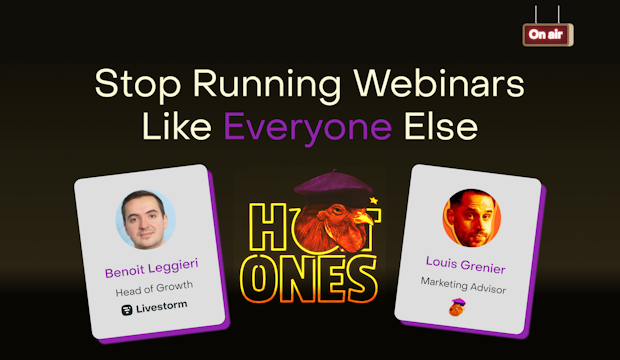
To unpack the findings of Livestorm's latest Webinar Benchmark Report, we sat down live with Louis Grenier, author of Stand The Fck Out* and one of the most candid voices in modern marketing.
Over the course of the session, we walked through five key insights from the report, gathered from a survey of more than 850 go-to-market leaders and an analysis of webinar data hosted on the Livestorm platform.
How to get people to actually show up to your webinar
Our data shows that 54% of respondents struggle to convert registrants into live attendees. This was also the top answer in our live audience poll, confirming it is a near-universal pain point.
Louis Grenier's take cuts through the noise: the problem is rarely the webinar itself. It is the absence of a genuine reason to show up live rather than catch the replay later.
"Give them a reason to be there live, something that only exists in the moment."
His recommendations are refreshingly practical. Hot seat coaching sessions, where attendees can only participate live, create an inherent incentive to show up.
Exclusivity and scarcity, meaning content or interactions that will not be available on demand, are equally effective.
Beyond format, he emphasises that marketers need to stay closely attuned to what their audience is obsessed with right now.
In 2026, that means AI adoption, cutting through market noise, and GTM efficiency.
Actionable tip:
Treat your webinar like a product. Ask what problem it solves, for whom, and why attending live is better than watching later. If you cannot answer that, neither can your audience.
For a deeper dive into attendance tactics, see our guide on how to boost webinar attendance rate.
Why your webinar title is killing your registrations
Should you call it a webinar, a workshop, a live training, or something else entirely? According to Louis, this is not a trivial question. It is a category decision with real consequences.
Every label carries a set of expectations.
"Webinar" signals a more passive, presentation-style experience.
"Workshop" implies hands-on exercises.
"Live training" suggests a structured curriculum.
Choosing the wrong label, or inventing a category your audience does not recognise, can quietly undermine registration rates before any promotion has started.
His advice: be specific, even if that makes the title longer. Specificity reduces perceived risk and helps the right people self-select in, while the wrong people self-select out. As a practical validation step, he points to a technique used by marketers on Reddit: running small paid ad tests on different title variations to measure click-through rates before committing to full production.
Actionable tip:
A/B test your webinar title and format name using a small ad budget before launch. Let audience behaviour, not internal preference, guide the final decision.
Need a step-by-step framework for planning your event? Check out our complete guide on how to host a webinar that converts.
Your audience isn't distracted — they have higher standards
The average webinar hosted on Livestorm last year ran 68 minutes, down 7.5% versus 2023, reflecting a broader trend toward shorter formats. Yet the average watch time across live attendees was just 26 minutes.
Louis's reaction was telling: rather than viewing this as a failure of audience attention, he sees it as confirmation of a higher standard.
"We don't have a lower attention span. We have higher standards."
The implication for webinar producers is clear: structure your content the way skilled TV writers and documentary filmmakers structure theirs.
Start with the highest-value moment, what Louis calls the "exploding grandma" principle, to earn the audience's continued attention.
Repeat key points, because a meaningful portion of attendees will be partially distracted.
And design each segment with the question: what specific thing will this person be able to do after watching this?
Actionable tip:
Map out your webinar like a TV episode. Open with your most compelling moment, repeat your core message across multiple segments, and design for an audience that may be partially distracted.
Stop panicking about late registrations
The Livestorm data shows that close to 50% of webinar registrations occur in the seven days before the live date.
This mirrors patterns Louis has observed consistently across his own work and through peers who run large-scale events.
Rather than treating this as a problem to solve, Louis encourages marketers to accept it as a feature of human behaviour.
People are overwhelmed, and late decisions are the norm, for concert tickets, travel bookings, and webinars alike.
The practical implication is twofold.
First, do not panic if your registration numbers look low ten days out.
Second, do not exhaust your creative energy trying to find new things to say across a four-week promotional window.
Instead, find one core message and express it in multiple formats and angles, what Louis calls "1,000 ways to stay the same."
Some effective angles for promotion include: the counter-intuitive approach (challenging a common assumption), the "x without y" framing (achieving a desirable outcome while avoiding a painful one), and the credibility-builder (addressing why the topic is easier than people assume).
Actionable tip:
Build a simple content matrix before your promotion period starts. List your core message on one axis and your channels or formats on the other. Fill each cell with a different angle, not a different topic.
The real reason you're not repurposing your webinars
When we asked our 800+ respondents how they repurpose webinar content, the most common formats were on-demand recordings, short video clips, emails, and blog posts.
But 32% cited lack of time as the primary barrier to repurposing, ranking higher than lack of tools, automation, or process ownership.
Louis pushes back gently on "lack of time" as the real answer.
In his view, the actual blocker is the absence of a system that can be followed without requiring fresh creative decisions each time.
When repurposing relies on someone remembering to do it and figuring out how on the fly, it almost never happens consistently.
His recommendation: create the repurposing system before you need it. Block focused time, separate from day-to-day execution, to document a step-by-step process that anyone can follow.
Identify which steps can be handled by AI, and which require a human decision. Once the system exists, follow it mechanically.
He also offers a clear warning on AI: use it to execute and amplify, not to think. The angles, the point of view, and the editorial instinct must come from a human. AI applied to weak source material will produce weak outputs at scale.
Actionable tip:
After your next webinar, block two hours specifically to build your repurposing SOP. Define each asset, assign ownership, and note where AI tools can accelerate production. Run the process once manually, refine it, then make it repeatable.
For a deep dive into building a repeatable repurposing workflow, read our guide on how webinars accelerate content velocity.
You can also explore Livestorm's AI content repurposing feature to automate part of the process.
Final Thought
The Livestorm Webinar Benchmark Report makes one thing clear: the webinar channel is not in decline, but the bar for what constitutes a valuable live experience is rising.
Marketers who treat webinars as a live product, invest in their positioning, and build repeatable systems around them will pull ahead of those still running one-off sessions without a strategic framework.
Frequently asked questions
What are common webinar mistakes to avoid?
What should you do 10 to 15 minutes before a webinar begins?
Run a quick tech and pacing check, then open the room for early arrivals. Confirm audio/video, screen sharing, and slide order, and post a welcome message in chat with instructions for Q&A.
How do you make your webinar stand out?
A webinar stands out when it's interactive, tightly structured, and designed for a specific audience problem. Build a clear hook on the registration page, then use polls, Q&A, and chat to keep people involved every few minutes.
What does a good webinar look like?
A good webinar is focused, easy to join, and keeps attention with regular interaction and clear takeaways. It typically includes a strong opening, a simple narrative, live Q&A, and a concise CTA.
What is webinar etiquette?
Webinar etiquette is the set of behaviors that keeps the session professional and smooth for everyone. For hosts, that means starting on time, moderating chat respectfully, and giving clear directions for questions; for attendees, it means staying on topic and using Q&A appropriately.
Are webinars outdated?
Webinars aren't outdated, but audiences expect more than a one-way slide deck. The most effective programs now feel like events with targeted topics, strong production basics, and built-in interaction.


Reports
The Pipeline Truth: 2026 Webinar Benchmark Report
Drive more registrations, boost attendance & multiply content 13x. Based on 7M+ registrations, 33K sessions + 850 go-to-market leader insights.

About the author
Brillixa Herdhiana - Senior Growth Manager
Brillixa joined Livestorm as Growth Manager in 2021. Her experience enables her to contribute to business growth through lead generation from ads and organic channels.
Related categories
Featured resource
Reports
The Pipeline Truth: 2026 Webinar Benchmark Report
Drive more registrations, boost attendance & multiply content 13x. Based on 7M+ registrations, 33K sessions + 850 go-to-market leader insights.
Newsletter