Content velocity is the speed at which you can consistently produce and publish content that matches your audience's needs. Webinars help by generating a content pillar you can repurpose into clips, posts, emails, and articles.
Content Marketing
How Webinars Accelerate Content Velocity
Published on February 20, 2026 • About 9 min. read
Written by Brillixa Herdhiana
The Content Repurposing Guide: turn 1 webinar into 10+ marketing assets

Table of content
Share this article
Key Takeaways
Webinar repurposing generates 13x more content assets while reducing creation time by 75% compared to traditional methods.
Operational issues, not strategy, are primary barriers to content repurposing, with 32% of teams lacking time and 17.8% lacking efficient tools or workflows.
AI usage in content creation is widespread, but a 20-point gap remains in applying AI specifically to webinars.
Webinar-derived content supports multiple business goals simultaneously, with 69.4% using it for lead gen, 61.9% for demos, and 42.8% for customer marketing.
A third (32%) of go-to-market leaders say they don't have time to repurpose content. Meanwhile, they're sitting on webinar recordings that could produce more than a dozen content assets each.
Livestorm's 2026 Webinar Benchmark Report, based on data from 850+ marketing professionals, shows how teams are using webinar repurposing to accelerate their content output without multiplying their workload.
This article breaks down the operational bottlenecks slowing down GTM teams, the math behind webinar content, and a four-phase system for building a repeatable repurposing workflow.
Why GTM teams can’t keep up with content demand
Limited content creation time
Most marketing teams already know repurposing works. In fact, our data shows that only 13.6% cite unclear ROI as a concern.
Instead, the real blocker is time. Our research shows 32.3% of marketing teams say time constraints are their biggest obstacle to repurposing content.
Another 17.8% point to inadequate tooling and manual workflows. This means half of all repurposing obstacles come down to operations, not strategy.
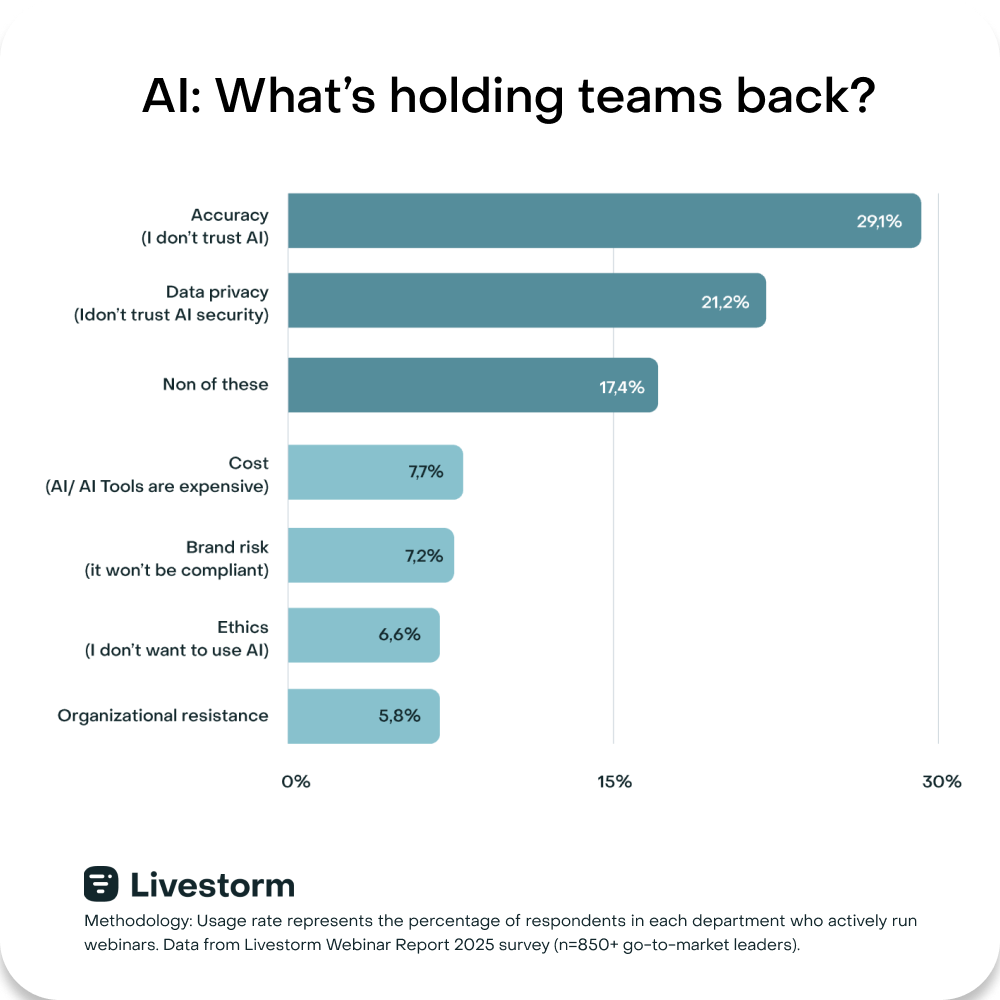
Every webinar, workshop, or presentation that you don’t repurpose is a missed chance to distribute across multiple channels. When those missed opportunities stack up month after month, the gap between your content output and your competitors' gets harder to close.
Manual workflow problems
Content teams typically work in a linear model: One piece of content gets dedicated resources from idea through distribution. This works fine until the demand for content increases. Once it does, you're often stuck choosing between producing more or producing better, when you should be able to do both.
When you rely on manual repurposing, the process tends to break down. For example, content from a great webinar sits untouched because no one has bandwidth to turn it into a blog post or social clips. Or a subject matter expert spends an hour sharing deep knowledge on camera, and that expertise turns into a video that gets used just once.
Many content teams split their time across creation, optimization, and distribution. If repurposing takes as much effort as creating something from scratch, teams often default to new content. This means existing content goes to waste.
Missed opportunities
Your team might already understand the value of repurposing content. For instance, you might see other companies multiplying their content output and know you should be doing the same. But knowing something has value and having the operational capacity to act on it are two very different things.
This gap often leads to inconsistent efforts. You might publish a blog post from one webinar here and a LinkedIn clip there. But you don’t end up with a process that produces reliable results.
When repurposing stays inconsistent, your team misses out on more than just volume. They lose chances to test messaging variations, tailor content to different audience segments, and build a real library of expertise around their core topics.
How webinars work as content velocity accelerators
Webinars are content multipliers
Our data shows that webinar repurposing generates 13x more assets compared to traditional single-format content creation. That's the difference between publishing one blog post and producing a full suite of content from the same source material.
A typical 68-minute webinar contains enough raw material for:
Blog posts
Social media clips
Email sequences
Infographics
Podcasts
Whitepapers
Sales enablement pieces
Each format reaches a different audience through a different channel. Yet the messaging stays consistent because it all comes from the same session.
Reach metrics back this up. A typical piece of content might reach around 1,000 people through its primary channel. Repurposed webinar content achieves 19.5x more reach (19,500 people) through multi-format distribution.
Plus, the cost per person reached drops dramatically. Every €1 you spend on promotion reaches 19.5x more people.
Webinars are time savers
AI marketing tools can cut content creation time from 8 hours to 2 hours per session. That's a 75% reduction in time without adding headcount.
Those six saved hours can add up fast. A team running weekly webinars can free up 24 hours a month, which is roughly the equivalent of a part-time content creator. That's time that can go toward audience research, performance analysis, or content optimization instead of manual repurposing.
There's also a workflow benefit. Instead of managing a handful of separate content creation projects, teams can manage one webinar that feeds multiple content streams. That means less context switching, less project management overhead, and more output.
Webinars do double (or triple) duty
Webinars excel as content velocity engines because they naturally serve multiple strategic objectives simultaneously. Our research shows that 69.4% of companies use webinars for lead generation, 61.9% for product demonstrations, and 42.8% for customer marketing.
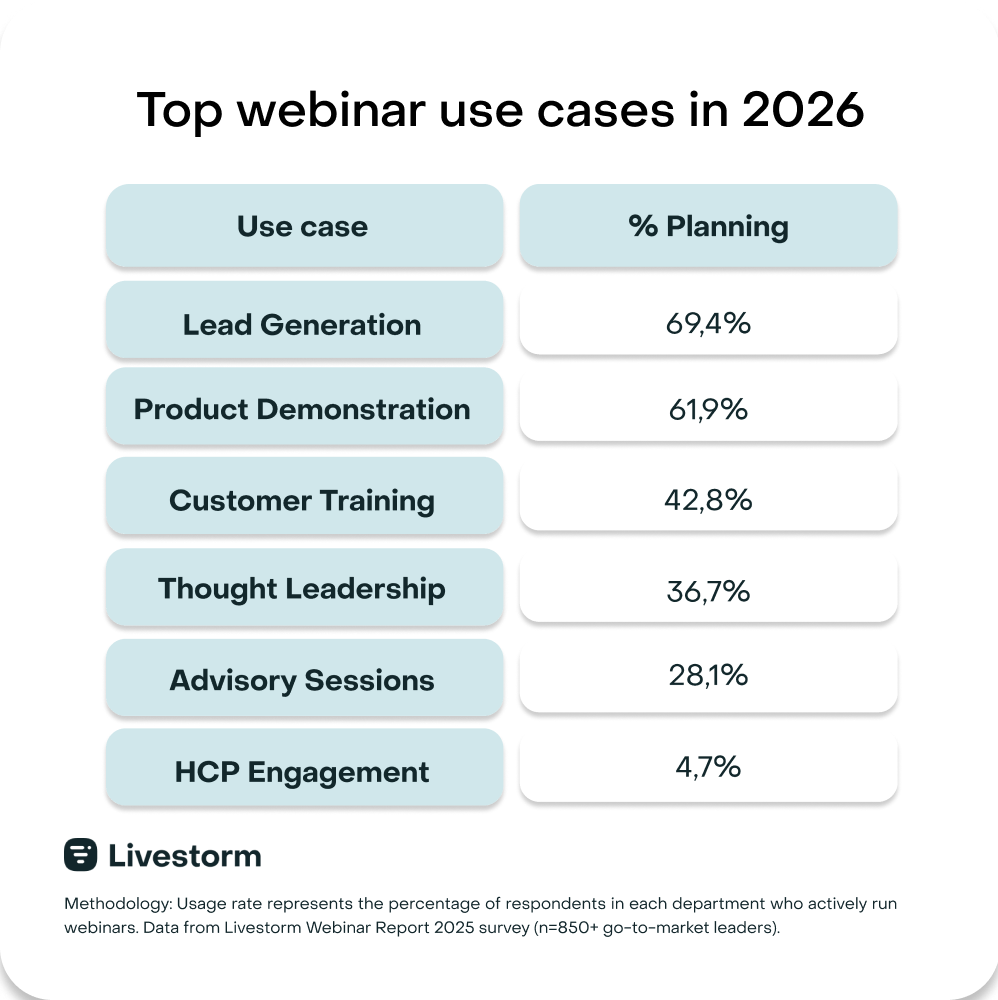
Webinars often serve multiple business goals. Our research shows that 69.4% of companies use webinars for lead generation, 61.9% for product demonstrations, and 42.8% for customer marketing. That means content repurposed from webinars can align with multiple objectives without extra effort.
This also helps with cross-team consistency. When marketing needs lead gen content and sales needs product demo materials, pulling from the same sales webinar keeps everyone on the same message. That means no more conflicting decks and one-pagers floating around different departments.
Your webinar marketing strategy can map to the full customer lifecycle:
Educational sessions can produce awareness-stage blog content.
Product-focused webinars can create consideration-stage materials.
Customer success sessions can generate retention and expansion content.
AI-Powered content velocity framework
The 20-point AI gap
While 80.2% of companies use AI tools in some capacity, only 59.8% apply AI specifically to webinar content creation. That 20-point gap means most teams haven't connected two tools they're already using: AI and webinars.
The teams that have made this connection are already automating the work that used to take hours. They're turning transcripts into written content, pulling highlights for social, and building email sequences. These workflows run in the background while the team focuses on planning and strategy instead of manual production work.
Using AI webinar platforms does more than just improve efficiency. It also helps teams respond faster to market shifts, test different content approaches, and maintain a steady output even during busy periods.
From experimental to systematic
Many GTM teams are still experimenting with AI rather than building repeatable processes around it. Our research shows that 42.7% of organizations operate at an intermediate AI maturity level, meaning they're using AI in one-off applications rather than embedding it into their workflows.
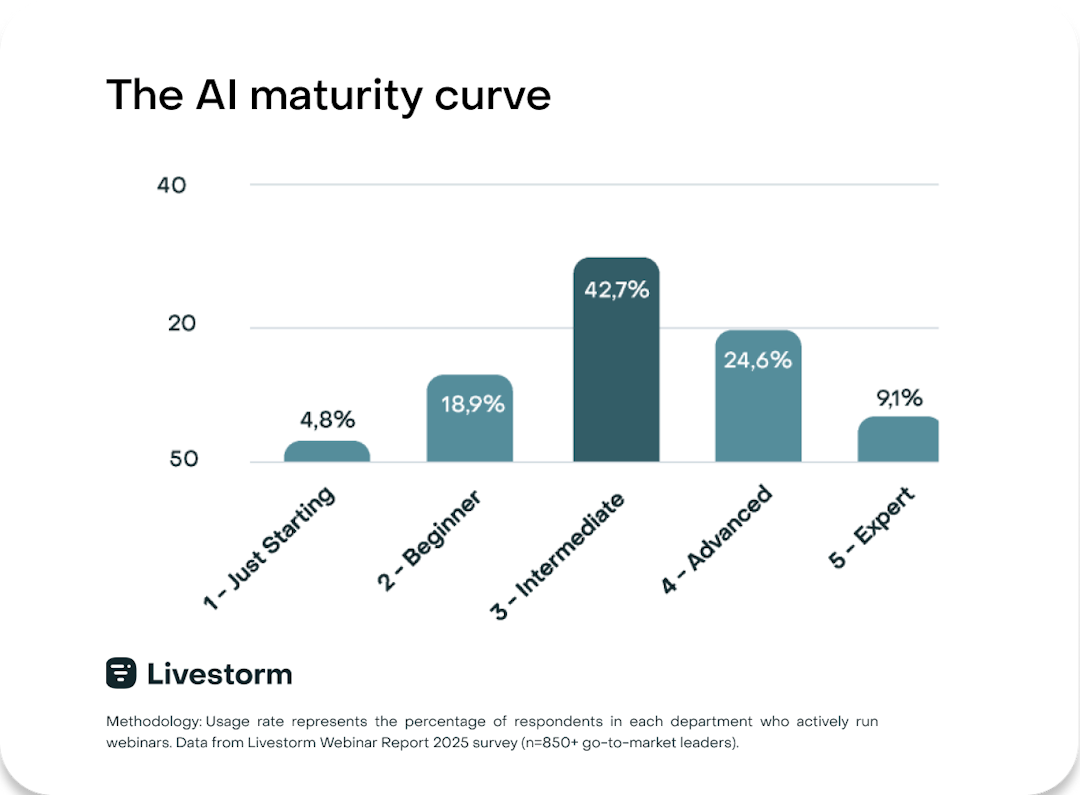
While having the right tech is certainly a factor, the real difference comes down to process.
Teams with consistent systems create templates, workflows, and quality standards so that every webinar produces a predictable set of content outputs. Teams without those systems use AI sporadically and get inconsistent results.
Making this work at scale means connecting AI-assisted repurposing to your existing content calendar, social media scheduler, email platform, and content management system (CMS). It also means developing style guides and approval processes so that AI-generated content stays on-brand and on-message.
The webinar-first content strategy
Some content teams are flipping their planning model. Instead of treating webinars as standalone events, they're using webinars as anchor points that feed the rest of the content calendar.
This changes how you pick topics. Rather than choosing based only on what will draw registrations, you also consider which topics will produce the most versatile range of repurposed content across formats and audiences.
It also means your team has to get started with content creation before the webinar even happens.
Teaser posts, speaker spotlights, and topic primers all build anticipation while generating assets on their own. After the session, you can keep the content flowing for weeks with a planned release schedule for blog posts, social clips, and email follow-ups.
Your 4-phase webinar content velocity system
Phase 1: Plan webinars with repurposing in mind
Start the repurposing process before hosting a webinar. When choosing a webinar topic, think about what you can do with the content afterward.
For example, some topics lend themselves to a single blog post. Others can generate social clips, email sequences, podcast episodes, and sales materials. Prioritize the latter.
Speaker selection is just as important. The best webinar guests are more than just great presenters. They deliver clear, quotable insights that hold up when pulled out of context and dropped into a blog post or LinkedIn carousel.
Structure your agenda with repurposing in mind. Break the session into distinct segments with their own takeaways so each one can stand alone as a content piece.
Don't overlook the technical side. Ideally, you want clean audio for podcast clips, solid video quality for social content, and slide design that works outside the webinar itself.
Phase 2: Optimize live sessions for content capture
A great live session gives you more than a recording. It gives you raw material. Think about how to create quotable moments, useful audience interactions, and natural breakpoints during the session itself.
Q&A segments, live polls, and open discussion all generate authentic content you can repurpose. For example, an audience question that sparks a good answer from the speaker can become a social post, a blog section, or an email hook.
Livestorm's built-in engagement tools make it easy to create these moments during the session and review them afterward. Polls and Q&A sessions are great for keeping your audience engaged and capturing content to repurpose.
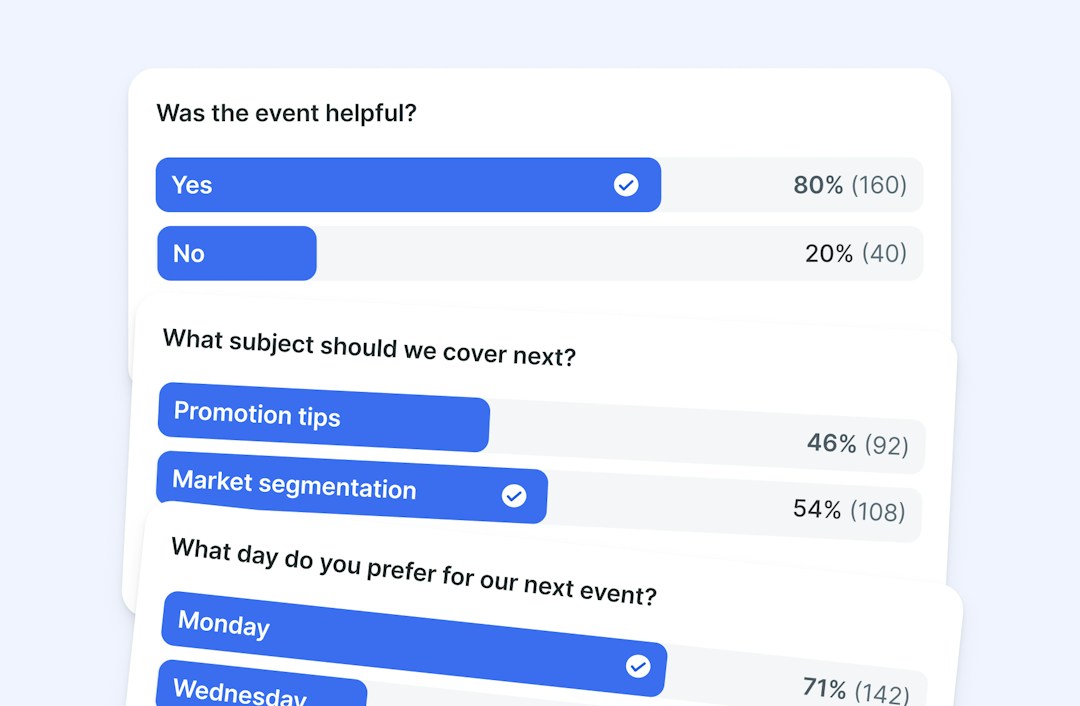
It helps to coach speakers ahead of time. Encourage them to land key points clearly, add enough context that the insight makes sense in written form, and repeat important ideas so they're easy to clip.
Assign someone on your team to flag standout moments, strong quotes, and audience reactions in real time. These notes make repurposing much faster than combing through a transcript after the fact.
Phase 3: Multiply content repurposing with AI
Once the session is recorded, you need a workflow that turns one webinar into multiple formats consistently. That means having a repeatable process for analyzing transcripts, segmenting content, and adapting formats.
Blog posts are much more than edited transcripts. A good AI-powered repurposing workflow pulls out the key insights, organizes the supporting points, and shapes them into a narrative that reads well on its own. AI can handle the initial draft, but a human should always review for quality and brand voice.
For social media, extract compelling quotes, pair them with visuals, and build a posting schedule across platforms. Templates for each platform and content type help you move fast without sacrificing consistency.
For email, identify the most educational moments from the webinar and arrange them into a logical nurturing sequence. Pre-built email frameworks make this easy to standardize.
Livestorm's AI content repurposing features handle much of this automatically. After a webinar, it generates a summary, blog post draft, social media posts, an email draft, and a full transcript, all in the language of your event. From there, you review, refine, and publish.
Phase 4: Distribute content and measure results
Repurposed content only works if it reaches the right people. Set up distribution workflows that schedule content across relevant channels, adapt it to platform-specific formats, and keep messaging consistent.
Track how much time you're saving through repurposing and how the repurposed content performs across formats. Both metrics will help you refine your team’s process over time.
Pay attention to how your content formats support each other. Do blog posts drive webinar registrations? Does social content boost email engagement? Understanding these connections helps you adjust your distribution strategy and get more out of each content cycle.
Advanced content velocity tactics
Run a webinar series instead of one-off events
A single webinar generates a lot of content. And a series compounds this effect. Each session builds on the last, which gives you a natural content arc for blog post series, email campaigns, and social threads that keep your audience engaged over weeks or months.
Webinar series also help with SEO. With interconnected content across multiple posts, you create internal linking opportunities and position your brand as a deep resource on a topic. Over time, that library can become a lead generation and education asset on its own.
Bring in guest experts
Inviting industry experts to your webinars does two things at once: It raises the credibility of the content and extends your distribution. When a guest shares the webinar and its repurposed assets with their own network, you reach a broader audience without having to produce additional content.
These collaborations can also turn into ongoing partnerships. A strong guest relationship often leads to co-marketing opportunities, repeat appearances, and a growing bench of contributors your team can tap for future sessions.
Feature customer stories
Customer stories make some of the strongest content because they combine real-world proof with practical takeaways. When a customer joins a webinar to share how they solved a problem, that session can become raw material for case studies, testimonials, and sales enablement decks.
If your customers span multiple industries, the same webinar can produce targeted content for different verticals. A single customer story, repurposed well, can support marketing, sales, and customer success teams at the same time.
Get started with webinar-powered content velocity
If you’re part of the 32% of marketing teams that struggle with content creation time, you don't need more resources. You need a better starting point.
Webinars give you just that: One recorded session that can produce 13x the content output while cutting creation time by 75%. Our four-phase framework gives you a simple structure to make this repeatable.
Ready to put this into practice? Explore our Pipeline Truth Benchmark Report for a deeper dive into the data, or get started with Livestorm’s AI-powered webinar tools today.
Frequently asked questions
What does content velocity mean?
What is high-velocity content?
High-velocity content is a steady, repeatable stream of content created quickly without sacrificing relevance or quality. A single webinar can fuel multiple assets, from highlight videos to FAQ sections and follow-up campaigns.
How do webinars accelerate content velocity?
Webinars generate rich material you can repurpose across channels, from video clips to blog posts and social media content. One live session can be recorded, repackaged, and distributed as on-demand content, multiplying your output.
What does creative velocity mean in marketing?
Creative velocity is the ability to produce, test, and refresh marketing ideas and assets quickly based on what's working. Webinars accelerate this by providing real audience questions, objections, and language you can turn into new creatives.
How can webinar data improve content velocity?
Webinar data including registrations, attendance, watch time, and engagement signals help you identify winning topics and optimize future sessions. This real-time feedback lets you prioritize content topics and improve promotion quickly.


Ebooks
The Content Repurposing Guide: turn 1 webinar into 10+ marketing assets
Turn a single webinar into 10+ marketing assets with the content repurposing method: SEO blogs, video clips, LinkedIn posts, newsletters. Free guide.

About the author
Brillixa Herdhiana - Senior Growth Manager
Brillixa joined Livestorm as Growth Manager in 2021. Her experience enables her to contribute to business growth through lead generation from ads and organic channels.
Related categories
Featured resource
Ebooks
The Content Repurposing Guide: turn 1 webinar into 10+ marketing assets
Turn a single webinar into 10+ marketing assets with the content repurposing method: SEO blogs, video clips, LinkedIn posts, newsletters. Free guide.
Newsletter