Start by tracking all webinar costs (platform fees, time, promotion), then measure your return metric like pipeline or qualified leads. Apply the formula: (Return minus Cost) divided by Cost, multiplied by 100 to get your ROI percentage.
Webinar
Webinar ROI Calculator: 5 Steps to Evaluate ROI (+Free Tool)
Published on March 26, 2026 • About 7 min. read
Written by Brillixa Herdhiana
Plan webinars and prove their ROI with Hubspot

Table of content
Share this article
Key Takeaways
Webinar ROI measurement provides concrete data to validate and optimize marketing strategies, turning webinars into quantifiable revenue drivers.
Livestorm's free ROI calculator automatically factors attendance, conversion rates, and all costs to deliver a clear ROI summary and cost-per-attendee metrics.
Best practices include targeting promotions, optimal scheduling, strategic lead identification, rapid follow-up, and content repurposing to increase ROI.
Your marketing team regularly runs webinars that get tons of signups. But without clear return on investment (ROI) metrics, it's tough to make a case for more budget, optimize for what's working, or scale your efforts.
I'll show you how to measure and analyze webinar ROI using a simple five-step formula. I'll also walk you through using Livestorm's webinar ROI calculator, so you can analyze performance and make data-backed decisions. Plus, I'll share tips from Pauline Mura, Senior Partnerships Marketing Manager, to help you improve webinar ROI.
What is webinar ROI?
Webinar ROI is a metric that measures how much value a webinar generates compared to how much you spend to create and host them.
A typical webinar ROI formula measures value in terms of revenue. So even if a webinar generates leads or other conversions instead of direct sales, you can still use the calculation to quantify how much the event contributes to your revenue goals.
Here's the standard formula to calculate your webinar ROI:
Webinar ROI = (Value of Investment - Cost of Investment) / Cost of Investment x 100%
Say your team spent $1,000 to organize and host a webinar. And the event directly led to $10,000 in sales. Your ROI would be 900% (($10,000 - $1,000) / $1,000 x 100%).
But what if your webinar focuses on brand awareness, booked demos, or other non-sales conversions? Using the standard formula isn't so straightforward when there's no immediate revenue. Below, I'll show you how Livestorm's ROI calculator makes the math easier.
Why tracking webinar ROI is so important
Monitoring webinar results helps you connect your marketing efforts to business outcomes. This way, you do much more than just host events — you track progress toward business goals.
Most teams already know ROI tracking is important. The problem is that almost nobody is doing it well.
As the Livestorm 2026 Webinar Benchmark Report reveals, 92% of practitioners can't demonstrate webinar ROI to their CFO. The data exists inside webinar platforms, but it rarely makes it into the systems where revenue decisions happen.
Measures webinar performance
When you calculate ROI for every webinar you host, you never have to guess which events were successful. Instead, you can easily identify your top-performing webinars along with the topics, formats, and promotional channels that worked best for your audience.
Then, you can put your ROI data to work. For example, say you learn that your audience prefers Q&A sessions over tutorials. When you plan future events, you can let the data guide decisions about the format.

Proves the value of your webinar strategy
Does leadership consider webinars a nice-to-have instead of an essential marketing initiative? With ROI data, you can show stakeholders why webinars matter — and quantify the value they create.
Part of the problem is attribution. An estimated 93% of webinar-sourced pipeline gets credited to other channels like direct traffic or organic search, because webinar engagement data never reaches the CRM. Without a clear link between the event and the deal, the pipeline becomes invisible to leadership.
For example, your data might show that overall, your team's webinars generate $5 for every $1 you invest. This data can help secure stakeholder buy-in for your webinar efforts.
If your CRM gives that pipeline to organic search, this short video shows what you can prove to Finance today (time, reach, and cost) and how to connect your webinar platform to your CRM so the data stops disappearing:
Justifies marketing budget allocation
Getting a bigger budget for an unproven marketing channel can be impossible — and for good reason. When other channels already have a track record of generating engagement or building pipeline, you need data to make a case for something new.
With a strong ROI analysis, you can present real numbers that compare webinar performance to other channels. Then, your team can make strategic decisions about where to invest and when to spend more on webinars.
How to calculate webinar ROI
I'll walk you through exactly what you need to calculate the ROI of your webinars using Livestorm's free tool. We designed it to give you a big-picture view of the value of your webinars.
1. Gather webinar attendance metrics
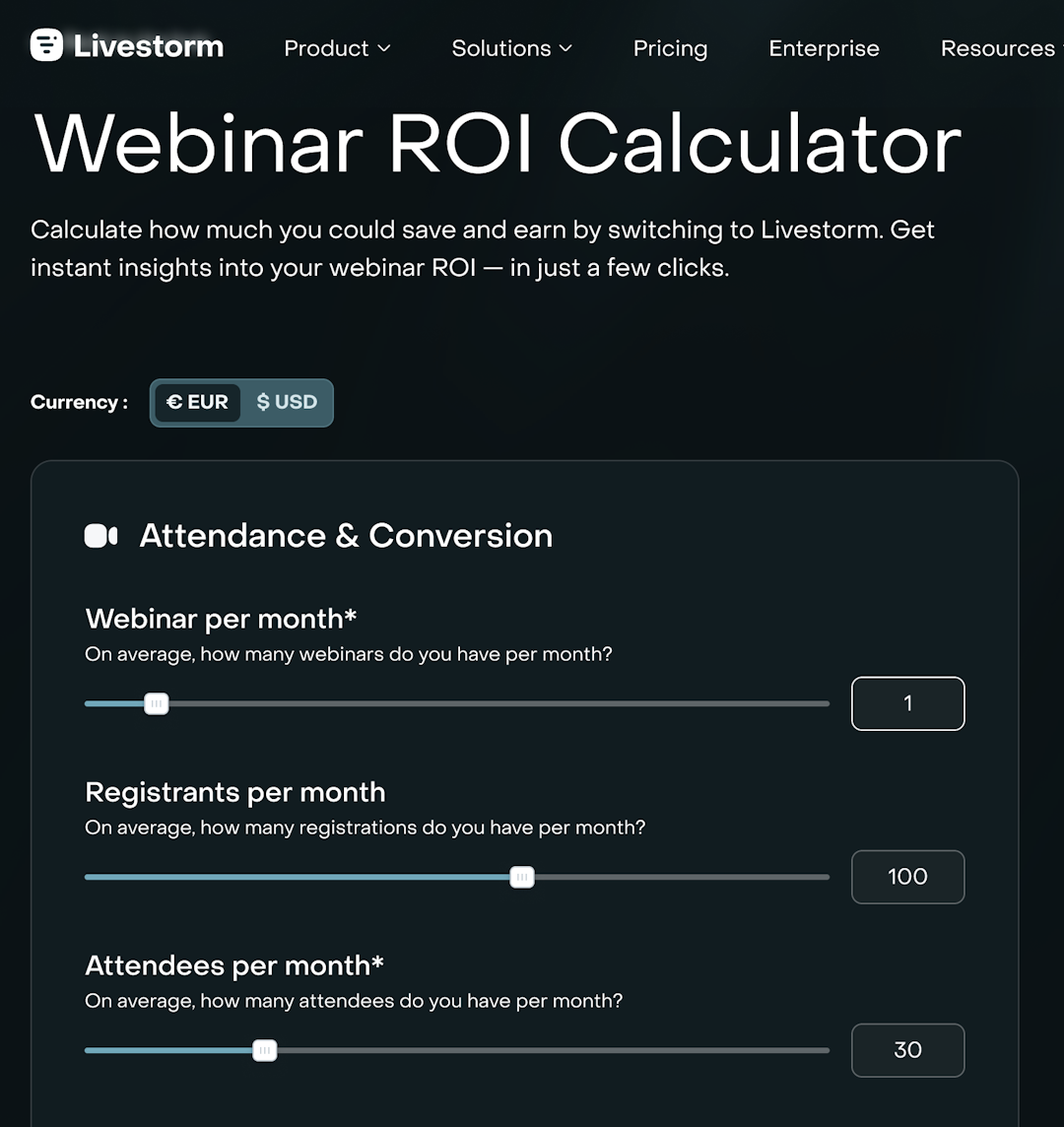
Start by collecting basic attendance and registration data. Input the number of webinars you typically host per month. Then, enter the number of registrants and attendees your webinars attract in a typical month.
2. Estimate lead generation
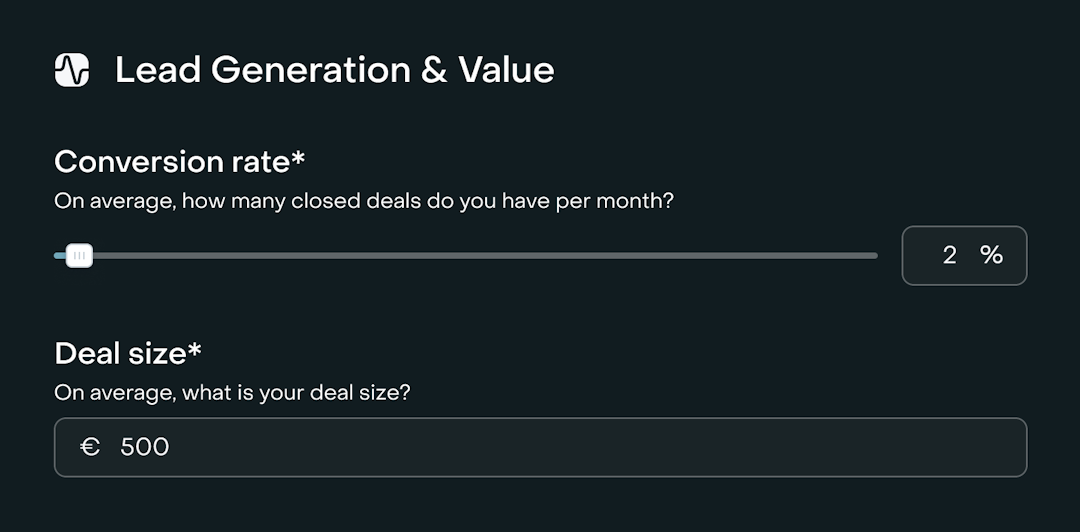
Next, gather conversion data from your webinars. Make note of your conversion rate (i.e., closed deals) and the average deal size.
3. Track webinar costs
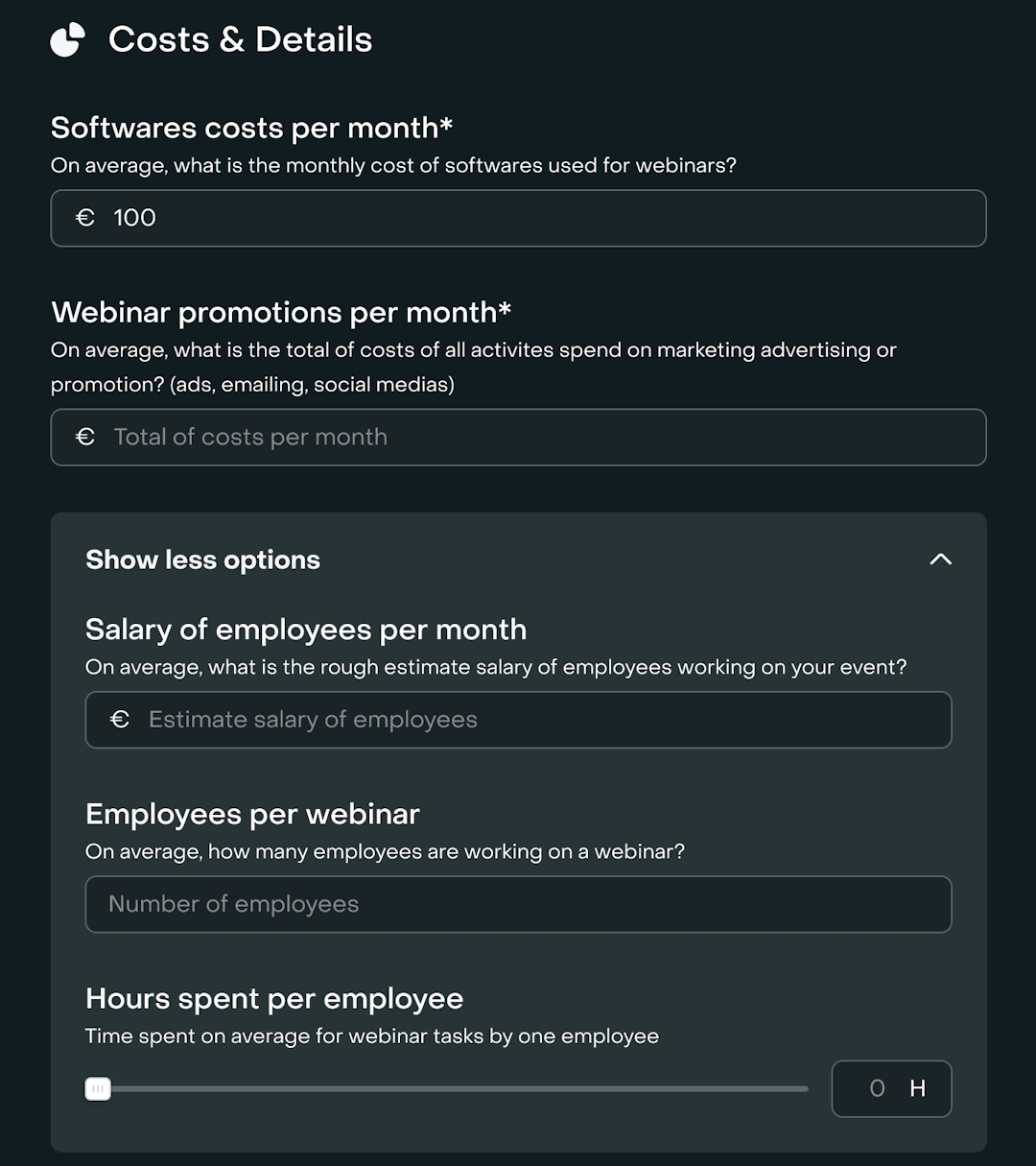
Then, add up all the costs. Start with software expenses, including webinar software, marketing automation tools, and any other marketing or sales platforms you use to manage virtual events.
Calculate the promotional costs next. This includes the amount you spend on advertising and on producing marketing content.
Don't forget to include labor costs in the total. Input employee salaries, number of employees per webinar, and hours spent per employee.
4. Get your ROI results
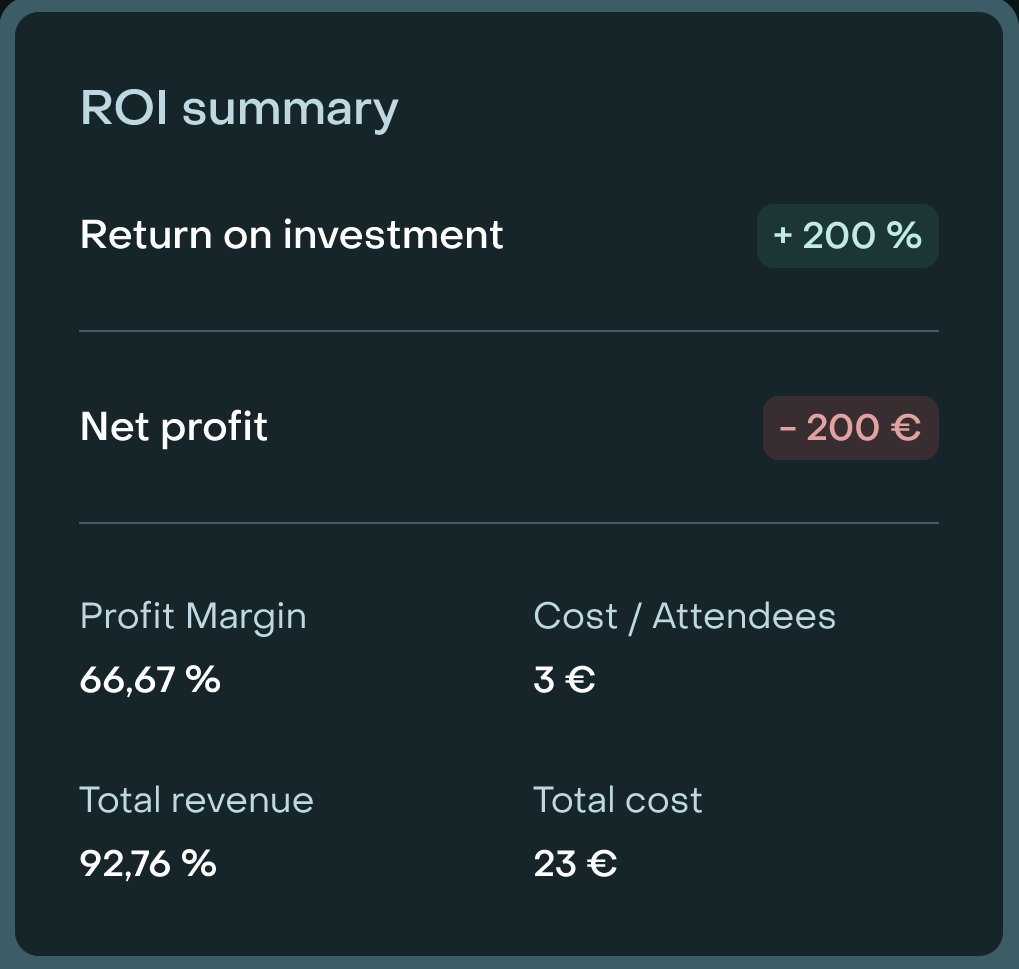
Once you've entered all your costs and outcomes into the calculator, you'll see your ROI summary.
In addition to your webinar ROI, our calculator shows your total cost per attendee. It also reveals your net profit and profit margin.
5. Analyze your webinar ROI
Review your webinar analytics to understand how successful this channel is for your business. Start by finding areas for improvement.
If your webinar ROI is below 100%, for example, take a closer look at each cost category to find areas to optimize. You might consider spending less on advertising if most attendees convert via organic campaigns. Or you might plan to switch to a webinar platform like Livestorm to lower software costs.
Compare ROI for webinars against the same metric for other channels. For example, the ROI from your email campaigns might be 500%, which sounds impressive. But if your webinar ROI is 750%, it might be worth allocating more of your marketing budget to webinars.
It's also helpful to compare your data to industry benchmarks. Here's a reference point: Across the 33,786 sessions we analyzed, the average webinar drew 175 registrants and 83 live attendees, for a 47.7% average show-up rate.
Review your ROI calculation every month to compare performance over time. Then, use the insights from your analysis to continue optimizing ROI.
Tips to improve webinar ROI
Cutting costs is just one way to improve webinar ROI. Try these tactics to get even more value from your efforts.
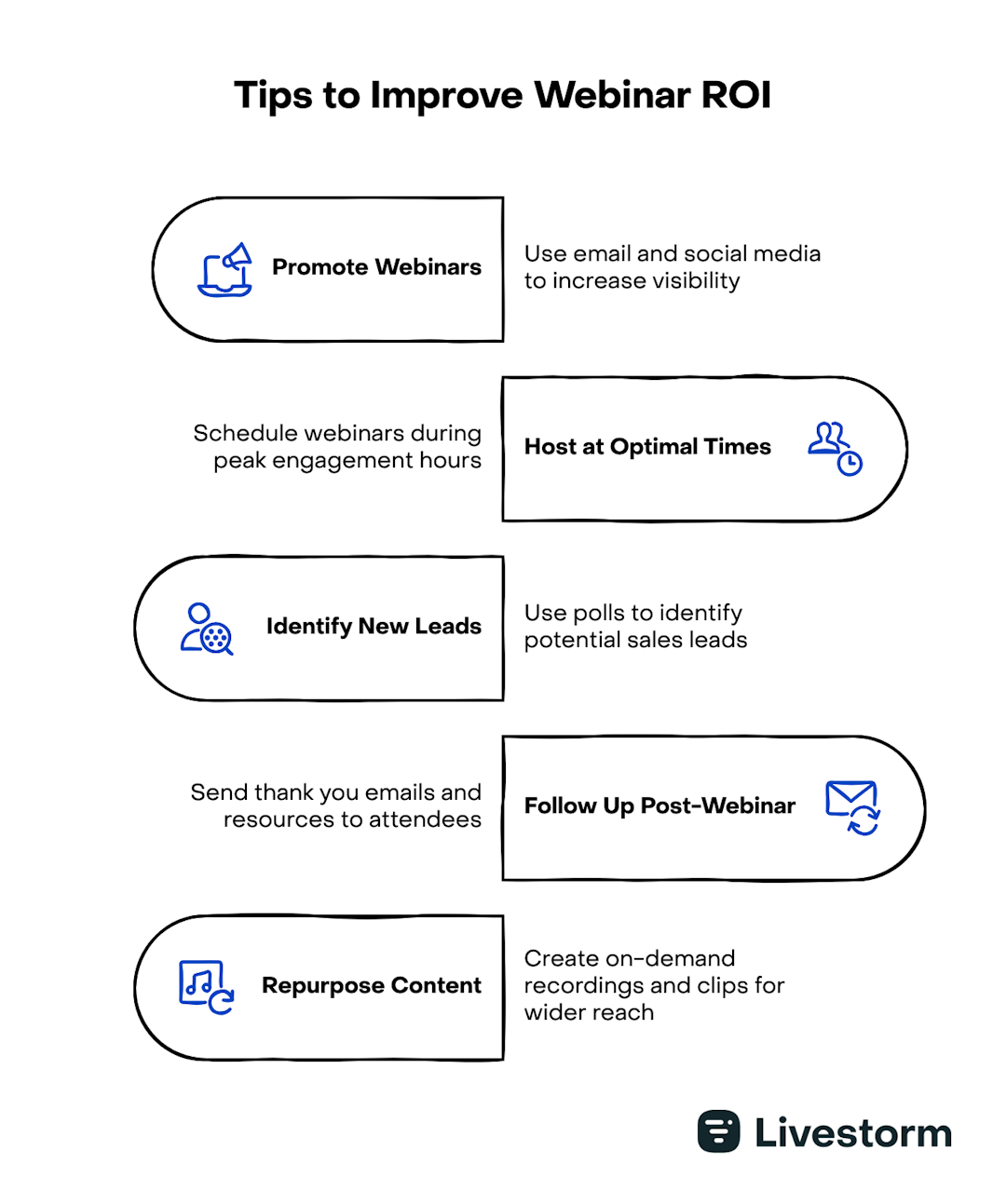
Promote webinars to your target audience
If your registrations are low, you could have a visibility problem. In other words, you need a better way to get the word out to your target audience. Two of the most effective webinar promotion channels include:
Email marketing: Segment your email list and send personalized invitations to your target audience. Send reminder emails before the event starts to increase attendance and engagement rates.
Social media marketing: Tease the webinar topic, speaker lineup, and bonus materials on social media. Encourage engagement on your social media posts to increase the reach of your content.
Continue promoting webinars up until the event starts. Our 2026 Webinar Benchmark Report shows that 49.6% of registrations land in the final seven days, and 15% come on the day of the event. Continued promotion through that final week can significantly impact your registration totals and, by extension, your ROI.
Host webinars at the optimal time
If you're attracting a lot of registrations but not many attendees, you could have a scheduling problem. The easiest way to fix it is to host webinars at the right time for your audience.
Our data shows that Tuesday has the highest show-up rate at 51.7%, while Wednesday pulls in the most attendees on average (94 per session). For best results, schedule events Monday through Wednesday at 11 a.m. or 2 p.m. ET.
For B2B audiences, it's typically best to plan webinars during the workday in your attendees' time zone. Test different days against your own data to see what resonates with your audience.
Identify leads to pass on to sales
Webinars only work as a lead generation tool if you use them to connect with new leads. A simple way to do this is to ask qualified leads to self-identify during the event.
Pauline Mura, Livestorm's Senior Partnership Marketing Manager, suggests leveraging polls during webinars to find hot leads. "Be strategic with poll questions. They could be as simple as 'Do you want to see a demo?' or 'What is your main challenge?'"
But keep in mind that polls are just the start. The average webinar also generates 20 audience questions and 85 chat messages. These are real-time buying signals: attendees asking about pricing, use cases, and implementation.
Once the event ends, share the data with your sales team so they can nurture leads, close deals, and improve webinar sales conversion rates. This helps you align marketing and sales so you work toward the same goals.
Be strategic with post-webinar follow-up
The end of a webinar isn't the end of your opportunity to communicate with attendees. When the event concludes, send a webinar follow-up email.
Pauline recommends that you don't wait long to keep the conversation flowing. "Follow up fast. Keep the momentum going by sending a follow-up email that includes a next step or resources. This will keep your audience engaged."
Repurpose webinar content across marketing channels
There's a lot of pressure to engage audiences and convert leads in real time. But the live event isn't your only chance to maximize ROI.
When you record your webinars, you gain countless opportunities to get more value from your hard work. Repurpose webinars by:
Creating an on-demand recording so registrants can watch at their convenience
Embedding webinar videos in relevant emails or blog posts
Uploading webinars to YouTube to attract more views
Sharing short-form clips on social media
Repurposing also shifts the cost equation in your favor. Outsourcing content creation from a single webinar costs roughly €1,540.
But with AI-assisted workflows, the same output runs about €350, a 78% reduction. Across 10 webinars a year, that's roughly €11,900 in savings. The repurposed content drops your cost per person reached from €5 to €0.26.
Livestorm's free webinar ROI calculator
The first step in maximizing your webinar ROI is understanding how well your current webinar marketing efforts are working. Livestorm's webinar ROI calculator helps you:
Understand ROI quantitatively, using real data from your events
Gauge which costs are eating into your profits
Compare webinar performance against other marketing channels
Build a business case for increased investment in webinars
Ready to gain deeper insights into your webinar program? Use Livestorm's free webinar ROI calculator to analyze your current performance and uncover opportunities to boost your results.
Frequently asked questions
How do I calculate webinar ROI step by step?
What costs should I include when calculating webinar ROI?
Include platform subscription fees, team time spent on planning and execution, speaker fees, promotional costs, and any content production expenses. Accurate cost tracking ensures your ROI calculation reflects the true investment.
How can I measure webinar returns beyond direct revenue?
You can measure returns through influenced pipeline value, number of qualified leads generated, engagement scores, or attributed revenue within a defined time window after the event. Choose metrics that align with your business goals.
Can I calculate webinar ROI for free?
Yes, by tracking your costs and returns manually and applying the basic ROI formula. Livestorm's analytics and reporting features help you capture attendance and engagement data to support free ROI calculations.
How does Livestorm help with ROI tracking?
Livestorm provides webinar analytics, engagement tracking, attendee data exports, and CRM integrations that make it easier to measure outcomes and calculate ROI. These features help you quantify real registration, attendance, and lead metrics instead of relying on estimates.
What attribution window should I use for webinar ROI?
Use a consistent time window after your webinar, such as 30, 60, or 90 days, to attribute pipeline or revenue. The right window depends on your sales cycle length and how you want to credit webinar influence.


Ebooks
Plan webinars and prove their ROI with Hubspot
From registration to closed deal, discover how to connect your webinar data to real revenue in HubSpot.

About the author
Brillixa Herdhiana - Senior Growth Manager
Brillixa joined Livestorm as Growth Manager in 2021. Her experience enables her to contribute to business growth through lead generation from ads and organic channels.
Related categories
Featured resource
Ebooks
Plan webinars and prove their ROI with Hubspot
From registration to closed deal, discover how to connect your webinar data to real revenue in HubSpot.
Newsletter