Best Time to Host a Webinar in 2026
Published on August 27, 2026 • About 4 min. read

Written by Brillixa Herdhiana
The Pipeline Truth: 2026 Webinar Benchmark Report

Table of content
Share this article
Key Takeaways
Tuesday leads webinar show-up rates at 51.7%, with Monday and Wednesday close behind. Thursday and Friday show the lowest engagement.
Webinar attendance peaks in January (50.4%), September (49.7%), and November (49.3%), reflecting seasonal work trends and priorities.
Optimal times are 11 a.m. and 2 p.m. ET, capturing both U.S. and European audiences while avoiding conflicts with lunch and end-of-day fatigue.
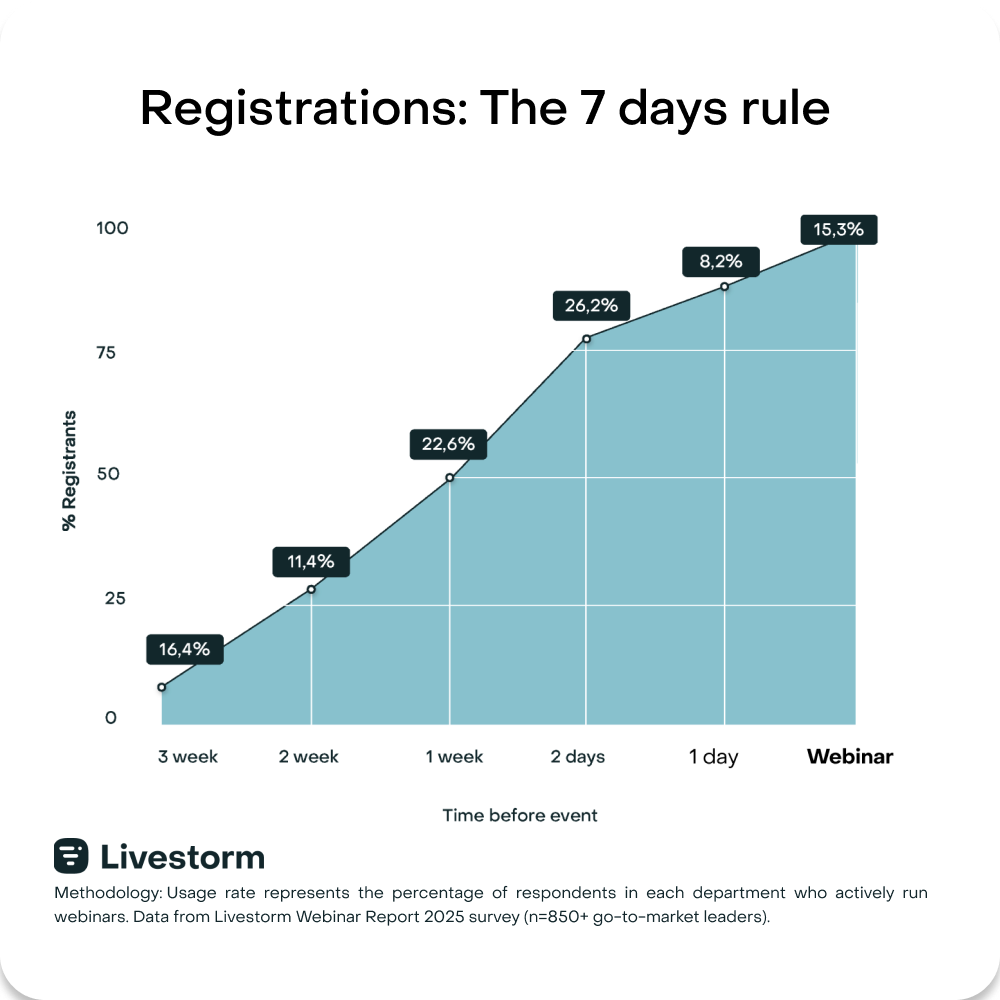
Nearly 50% of registrations occur during the week before the event; 15.3% register on the same day, supporting ongoing promotion until start time.
Show-up rates increased from 48.9% (2024) to 51.3% (2025), driven by improved platforms and user experience.
Most webinar scheduling advice recommends planning events at 10 a.m. on Wednesdays or Thursdays. But that guidance rarely cites current data.
We analyzed 4.35 million registrations and 33,786 sessions on Livestorm to find out what the numbers say today. In this post, we'll break down the best days, times, and months to host a webinar, plus the scheduling traps that drag down show-up rates. Several of the findings challenge common assumptions.
Choosing the tool as well as the time? See the best webinar platforms by use case.
What is the best time to host a webinar?
What day of the week is best for a webinar?
Monday, Tuesday, and Wednesday all have strong show-up rates. Tuesday leads slightly with a show-up rate of 51.7%, and Monday takes second place with a rate of 51.5%. But the differences between these three days are minimal.
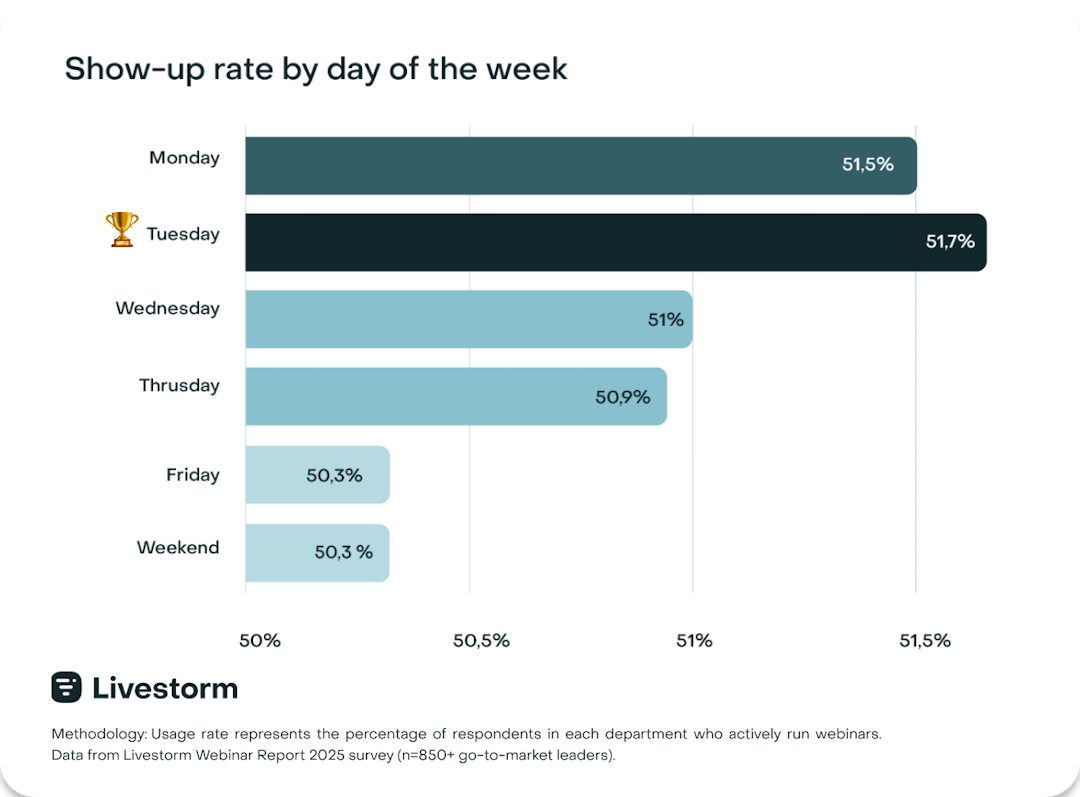
Professional behavior patterns support this range. Early in the week, audiences are in work mode and haven't yet hit the meeting overload that drags down Thursday and Friday attendance.
Best practice: Pick one consistent day from the optimal Monday–Wednesday window and stick with it. Consistency builds audience habits and improves attendance over time.
What are the worst days for webinars?
Show-up rates dip on Thursday and Friday compared to the Monday–Wednesday window. Thursday suffers from accumulated meeting fatigue, while Friday faces weekend-mindset distractions.
Saturday can work for healthcare audiences. But Sunday shows poor performance across all sectors.
What months are best for hosting webinars?
January, September, and November consistently deliver the strongest show-up rates. January leads at 50.4%, followed by September (49.7%) and November (49.3%).
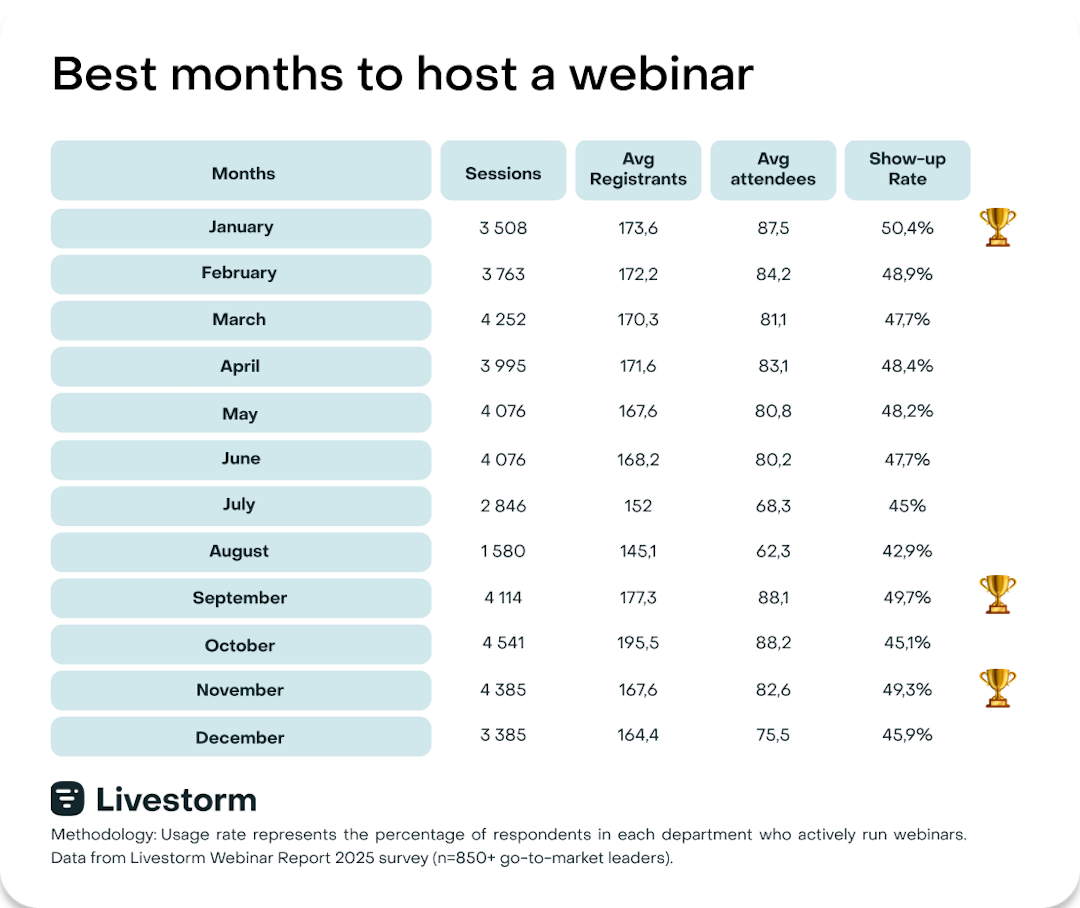
January captures goal-setting energy, while September benefits from back-to-business focus. November rides Q4 urgency before holiday schedules take over.
Strategic planning: Schedule major webinars, product launches, and strategic content during these three months for the highest attendance.
What months should you avoid hosting webinars?
With a show-up rate of just 42.9%, August is the worst month for webinars. Summer vacation patterns and reduced business focus create challenging conditions for webinar attendance.
Instead of hosting events in August, focus on automated webinar sequences. Then, prioritize content preparation for your September webinar plan.
What time of day should you host a webinar?
Morning webinars: 11 a.m. ET
11 a.m. ET captures high-energy engagement with fresh attention spans and pre-meeting clarity. It also doubles as late afternoon in Europe, making it a strong pick for international audiences.
Best for: Energetic presentations, product demonstrations, and interactive content that benefits from high alertness levels.
Afternoon webinar peak: 2 p.m. ET
2 p.m. ET avoids lunch conflicts while capturing post-meal focus. Most organizations schedule fewer internal meetings during this window, which reduces attendance conflicts.
Global timing: Works for audiences with US and European attendees, but it pushes European attendees into early evening.
Webinar times to avoid: Lunch, early morning, and late afternoon
Lunch hours (12-1 p.m.) compete with break time. Early morning (before 9 a.m.) conflicts with commutes. Late afternoon (after 4 p.m.) faces end-of-day fatigue and personal schedule transitions.
How does webinar timing vary by industry?
Healthcare webinar timing
Healthcare audiences have different preferences due to patient care schedules. Saturday morning sessions often work well, and evening options can accommodate shift patterns.
Financial services webinar timing
Avoid market hours and earnings seasons when professionals have competing priorities. Quarter-end periods show reduced availability due to reporting responsibilities.
Global webinar audience strategies
8 a.m. PT / 11 a.m. ET / 4 p.m. GMT provides reasonable coverage across North America and Europe. For wider global reach, consider multiple regional sessions or provide high-quality webinar recordings.
How have webinar attendance rates changed?
The webinar attendance boost
Show-up rates improved from 48.9% in 2024 to 51.3% in 2025, a 2.4-point gain. Technology improvements, better user experiences, and enhanced mobile accessibility all contribute to higher webinar attendance.
2026 implications: This upward trend suggests continued optimization opportunities, making data-backed timing decisions more critical for capturing improved engagement.
The impact of webinar platforms
Better webinar experiences often mean higher attendance. The best webinar platforms have user-friendly interfaces, engaging interaction tools, and seamless calendar integration. Webinar platforms with AI features help organizations fine-tune timing strategies, plan content, and repurpose webinars.
When do most people register for webinars?
Last-minute webinar registration reality
Almost half (49.6%) of registrations occur in the final week before a webinar, with 15.3% of registrations taking place on the day of the event. This pattern affects how marketing teams should schedule and promote webinars:
Early-week advantage: Weekend decision-making often leads to Monday and Tuesday registrations, benefiting webinars scheduled in the Monday–Wednesday window.
Promotion strategy: Maintain marketing activities through the webinar start time rather than cutting off efforts early. That 15.3% same-day registration segment is worth capturing.
How to build a webinar series schedule
Webinar series optimization
Consistent scheduling on the same day each week builds audience habits that can improve attendance and retention. Weekly or biweekly intervals maintain engagement without creating calendar fatigue.
Webinar competitive analysis
Maintaining an awareness of industry calendars helps avoid conflicts with major conferences and seasonal events. Understanding competitor patterns creates opportunities for strategic timing that captures greater market attention.
Your 2026 webinar scheduling checklist
Key recommendations for scheduling webinars:
Primary choice: Monday, Tuesday, or Wednesday at 11 a.m. or 2 p.m. ET
Peak months: January, September, and November for major initiatives
Months to avoid: August requires special consideration
Series strategy: Consistent same-day timing builds attendance habits
Global coverage: Leverage recordings for accessibility across time zones
Monitor timing-related performance against these benchmarks. Adjust for industry patterns as necessary.
Timing is one step of the process. For the rest, from picking a topic to following up, see our step-by-step guide on how to host a webinar.
Ready to optimize your webinar marketing strategy? Download The Pipeline Truth: 2026 Webinar Benchmark Report for a deep dive into the data, and sign up to get started with Livestorm today.


The Pipeline Truth: 2026 Webinar Benchmark Report
Drive more registrations, boost attendance & multiply content 13x. Based on 7M+ registrations, 33K sessions + 850 go-to-market leader insights.

About the author
Brillixa Herdhiana - Senior Growth Manager
Brillixa joined Livestorm as Growth Manager in 2021. Her experience enables her to contribute to business growth through lead generation from ads and organic channels.
Featured resource
The Pipeline Truth: 2026 Webinar Benchmark Report
Drive more registrations, boost attendance & multiply content 13x. Based on 7M+ registrations, 33K sessions + 850 go-to-market leader insights.