Small companies should focus on establishing authority and building relationships through educational content. Prioritize simple, repeatable formats and use webinars to nurture leads with personalized follow-up.
Webinar
Webinar Strategy by Company Size
Published on February 20, 2026 • About 2 min. read
Written by Brillixa Herdhiana
The Pipeline Truth: 2026 Webinar Benchmark Report

Table of content
Share this article
Key Takeaways
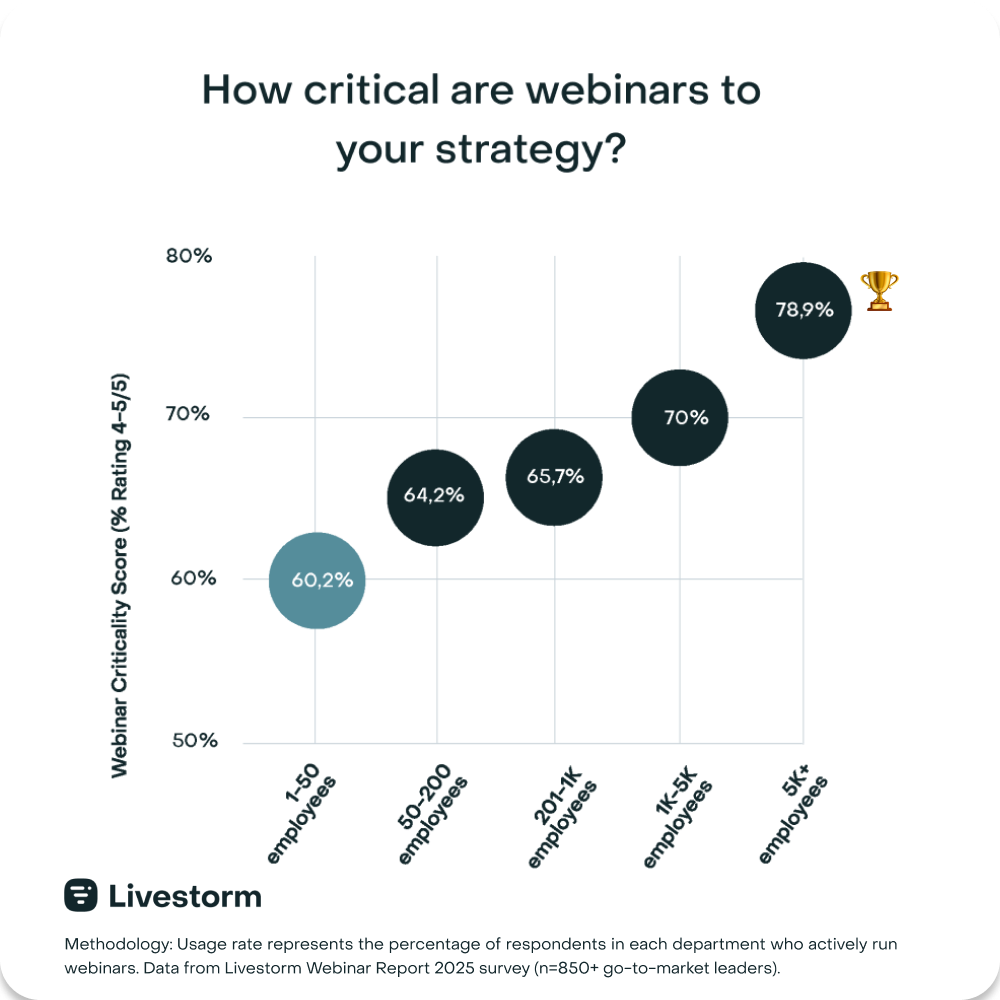
Webinars are rated as critical by 78.9% of enterprises versus 60.2% of SMBs, reflecting differing strategic priorities.
Enterprises benefit from systematized webinars for scalable lead generation, standardized demos, and large-scale customer education.
SMBs use webinars for personalized engagement, adaptable demos, and community-driven marketing with a focus on ease of use and direct metrics like revenue per event.
AI adoption for webinars stands at 80%, but only 60% report webinar-specific use cases, with most teams at early or intermediate maturity levels.
Webinars aren't a one-size-fits-all tactic. Our Pipeline Truth survey of 853 marketing professionals reveals that 78.9% of enterprises rate webinars as critical, compared to 60.2% of SMBs. This 18-point gap reflects fundamentally different operational needs.
Here's how to build a webinar strategy that works for your company size.
| Company size | Criticality score |
|---|---|
| 1–50 employees | 60.2% |
| 51–200 employees | 64.2% |
| 201–1,000 employees | 65.7% |
| 1,001–5,000 employees | 70% |
| 5,001+ employees | 78.9% |
The trend is clear: As companies grow, webinars shift from a tactical channel to operational infrastructure. The larger the company, the more critical webinars become to its marketing strategy, suggesting that large enterprises benefit the most from systematizing their webinar programs.
What does an enterprise webinar strategy look like?
Enterprises depend on webinars to solve problems at scale:
Scalable lead generation: Filling pipeline across multiple segments with qualified leads through consistent, repeatable programming
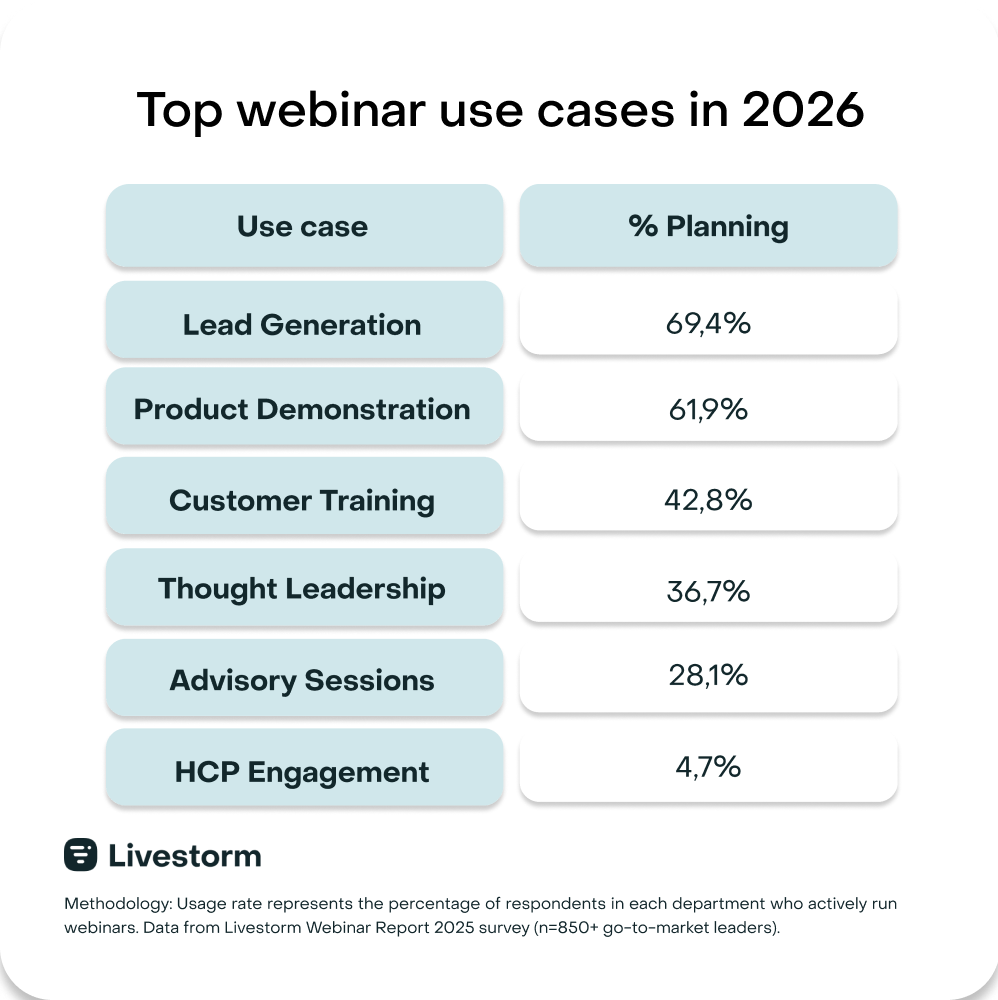
Standardized product demos: Ensuring consistent messaging across global sales teams — critical when 61.9% of companies use webinars for demos
Customer education at scale: Training thousands of customers at minimal cost through on-demand content libraries
What enterprise webinar operations require
With 95.5% of survey respondents reporting that sales teams run webinars and 90.6% indicating that growth teams handle webinars, it’s clear that enterprise programs demand cross-departmental coordination.
Enterprise programs benefit from integrated CRM systems and robust webinar platforms with enterprise-grade security, scalability, and API access. These teams should measure metrics like pipeline contribution, cost per qualified lead, and multi-touch attribution across 3–12 month sales cycles.
How should small businesses approach webinar marketing?
SMBs also see strong strategic value from webinars, with advantages that enterprises can't replicate:
Flexible lead generation: Prioritizing quality over volume, with personal engagement and follow-ups
Customizable demos: Adapting presentations in real time based on prospect questions, without scripts or approval workflows
Community-driven customer marketing: Building intimate experiences and direct relationships that drive loyalty
What SMB webinar operations look like
Small teams wear multiple hats. The right approach is a cost-effective, easy-to-use webinar platform that delivers core functionality without the complexity and that scales as you grow.
SMB teams should monitor metrics like engagement quality, direct opportunities, customer satisfaction, and revenue per event.
How are companies using AI for webinars in 2026?
Our data shows that 80% of respondents have adopted AI, but only 60% have webinar-specific AI use cases. In addition, two-thirds (66.4%) are at the beginning or middle of the AI maturity curve, with few at the advanced or expert level.
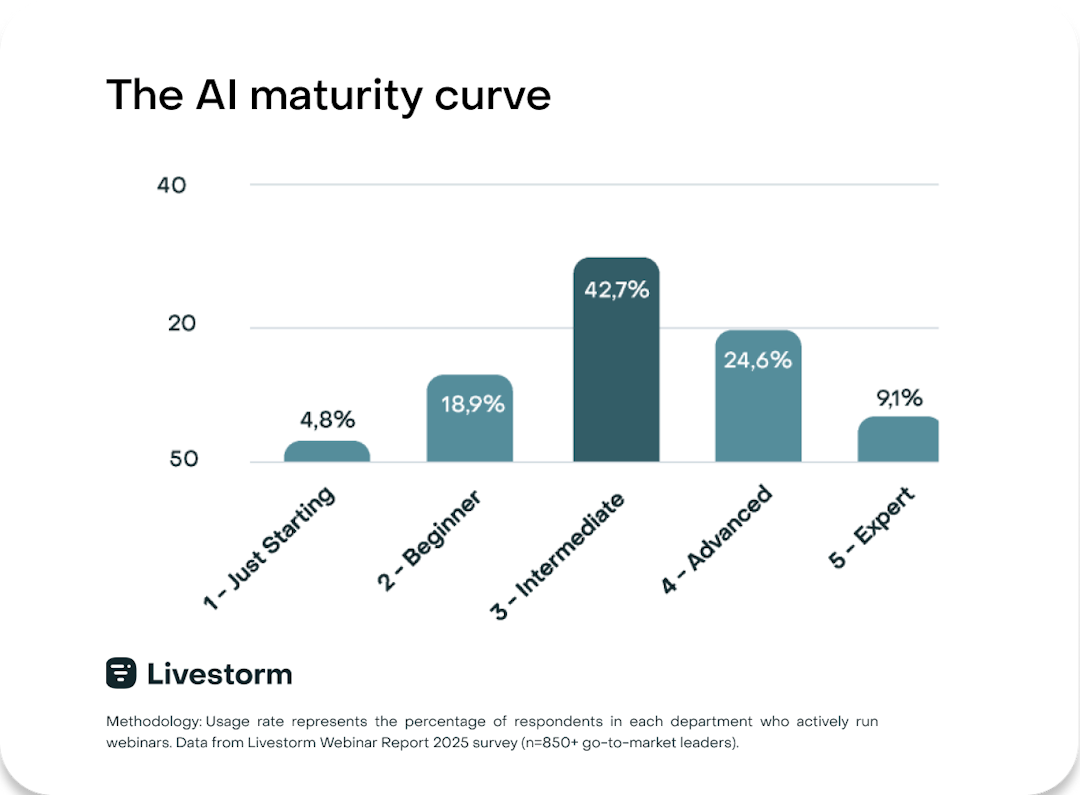
Enterprise and small business teams alike can leverage this gap:.
Enterprises should deploy AI for automated content repurposing, predictive attendance modeling, and lead scoring at scale
SMBs should target high-impact automation like email copy, social content, transcription, and follow-up sequences
Explore AI-powered webinar platforms to help your team close this gap.
When SMBs should shift to enterprise strategy
Small businesses should watch for these transition signals:
Webinar demand consistently exceeds team capacity
Quality varies across presenters or regions
Manual follow-up can't keep pace with lead volume
Webinar activity doesn’t easily connect to revenue
Systematize your strategy before operational pressure catches up with your team. Build processes, upgrade technology, and specialize roles gradually while preserving the agility that got you there.
Methodology
Livestorm’s 2026 Webinar Benchmark Report is based on 853 survey responses. 72% were SMB (1–200 employees), and 28% were enterprise (201+ employees). The larger SMB sample provides higher statistical confidence. Enterprise findings, particularly the 5,001+ segment (4% of respondents), should be interpreted as directional. High criticality = rating of 4 or 5 on a 5-point scale.
Frequently asked questions
How should small companies approach webinar strategy?
What webinar strategy works best for mid-sized companies?
Mid-sized companies should scale proven formats and segment their audience by persona or funnel stage. Focus on combining live sessions with on-demand content to maximize reach and engagement.
How do enterprise webinar strategies differ from smaller companies?
Enterprises need multi-regional programs, advanced integrations with CRM and marketing automation, and dedicated teams for execution. They should prioritize data-driven optimization and consistent branding across all sessions.
What are common webinar mistakes to avoid?
Common mistakes include unclear objectives, skipping rehearsals, overloading slides with information, and ignoring audience engagement. Companies should also avoid generic content that doesn't match their audience's needs or company size.
Are webinars still effective in 2026?
Webinars remain effective when tailored to audience needs and company goals. Modern audiences expect interactive formats, targeted content, and on-demand access, not generic one-size-fits-all presentations.
What makes a webinar engaging for attendees?
Engaging webinars include live polls, Q&A sessions, chat interaction, and a clear single focus. Keep presentations concise, use visuals effectively, and follow up with recordings and actionable next steps.


Reports
The Pipeline Truth: 2026 Webinar Benchmark Report
Drive more registrations, boost attendance & multiply content 13x. Based on 7M+ registrations, 33K sessions + 850 go-to-market leader insights.

About the author
Brillixa Herdhiana - Senior Growth Manager
Brillixa joined Livestorm as Growth Manager in 2021. Her experience enables her to contribute to business growth through lead generation from ads and organic channels.
Related categories
Featured resource
Reports
The Pipeline Truth: 2026 Webinar Benchmark Report
Drive more registrations, boost attendance & multiply content 13x. Based on 7M+ registrations, 33K sessions + 850 go-to-market leader insights.
Newsletter