



Adobe Connect is a virtual-classroom and training platform built on persistent, customizable rooms. Zoom is a meeting-first tool with webinar and events add-ons for teams already on Zoom.
Adobe Connect vs Zoom: which webinar software is right for you?
Explore a detailed comparison of Adobe Connect and Zoom to see which is the best webinar software. Compare platforms by features, integrations, and price.
General information
Customer Rating
Average rating on review websites Capterra and G2 Crowd.
Last update: September 2026
8.3
9.1
Browser based
Webinar platforms that work directly in the browser, there's no need to download any software.
Adobe Connect: Yes
Zoom: Yes
Device versatility
Host events from a desktop, tablet or mobile.
Adobe Connect: Yes
Zoom: Yes
On-demand webinars
Create or access pre-recorded on-demand webinars, available any time.
Adobe Connect: Yes
Zoom: No
Automated webinars
Automate entire webinars or key actions like CTAs, start and stop times or page redirects.
Adobe Connect: No
Zoom: No
Promotion Features
Customizable registration pages
Add a banner, logo, social channels or speaker information to the event registration page without any coding skills.
Adobe Connect: Yes
Zoom: Yes
Customizable emails
Customize emails with ease by adding an event banner, social sharing buttons, or a signature.
Adobe Connect: Yes
Zoom: Yes
Customized email sequence
Customize your own email sequence and schedule them to be sent automatically.
Adobe Connect: Yes
Zoom: Yes
Embed forms
Embed a registration form on your own website to capture more registrants.
Adobe Connect: No
Zoom: No
Company page
Publish events to a public company page that gathers all upcoming and past events.
Adobe Connect: Yes
Zoom: No
Built-in social sharing
Share event registration pages on your company's social channels directly from your webinar platform.
Adobe Connect: No
Zoom: No
Custom registration forms
Customize the fields of your registration form to capture insights on your audience.
Adobe Connect: No
Zoom: Yes
Registration filter
Apply a filter to accept event registrations only from work email addresses.
Adobe Connect: No
Zoom: Yes
Activation Features
Chat
Send chat messages through a tab built right into your webinar room.
Adobe Connect: Yes
Zoom: Yes
Emoji reactions
Enable emoji reactions during live events to allow attendees to react in real-time.
Adobe Connect: Yes
Zoom: Yes
Q&A
Audiences can ask questions in a dedicated space.
Adobe Connect: Yes
Zoom: Yes
Question upvotes
Audiences can vote on questions that they most want to see answered. Organizers can sort them by date or most upvotes.
Adobe Connect: No
Zoom: Yes
Live answer notification
Display a notification that shows the question you are answering live during the webinar.
Adobe Connect: No
Zoom: Yes
Polls
Create drafts of polls in advance and publish them during your event. Or, create them live during your event to further activate your audience.
Adobe Connect: Yes
Zoom: Yes
Call-to-action button
Direct your attendees to a promotional offer via a CTA displayed in the event room.
Adobe Connect: No
Zoom: No
Virtual backgrounds
Change your background to personalize your webinar or look more professional.
Adobe Connect: No
Zoom: Yes
Digital whiteboards
Collaborate with digital whiteboards within the platform or through a native integration.
Adobe Connect: Yes
Zoom: Yes
Organization Features
Private chat
Chat privately with event organizers and moderators during the event.
Adobe Connect: Yes
Zoom: Yes
Registrants moderation
Control which registrants can and cannot access the event.
Adobe Connect: Yes
Zoom: Yes
One-click integrations
Integrate the software with any app to capture other valuable insights.
Adobe Connect: Yes
Zoom: Yes
Maximum number of attendees
The maximum number of attendees supported.
1500
10000
Unique contact list
Find all your event contacts in one place and get a 360 view of their activity within different events.
Adobe Connect: Yes
Zoom: Yes
SAML SSO
Secure your team's access to the platform with SAML SSO.
Adobe Connect: Yes
Zoom: Yes
Dial-in to webinars
Attendees can opt to dial-in to the webinar from a phone number.
Adobe Connect: Yes
Zoom: Yes
Reporting Features
Analytics reports
Track and analyze all of your data with our powerful analytics tool built into the dashboard.
Adobe Connect: Yes
Zoom: Yes
Webinar recordings
Record webinars automatically and send them to attendees at the end of each session.
Adobe Connect: Yes
Zoom: Yes
Choose Livestorm, the industry leader
Discover a better experience for your attendees and less stress for your team.
What is Adobe Connect ?
Adobe Connect is a virtual-classroom, webinar and e-learning platform owned and developed by Adobe.
It is built for structured training, education and regulated sectors, with persistent rooms, customizable pods for video, chat, polls and Q&A, and participant reports. It is licensed per named host per year, from $190 on Standard as of September 2026.
Adobe Connect is best for:
Online courses
Webinars

Online meetings
What is Zoom ?
Zoom is a meeting-first video platform, and Zoom sells Zoom Webinars and Zoom Events as add-ons for broadcasts and large events.
It suits organizations already using Zoom for daily calls, with webinar registration, Q&A, polls and ticketed, multi-session events. Zoom Webinars requires a paid Zoom Meetings plan and is priced by attendee capacity.
Zoom is best for:
Online meetings
Webinars

Workshops
Webinar software comparison: Adobe Connect vs Zoom
Adobe Connect vs Zoom: features
The short answer: Adobe Connect is built for repeatable training sessions, while Zoom is built to get everyone into a call quickly.
Rooms and engagement. Adobe Connect rooms keep polls, breakouts, whiteboards and notes in place between sessions. Zoom is smoother for first-time attendees, and Zoom Webinars adds registration, Q&A and polls for broadcasts.
Reporting. Adobe Connect tracks per-participant activity for training completion, while Zoom covers registration, attendance and Q&A, with deeper analytics in Zoom Events.
Why it matters: Adobe Connect suits training, where structure matters more than simplicity.
Adobe Connect vs Zoom: integrations
The short answer: Adobe Connect integrations center on learning and training workflows, while Zoom connects broadly with everyday business tools.
Learning systems and CRM. Adobe Connect integrates with learning management systems through LTI, so sessions launch from an LMS with attendance tracked back into it, and it schedules through an Outlook add-in. Zoom connects with common CRM, calendar and collaboration tools through a broad app marketplace.
Why it matters: Neither is a native marketing-automation hub, so CRM-driven webinar funnels often need extra software.
Adobe Connect vs Zoom: pricing
The short answer: Adobe Connect charges per host per year, while Zoom charges a Meetings plan plus a webinar add-on.
Pricing model. Adobe Connect costs $190 to $390 per host per year, and larger rooms $2,200 to $4,900. Zoom prices webinar tiers by attendee capacity, from $66.67 per month billed annually, on top of the base plan (as of September 2026).
Which is cheaper for you: Adobe Connect is easier to predict for a few hosts, while Zoom scales more simply if you already pay for Meetings. Pricing changes, so confirm current figures with each vendor.
Frequently Asked Questions
What is the difference between Adobe Connect and Zoom?
How much do Adobe Connect and Zoom cost?
Adobe Connect costs $190, $290 or $390 per host per year for Standard, Premium and Enterprise as of September 2026. Zoom Webinars is an add-on priced by attendee capacity, on top of a paid Zoom Meetings plan.
Is Adobe Connect discontinued?
No. Some universities retired their own deployments, but Adobe still owns, sells and actively develops the product, with releases continuing through 2026.
Does Adobe Connect work in a browser?
Partly. It runs in the browser, but full functionality relies on the desktop app or add-in, while Zoom offers a browser join with fewer features than its apps.
What is a good alternative to Adobe Connect and Zoom for marketing webinars?
Livestorm is browser-based, hosts up to 3,000 live attendees and starts from $3.00 per attendee (as of September 2026), with native HubSpot sync on Pro and Salesforce on Enterprise.
Livestorm, the best webinar software
Run great webinars right in your browser
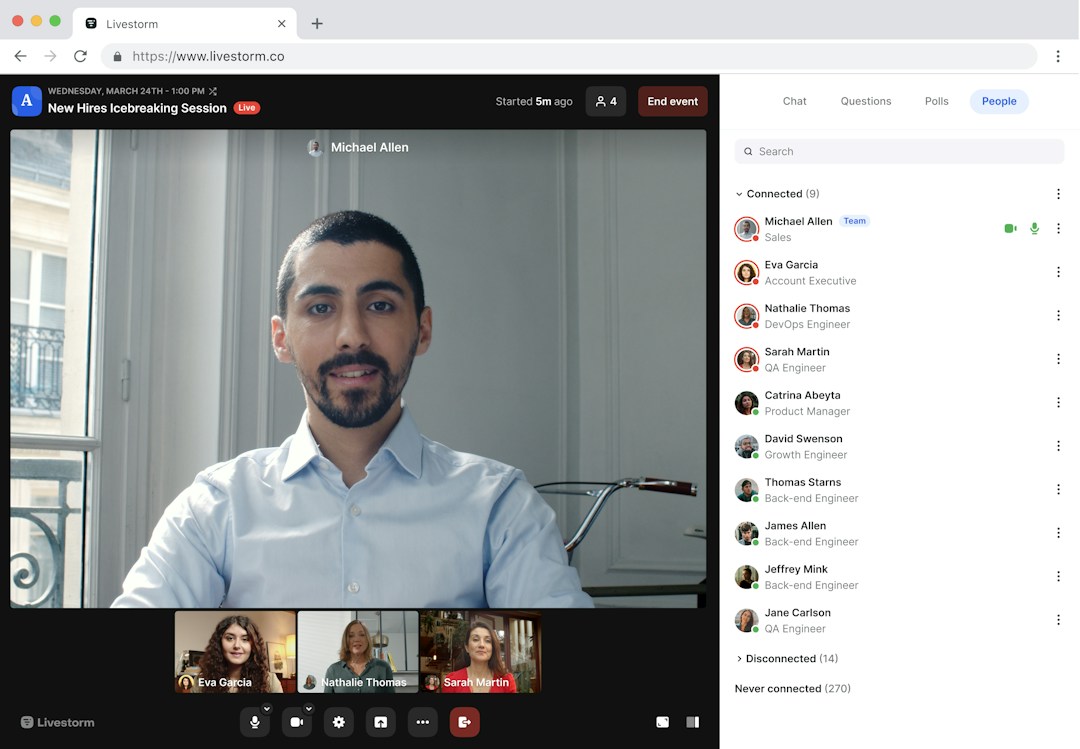
Livestorm makes it easy to run great webinars straight from the browser of any mobile or desktop. This makes if possible for your audience to join, no matter where they are in the world, without having to download or install anything.
Removing these extra steps helps attendance rates soar for no-download webinars. This is why Livestorm has a 53% higher attendance rate than the industry average.
Manage everything with our end-to-end platform
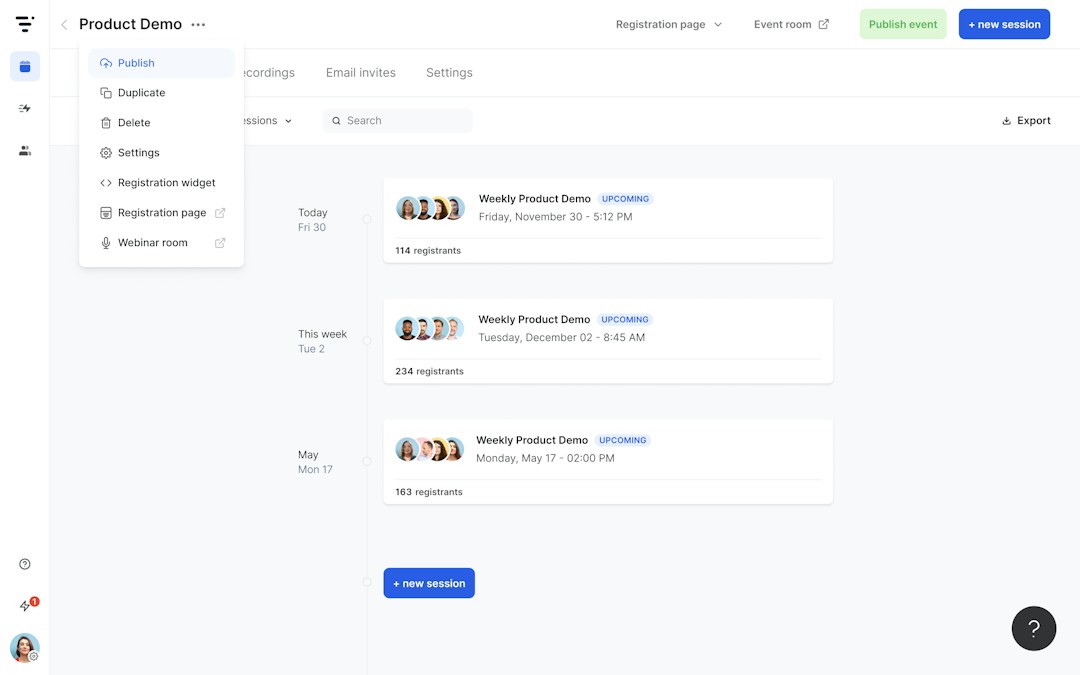
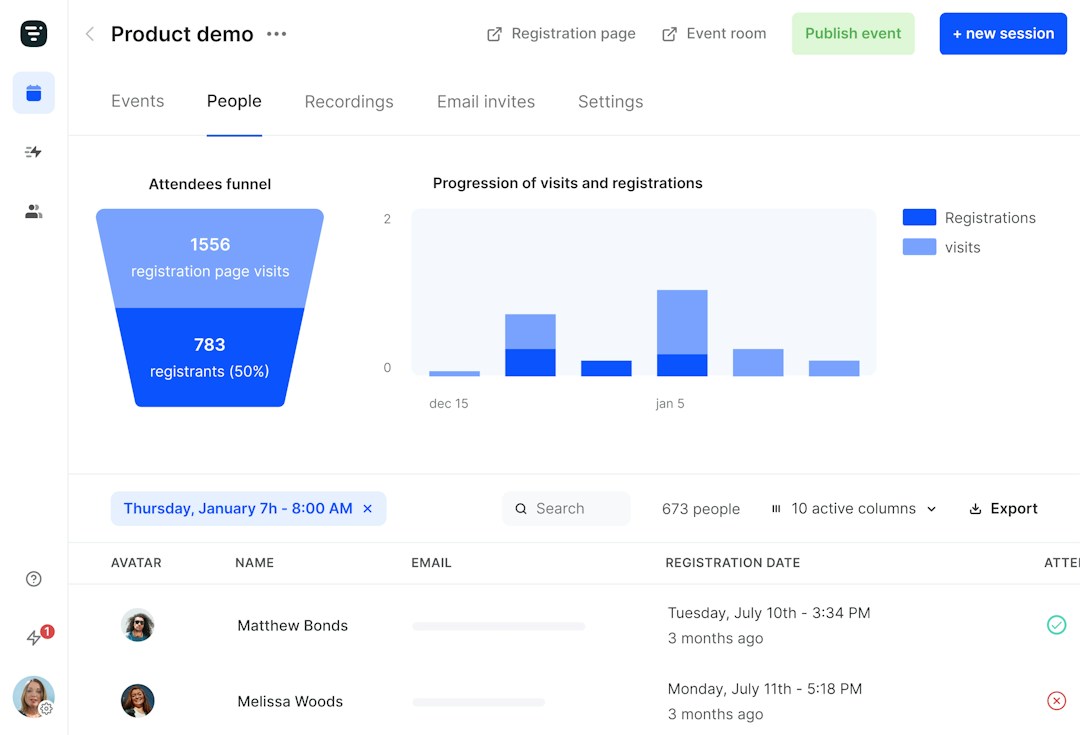
Every part of your webinar can be managed within Livestorm. You can organize, promote, analyze and host great webinars with only one end-to-end platform. Collaborate with your team using the intuitive dashboard.
Promote your webinar to your audience with customizable registration pages and automated emails. Most webinar platforms need integrations to be able to send emails or create registration pages, but with Livestorm you can do that right in your account.
Experience an intuitive webinar platform
Designed with ease-of-use in mind, Livestorm is a modern webinar solution. Enjoy a frictionless experience with intuitive controls that make it easy to plan, host, or promote your webinar sessions.
Attendees also benefit from a great user experience. Says Elise on the software review platform G2: "Livestorm is easy to use, the support is very responsive and the analytic system is very helpful."



'%3e%3cpath%20d='M10.0001%201.66675L12.5751%206.88341L18.3334%207.72508L14.1667%2011.7834L15.1501%2017.5167L10.0001%2014.8084L4.85008%2017.5167L5.83342%2011.7834L1.66675%207.72508L7.42508%206.88341L10.0001%201.66675Z'%20fill='%23FFD23F'/%3e%3c/g%3e%3c/svg%3e)
"The elegance of Livestorm's UI and its simplicity for creating beautiful landing pages made a big positive impact on the way we communicate with customers at scale."

Stan Massueras
European Sales Director

"Livestorm is really easy to use and offers a lot of customization. We are very happy with the visual rendering and the user experience."
Read the customer story
Poppy Acton Davis
Global Account Manager

"Livestorm offered an alternative to our 1:1 demos and helped us acquire new customers. We also saw much more engagement as a result!"
Read the customer story
Clement Spiers
Lead Generation Manager

"Livestorm made it easy to automate our customer trainings. The ability to set up prerecorded content while still offering live Q&A helps our team provide personalized attention at scale."

Diana Stegall
Manager, Customer Education

Try Livestorm for free
Get started in minutes and run your first engaging webinar today.
- No credit card needed
- No installation required