Zoom vs Microsoft Teams: which is best for webinars?
Compare Zoom and Microsoft Teams on features, integrations and pricing. Every claim is checked against each vendor's website, pricing and help pages, plus G2 and Capterra reviews.
Zoom vs Microsoft Teams at a glance
Where each platform is strong, and where it falls short.
Zoom
Teams already on Zoom
Zoom Events adds a lobby, ticketing and networking
Polls, Q&A, reactions and registration for broadcasts
Attendee-tier pricing, cheaper on annual billing
Costs climb with each attendee tier
CRM links via App Marketplace, not native marketing workflows
Custom webinar branding reserved for higher tiers
Microsoft Teams
Microsoft 365 meetings
Advanced webinar features in Teams Enterprise since April 2026
Direct links to Outlook, PowerPoint Live and Dynamics 365
Custom event emails, waitlists and registration approvals
No standalone webinar product, runs inside Teams
Advanced branding and meeting protection need Teams Premium
Per-user Microsoft 365 pricing, less value on other stacks
Zoom vs Microsoft Teams: Features Deep Dive
Zoom
Microsoft Teams
Zoom
Microsoft Teams
General information
Customer Rating
Average of G2 and Capterra ratings out of 5, with the number of reviews in brackets (rounded).
Last update: October 2026
4.6/5 (6,000+)
4.5/5 (30,000+)
Browser based
Webinar platforms that work directly in the browser, there's no need to download any software.
App recommended
Microsoft Teams: Yes
Device versatility
Host events from a desktop, tablet or mobile.
Zoom: Yes
Microsoft Teams: Yes
On-demand webinars
Create or access pre-recorded on-demand webinars, available any time.
Zoom: Yes
Recordings only
Automated webinars
Automate entire webinars or key actions like CTAs, start and stop times or page redirects.
Webinars Plus
Microsoft Teams: No
Free plan
A free plan you can use without time limits, not just a trial.
Last update: October 2026
Meetings only
Meetings only
Multi-session events
Run events with several sessions or tracks under one registration.
Higher tiers
Add-on
Promotion Features
Customizable registration pages
Add a banner, logo, social channels or speaker information to the event registration page without any coding skills.
Zoom: Yes
Basic
Customizable emails
Customize emails with ease by adding an event banner, social sharing buttons, or a signature.
Zoom: Yes
Microsoft Teams: Yes
Customized email sequence
Customize your own email sequence and schedule them to be sent automatically.
Zoom: Yes
Microsoft Teams: Yes
Embed forms
Embed a registration form on your own website to capture more registrants.
Zoom: No
Microsoft Teams: No
Company page
Publish events to a public company page that gathers all upcoming and past events.
Plus / Events
Microsoft Teams: No
Built-in social sharing
Share event registration pages on your company's social channels directly from your webinar platform.
Zoom: Yes
Link only
Custom registration forms
Customize the fields of your registration form to capture insights on your audience.
Zoom: Yes
Microsoft Teams: Yes
Registration filter
Apply a filter to accept event registrations only from work email addresses.
Zoom: Yes
Microsoft Teams: Yes
Activation Features
Chat
Send chat messages through a tab built right into your webinar room.
Zoom: Yes
Microsoft Teams: Yes
Emoji reactions
Enable emoji reactions during live events to allow attendees to react in real-time.
Zoom: Yes
Microsoft Teams: Yes
Q&A
Audiences can ask questions in a dedicated space.
Zoom: Yes
Microsoft Teams: Yes
Question upvotes
Audiences can vote on questions that they most want to see answered. Organizers can sort them by date or most upvotes.
Zoom: Yes
Microsoft Teams: Yes
Live answer notification
Display a notification that shows the question you are answering live during the webinar.
Zoom: Yes
Microsoft Teams: No
Polls
Create drafts of polls in advance and publish them during your event. Or, create them live during your event to further activate your audience.
Zoom: Yes
Microsoft Teams: Yes
Call-to-action button
Direct your attendees to a promotional offer via a CTA displayed in the event room.
Zoom: No
Microsoft Teams: No
Virtual backgrounds
Change your background to personalize your webinar or look more professional.
Zoom: Yes
Microsoft Teams: Yes
Digital whiteboards
Collaborate with digital whiteboards within the platform or through a native integration.
Zoom: Yes
Webinars only
Custom room branding
Add your logo, colors and backgrounds to the live event room.
Higher tiers
Add-on
Organization Features
Private chat
Chat privately with event organizers and moderators during the event.
Zoom: Yes
Microsoft Teams: No
Registrants moderation
Control which registrants can and cannot access the event.
Zoom: Yes
Microsoft Teams: Yes
One-click integrations
Integrate the software with any app to capture other valuable insights.
Zoom: Yes
Microsoft Teams: Yes
Maximum number of attendees
The maximum number of attendees supported.
10000
1000
Unique contact list
Find all your event contacts in one place and get a 360 view of their activity within different events.
Zoom: Yes
Microsoft Teams: Yes
SAML SSO
Secure your team's access to the platform with SAML SSO.
Zoom: Yes
Microsoft Teams: No
Dial-in to webinars
Attendees can opt to dial-in to the webinar from a phone number.
Zoom: Yes
Extra license
Reporting Features
Analytics reports
Track and analyze all of your data with our powerful analytics tool built into the dashboard.
Zoom: Yes
Microsoft Teams: Yes
Webinar recordings
Record webinars automatically and send them to attendees at the end of each session.
Zoom: Yes
Microsoft Teams: Yes
Engagement scoring
A score per attendee based on how they interacted during the event.
Higher tiers
Microsoft Teams: No
AI Features
AI summaries & transcripts
Automatic transcripts and AI summaries of each session.
Last update: October 2026
Zoom: Yes
Add-on
Automatic video clipping
AI turns recordings into short clips ready to share.
Last update: October 2026
Higher tiers
Microsoft Teams: No
AI content generation
AI drafts posts, emails or articles from your webinar content.
Last update: October 2026
Higher tiers
Add-on
Integrations
HubSpot (native)
Syncs registrants and attendance with HubSpot without a third-party tool.
Zoom: Yes
Microsoft Teams: Yes
Salesforce (native)
Syncs registrants and attendance with Salesforce without a third-party tool.
Zoom: Yes
Limited
Zapier / Make
Connects to thousands of apps through Zapier or Make.
Zoom: Yes
Microsoft Teams: Yes
Native AI connector (MCP)
Official connector that lets AI assistants like Claude work with your webinar data.
Last update: October 2026
Meetings only
Add-on
Security & Compliance
EU data hosting
Your data can be stored on servers in the European Union.
Zoom: Yes
Microsoft Teams: Yes
ISO 27001
Certified to the ISO 27001 information security standard.
Webinar software comparison: Zoom vs Microsoft Teams
Zoom vs Microsoft Teams: key differences
The short answer: Zoom sells large events as dedicated products for external audiences, while Microsoft Teams runs events inside its collaboration suite.
Capacity and reporting: Zoom Webinars reaches up to 50,000 attendees per session, with webinar analytics geared to lead-focused events. Teams supports 1,000 fully interactive attendees, 3,000 with chat, polls and Q&A, and 10,000 view-only, reaching 100,000 only with a paid Attendee Capacity Pack, and offers attendance reports, event insights and eCDN analytics (as of September 2026).
CRM and productivity apps: Zoom links to common calendars, CRM and marketing tools through its App Marketplace, which suits non-Microsoft stacks. Teams connects directly to Dynamics 365, Outlook, PowerPoint Live, SharePoint and OneDrive, so event data stays inside Microsoft 365.
Why it matters: Zoom scales cleanly to tens of thousands of attendees, while Teams needs an add-on to go past 10,000. Neither is built primarily as a marketing-webinar engine, so buyers who need native CRM workflows often evaluate a specialized webinar platform as well.
Zoom vs Microsoft Teams: pricing
The short answer: Zoom charges by attendee tier on top of a Workplace license, while Microsoft Teams is priced per user inside Microsoft 365.
Which is cheaper for you: On eligible Microsoft 365 E-tier licenses, Teams events add no extra cost until you need the Attendee Capacity Pack.
Prices as of September 2026. Livestorm is shown as an alternative that charges only for the attendees who join (see Livestorm pricing).
Pricing
Zoom
Microsoft Teams
Livestorm
What you pay for
Audience capacity, plus a Zoom Workplace Pro license
Microsoft 365 user licenses; Teams Premium adds advanced branding
Webinars from Microsoft 365 Business Standard: $14 per user/month, paid yearly
$3.00 per attendee (400-credit annual pack)
Larger audiences
Capacity tiers from 300 to 50,000 attendees; Zoom Events from $124.17/month billed annually
Business Premium at $22 per user/month; town halls up to 10,000 viewers, more with the paid Attendee Capacity Pack
Lower price per attendee on bigger packs, up to 3,000 live attendees per event, custom Enterprise plan
No-shows and team members
You pay for the full capacity tier, whoever shows up
Attendees are free; you pay for every licensed user
Not counted
Frequently Asked Questions
What is the difference between Zoom and Microsoft Teams?
Zoom is a video platform with dedicated webinar and events products that scale to large external audiences. Microsoft Teams is a collaboration hub inside Microsoft 365 that runs webinars and town halls per user, and is strongest for internal events.
How much do Zoom and Microsoft Teams cost?
Zoom Webinars and Events are attendee-tier add-ons on a Zoom Workplace license, while Teams webinars are included in eligible Microsoft 365 E-tier licenses priced per user. Prices change often, so confirm current figures with each vendor (as of September 2026).
Did Microsoft change Teams webinar licensing in 2026?
Yes. On April 1, 2026, advanced webinar and town hall features moved from Teams Premium into Teams Enterprise, while Premium still covers advanced meeting protection, branding and personalization.
Do I need a Zoom Workplace license to run Zoom Webinars?
Yes. Zoom Webinars and Zoom Events are paid add-ons that require a Zoom Workplace base license, while Teams webinars run under your Microsoft 365 licenses.
What is a good alternative to Zoom and Microsoft Teams for marketing webinars?
Livestorm is browser-based, hosts up to 3,000 live attendees and costs $3.00 per attendee on its entry pack (as of September 2026), with native HubSpot sync on Pro and Salesforce on Enterprise.
Why teams choose Livestorm
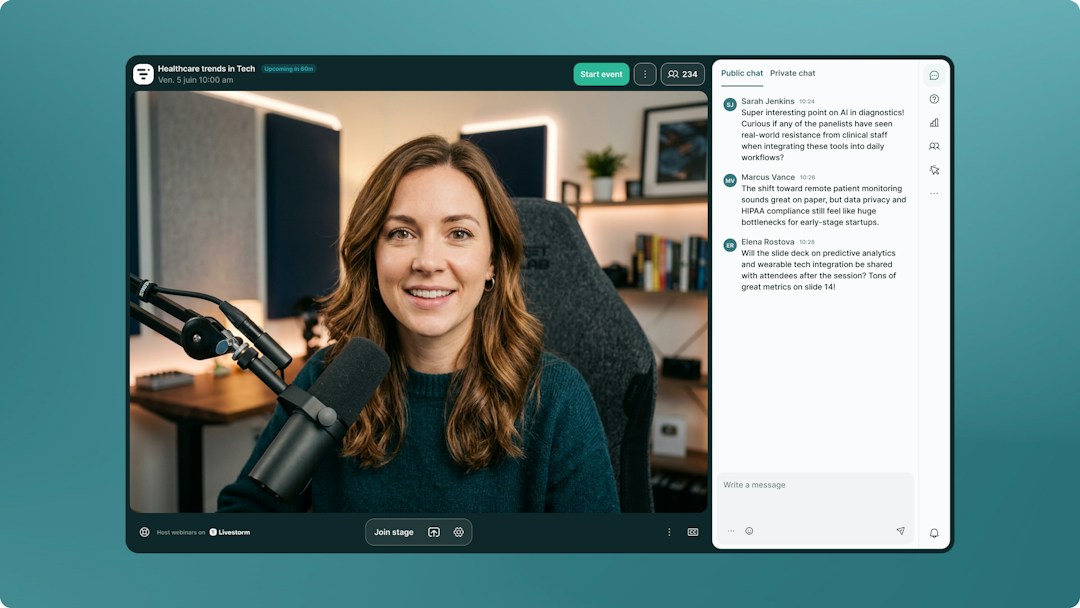
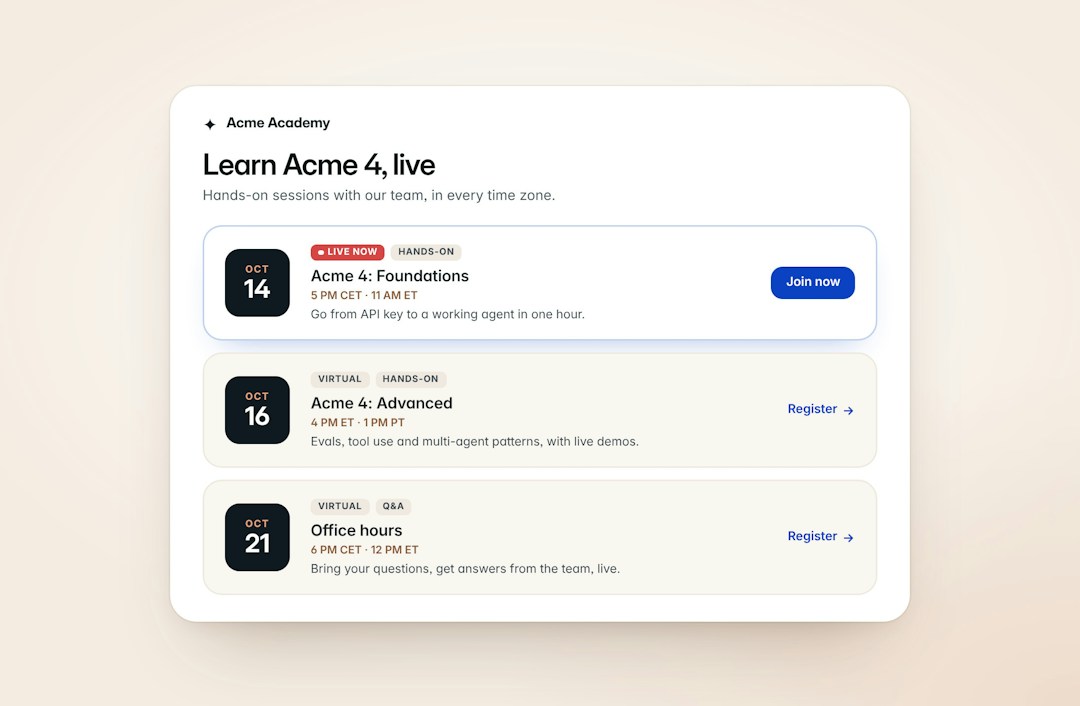
Run your marketing webinars from one all-in-one platform
Plan, promote, host and analyze your webinars in one place. Build branded registration pages, send automated reminder and follow-up emails, and engage attendees with polls, Q&A and live CTAs, with no extra tools.
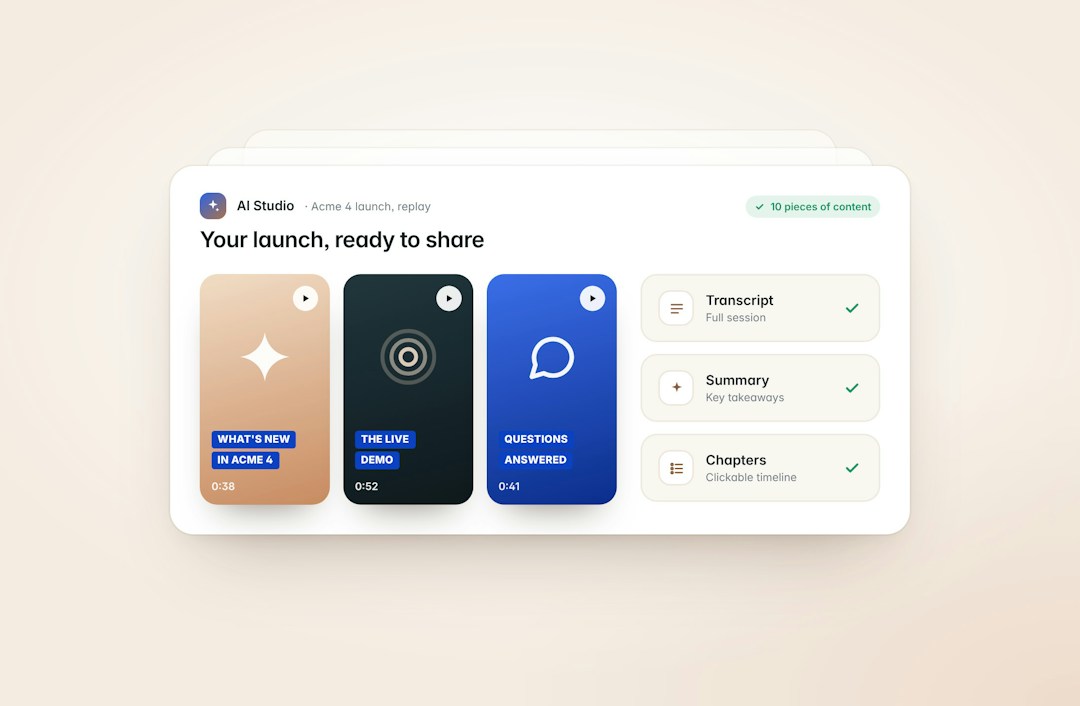
After the event, attendance and engagement data flow to your CRM, and AI Studio turns replays into short clips for your social channels.
Livestorm runs straight from the browser on any desktop or mobile device, so your audience can join from anywhere without downloading or installing anything.
Removing that extra step helps attendance: on Livestorm, 47.7% of registrants show up live on average (2026 Webinar Benchmark Report, 33,786 webinars analyzed).
Connect Livestorm to Claude with its verified connector, or to any AI agent that supports MCP, to create events, register attendees and analyze engagement in plain language.
Add-ons take it further: AI Studio turns every replay into short clips, and live translations show real-time AI subtitles in your attendees' language.
"The elegance of Livestorm's UI and its simplicity for creating beautiful landing pages made a big positive impact on the way we communicate with customers at scale."
"Livestorm is really easy to use and offers a lot of customization. We are very happy with the visual rendering and the user experience."
"Livestorm made it easy to automate our customer trainings. The ability to set up prerecorded content while still offering live Q&A helps our team provide personalized attention at scale."







'%3e%3cpath%20d='M10.0001%201.66675L12.5751%206.88341L18.3334%207.72508L14.1667%2011.7834L15.1501%2017.5167L10.0001%2014.8084L4.85008%2017.5167L5.83342%2011.7834L1.66675%207.72508L7.42508%206.88341L10.0001%201.66675Z'%20fill='%23FFD23F'/%3e%3c/g%3e%3c/svg%3e)